Cathedral Of Saint Domnius
Split, Croatia
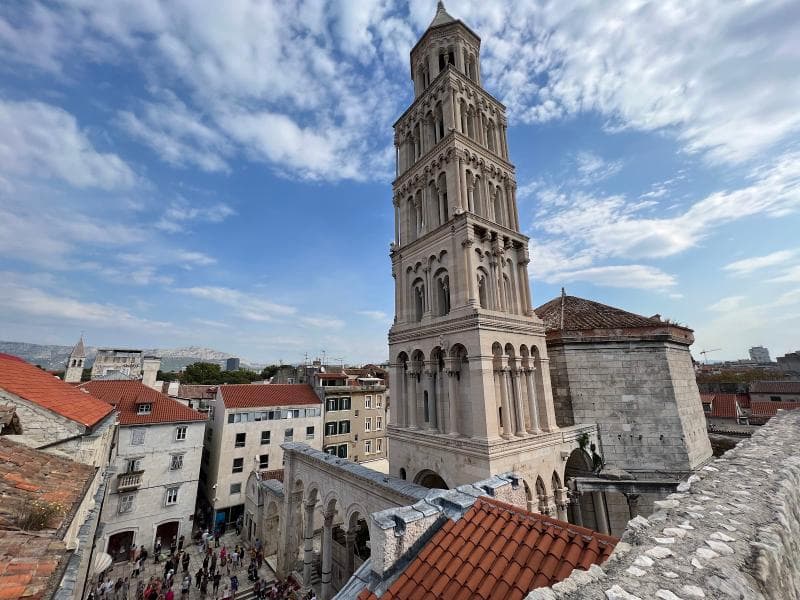
Explore the Cathedral of Saint Domnius in Split, Croatia, an ancient Roman mausoleum transformed into a living cathedral. Discover its unique history.
Overview
Nestled within the ancient walls of Diocletian's Palace in Split, Croatia, the Cathedral of Saint Domnius stands as a remarkable testament to millennia of history. This iconic landmark, known locally as Sveti Duje or Sveti Dujam, is not merely a church; it is a living monument, unique in its origins and continuous use. What began around 305 AD as the opulent mausoleum of the Roman Emperor Diocletian, a persecutor of Christians, was transformed in the 7th century into a Catholic cathedral. This conversion makes it arguably the oldest Catholic cathedral in the world still operating within its original structure.
The complex is a harmonious blend of architectural styles and historical layers. While the central church is formally dedicated to the Virgin Mary, the bell tower, which dominates Split's skyline, honors Saint Domnius, the city's patron saint. Its octagonal Roman core, surrounded by an aisle supported by 24 columns, still forms the heart of the cathedral. Visitors approaching the Peristyle, the central court of Diocletian's Palace, are immediately drawn to the cathedral's elegant silhouette and its towering campanile, inviting them to explore the rich stories held within its ancient stones.
History & Cultural Background
The story of the Cathedral of Saint Domnius is deeply intertwined with the tumultuous history of the Roman Empire and the rise of Christianity. Emperor Diocletian, renowned for his elaborate retirement palace built between 295 and 305 AD, commissioned the mausoleum as his final resting place. He was interred there in 316 AD. However, Diocletian's legacy is also marked by his severe persecutions of Christians, a poignant irony given the building's later fate.
Centuries later, in the 7th century, the nearby Roman city of Salona, then the capital of the Roman province of Dalmatia, fell to invading Slavic tribes. Refugees from Salona sought safety within the fortified walls of Diocletian's Palace, establishing a new community. These early Christian settlers, in a powerful act of historical reclamation, chose to convert the pagan emperor's mausoleum into their cathedral. They desecrated Diocletian's tomb, removing his sarcophagus, and brought the relics of their martyred bishop, Saint Domnius of Salona (Sveti Duje), into the very structure where his persecutor had once rested. Saint Domnius, along with other martyrs like Saint Anastasius, had been executed during Diocletian's purges around 304 AD.
The iconic bell tower, a prominent feature of the cathedral today, saw its construction begin in the 12th or 13th century. Its completion spanned three centuries, incorporating Romanesque, Gothic, and even some Renaissance elements, reflecting the various periods of its creation. This lengthy construction period contrasts sharply with the mere decade it took to build the entire palace. The bell tower underwent significant renovation in the late 19th and early 20th centuries, which unified its architectural style.
What Makes It Special
The Cathedral of Saint Domnius is extraordinary not just for its age, but for the profound layers of history it embodies. Its primary distinction is its transformation from a Roman imperial mausoleum to a Christian place of worship, a tangible symbol of the triumph of a once-persecuted faith over its oppressors. The original Roman structure, with its impressive octagonal form, robust walls, and vaulted ceiling, is exceptionally preserved, allowing visitors to glimpse 4th-century Roman engineering alongside medieval additions.
Architecturally, it's a fascinating blend. The interior showcases eight red granite Corinthian pillars supporting a cornice adorned with reliefs of erots, masks, and human heads. Of particular note is the cupola's construction, featuring a unique fan-like arrangement of bricks. Inside, the cathedral houses artistic treasures, including the magnificent 13th-century carved wooden doors by local master Andrija Buvina, which depict 14 scenes from the Gospels with intricate details. The hexagonal pulpit, crafted from precious green porphyry in the 13th century, is another highlight. The altars, including the Gothic altar of Saint Domnius from 1427 and the altar of Saint Anastasius carved by Juraj Dalmatinac in 1448, further enrich its artistic heritage. The treasury on the first floor of the sacristy safeguards relics of Saint Domnius and ancient manuscripts, offering a glimpse into centuries of religious devotion.
Stories, Fun Facts & Local Details
One of the most compelling narratives woven into the fabric of the Cathedral of Saint Domnius is the profound irony of its existence. Here, in the very tomb of an emperor who unleashed brutal persecutions against them, Christians found a sanctuary and transformed it into a symbol of their enduring faith. This reversal of fortunes is a powerful historical anecdote that resonates deeply with visitors.
A fun fact often shared is the contrasting construction times within Diocletian's Palace. While the entire palace was built in a mere decade, the cathedral's bell tower took approximately three centuries to reach its full height of 57 meters, making it one of Split's slowest-built structures. Tradition suggests that two medallions within the former mausoleum, now part of the cathedral, depict Emperor Diocletian and his wife Prisca. Originally, the cupola was covered in glittering mosaics, similar to those found in the Vestibule of the palace, adding to its imperial grandeur. A small glazed section of the floor provides a unique view into the cathedral's original mosaic flooring, which lies several inches below the current level.
Visitor Perspective
A visit to the Cathedral of Saint Domnius offers a truly immersive journey through time. Located centrally within the pedestrianized Diocletian's Palace, it's easily accessible on foot from anywhere in Split's old town. The towering bell tower serves as a natural beacon, visible from many parts of the city.
Climbing the bell tower is an absolute must for many, despite the narrow and sometimes steep steps. From its summit, approximately 57 meters high, visitors are rewarded with breathtaking panoramic views that stretch across the red-tiled rooftops of Split, the sparkling Adriatic Sea, and the nearby islands of Brač and Šolta, as well as Marjan Hill. This experience offers unparalleled photographic opportunities and a unique perspective on the ancient city. While the cathedral is an active place of worship, meaning access may be restricted during services, it generally welcomes visitors. To fully appreciate the cathedral, its treasury, and the crypt of Saint Lucy below, visitors should allocate one to two hours. Those wishing to avoid the busiest crowds, especially during peak summer months, might consider visiting right at opening time or during the shoulder seasons when the atmosphere is calmer.
Coordinates: 16.439, 43.5085
View on Google Maps💬 How Travelers Describe This Place
Based on community votes
Must See
787Interesting
748Beautiful
85Unique
73Photogenic
35
Traveler Stories
Discover memorable experiences shared by travelers who have visited this place.
No traveler stories yet.
Be the first traveler to share what made this place memorable.
Things to see at Cathedral Of Saint Domnius



Tour
By
Spot
Discover amazing places around the world. Your journey starts here.
Explore
© 2026 TourBySpot. All rights reserved.