Choir Stalls
Split, Croatia
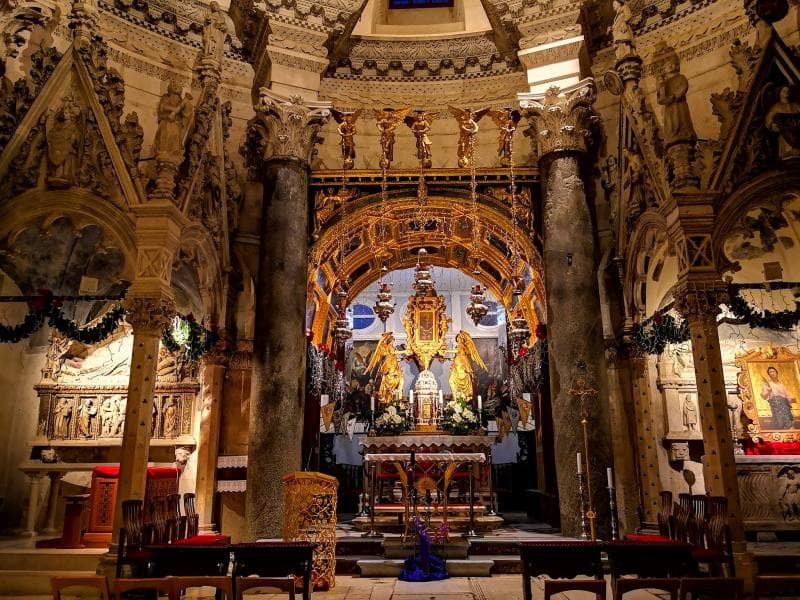
Explore the 13th-century Choir Stalls in the Cathedral of Saint Domnius in Split, Croatia. Discover their rich history and Romanesque craftsmanship.
Overview
Deep within the ancient walls of Split's most iconic landmark, the Cathedral of Saint Domnius, lie the remarkable Choir Stalls – a testament to centuries of artistic devotion and enduring craftsmanship. These exquisitely carved wooden stalls are nestled within the cathedral's Baroque choir, an area that became an integral part of the structure centuries after its origins as the mausoleum of Roman Emperor Diocletian. Visitors to this extraordinary cathedral are often captivated by the rich tapestry of history, and the Choir Stalls represent a significant thread in that narrative, showcasing the meticulous detail and spiritual dedication of medieval artisans. They offer a tangible connection to the past, allowing one to imagine the solemn rituals and hymns that have echoed through these sacred spaces for hundreds of years.
History & Cultural Background
The Cathedral of Saint Domnius boasts a history unlike any other, having begun its life around 305 AD as the final resting place for Emperor Diocletian, a persecutor of Christians. Ironically, by the 7th century, this imperial mausoleum was transformed into a Christian cathedral dedicated to Saint Domnius, a bishop martyred under Diocletian's own reign. The Choir Stalls themselves hail from a later period, specifically the first half of the 13th century, an era when Romanesque art flourished in Dalmatia. While the main structure of the cathedral dates back to Roman times, the Baroque choir, where the stalls now reside, was a 17th-century addition. This expansion involved unifying the mausoleum's interior with a new eastern section, creating the space for these magnificent wooden carvings. The stalls represent a significant example of early medieval church furniture, reflecting the enduring influence of Romanesque styles in the region.
What Makes It Special
What truly sets the Choir Stalls apart is their age and the intricate artistry preserved within them. Dating back to the 13th century, they are celebrated as some of the oldest surviving examples of Romanesque woodwork in the entire Dalmatian region. Crafted from rich walnut wood, each panel and seat tells a silent story through its detailed carvings, showcasing the remarkable skill of the master sculptors of that era. These aren't merely functional pieces of furniture; they are historical artifacts that demonstrate the sophisticated artistic expression and the deep spiritual commitment prevalent in medieval Split. The juxtaposition of these medieval wooden carvings within a structure that originated as a Roman emperor's mausoleum and later received Baroque modifications creates a unique layering of history. This blend of styles and eras makes the Choir Stalls a focal point for understanding the continuous evolution of the Cathedral of Saint Domnius.
Stories, Fun Facts & Local Details
While specific 'fun facts' directly about the Choir Stalls are scarce, their existence within the Cathedral itself offers fascinating insights. It's an often-remarked irony that the very building intended to house the remains of Emperor Diocletian, a fervent persecutor of Christians, now honors a Christian saint and serves as a place of Christian worship, complete with these ancient ecclesiastical fittings. Though much of the cathedral's famous wooden doors are attributed to Andrija Buvina in 1214, some historical accounts suggest that a local master sculptor of his time might also have been responsible for the 'wooden bench-rests' that originally stood before the main altar, which are now recognized as the Choir Stalls. This connection, if direct, would link the stalls to one of Dalmatia's most renowned medieval artists. Imagine the countless voices that have risen in prayer and song from these very seats over the centuries, bearing witness to the ebb and flow of empires, the dedication of the faithful, and the enduring spirit of Split.
Visitor Perspective
Visiting the Choir Stalls within the Cathedral of Saint Domnius offers a moment of quiet reflection amidst the bustling atmosphere of Diocletian's Palace. As you step into the cooler, often dimmer, interior of the cathedral, the intricate details of the stalls demand closer inspection. The rich, dark wood contrasts beautifully with the ancient stone, inviting contemplation of the hands that shaped them over 800 years ago. Standing before them, one can almost hear the faint echoes of medieval chants and envision canons and clergy occupying these very seats during liturgical services. It's a place where time seems to fold in on itself, bridging the gap between the Roman Empire and the present day. Observing these well-preserved pieces provides a profound appreciation for the enduring legacy of medieval art and the spiritual heart of Split, offering a unique perspective on the city's layered historical identity. It's a humbling experience to witness such ancient, functional art still in its sacred context.
Coordinates: 16.44041, 43.50802
View on Google Maps💬 How Travelers Describe This Place
Based on community votes
Unique
894Interesting
862Photogenic
443Beautiful
304Must See
35
Traveler Stories
Discover memorable experiences shared by travelers who have visited this place.
No traveler stories yet.
Be the first traveler to share what made this place memorable.

Tour
By
Spot
Discover amazing places around the world. Your journey starts here.
Explore
© 2026 TourBySpot. All rights reserved.