Roman Columns
Split, Croatia
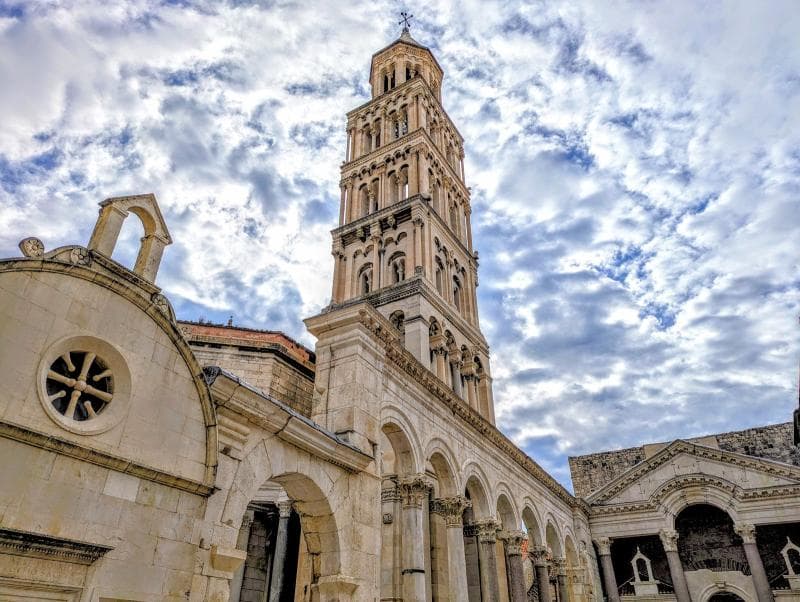
Explore the ancient Roman Columns within the Cathedral of Saint Domnius in Split, Croatia. Discover the rich history of this 4th-century mausoleum turned cathedral.
Overview
Deep within the ancient walls of Diocletian's Palace in Split, Croatia, stands the magnificent Cathedral of Saint Domnius, a structure unlike any other. At its heart, and central to its enduring charm, are the remarkable Roman Columns. These columns are not mere decorative elements; they are integral parts of what was originally the Mausoleum of Emperor Diocletian, a monument dating back to the early 4th century AD. The Cathedral itself holds the distinction of being considered the oldest Catholic cathedral in the world that remains in use in its original structure, offering a rare glimpse into over 1700 years of continuous history and adaptation.
Visitors stepping into this sacred space are immediately transported back to the Roman Empire, encountering the tangible legacy of one of its most powerful emperors. The Roman Columns here are a testament to the architectural prowess of antiquity, preserving the grandeur of Diocletian's era while harmoniously integrating into its later transformation into a Christian place of worship. They stand as silent witnesses to millennia of change, conflict, and cultural evolution in the heart of Split.
History & Cultural Background
The story of the Roman Columns begins with Emperor Diocletian, who, after abdicating his throne in 305 AD, retired to his lavish palace in Spalatum, modern-day Split. He commissioned a grand octagonal mausoleum for himself, which was completed around 305 AD. This mausoleum, the very core of today's cathedral, was built with impressive foresight and enduring materials. The interior was circular, articulated by four semicircular and four rectangular niches. Above these niches rose a striking arrangement of eight Corinthian columns made of red granite, topped by a second ring of eight smaller columns. The exterior of the mausoleum was originally encircled by an additional colonnaded porch, supported by 24 to 28 granite and marble columns, some of which were imported from Greek and Egyptian temples.
In a profound historical irony, the mausoleum of an emperor known for persecuting Christians was transformed into a Christian cathedral in the 7th century. Refugees from the nearby Roman city of Salona, which had been destroyed, sought shelter within Diocletian's Palace and converted his tomb into a church dedicated to Saint Domnius, a bishop martyred during Diocletian's reign. This audacious act not only preserved the Roman structure but imbued it with new meaning, symbolizing the triumph of Christianity. While Diocletian's sarcophagus was removed and destroyed, the original Roman Columns remained, repurposed and revered within their new sacred context.
What Makes It Special
What truly sets the Roman Columns within the Cathedral of Saint Domnius apart is their exceptional preservation and their seamless integration into a living, continuously used structure. Unlike many Roman ruins that exist as fragments, these columns stand largely as they did nearly two millennia ago, supporting the impressive dome of what was once an emperor's final resting place. The materials themselves are a story of the vast reach of the Roman Empire: the red granite of many columns was brought from distant Egypt, while fine marble for other elements came from Greece.
The interior arrangement, with its two tiers of columns, creates a sense of majestic height and architectural complexity, a hallmark of Roman design. This core structure, born of pagan imperial ambition, now serves as the spiritual heart of Split, embodying a unique blend of Roman and medieval architectural styles. The columns bear the subtle marks of time, yet their Corinthian capitals and fluted shafts speak volumes of their ancient origin. They offer a tangible link to a bygone era, allowing visitors to literally walk through history.
Stories, Fun Facts & Local Details
Beyond their structural significance, the Roman Columns are surrounded by fascinating details that add layers to their narrative. High above, encircling the interior, a continuous frieze captivates with its intricate carvings. This frieze depicts hunting Erotes, theatrical masks, and human heads. Particularly intriguing are two ribboned medallions within this frieze, which archaeologists and local tradition identify as portraits of Emperor Diocletian and his wife, Prisca.
The very act of converting Diocletian's Mausoleum into a Christian cathedral by the 7th-century refugees from Salona is a powerful tale of resilience and transformation. Imagine the daring and determination required to inhabit the tomb of their persecutor and sanctify it into a place of Christian worship. This act of appropriation turned a monument of imperial power into a symbol of spiritual endurance. The columns themselves witnessed this monumental shift, standing strong as the sarcophagus of the emperor was removed and the relics of martyrs like Saint Domnius were brought in for veneration.
Visitor Perspective
Visiting the Roman Columns inside the Cathedral of Saint Domnius is an immersive experience. As you pass through the ancient entrance, the sheer age and scale of the columns are immediately striking. They evoke a profound sense of continuity, a bridge connecting the modern world to the ancient Roman Empire. Standing amidst these enduring structures, one can almost hear the echoes of imperial ceremonies and the chants of early Christian worshippers. It is a place where history is not just observed but felt.
The columns are a focal point within the octagonal chamber, drawing the eye upwards towards the impressive dome. They provide a powerful visual anchor, reminding visitors that they are inside a structure originally built for an emperor, yet now serving a very different, sacred purpose. Exploring these columns is not merely an architectural appreciation; it is a journey through the layers of time that define Split, a city that truly lives within its ancient heritage. The Cathedral, with its Roman Columns, is a must-see for anyone seeking to understand the deep historical and cultural tapestry of Split, Croatia.
Coordinates: 16.44, 43.50833
View on Google Maps💬 How Travelers Describe This Place
Based on community votes
Beautiful
873Interesting
477Unique
422Photogenic
157Must See
53
Traveler Stories
Discover memorable experiences shared by travelers who have visited this place.
No traveler stories yet.
Be the first traveler to share what made this place memorable.

Tour
By
Spot
Discover amazing places around the world. Your journey starts here.
Explore
© 2026 TourBySpot. All rights reserved.