Mausoleum Interior
Split, Croatia
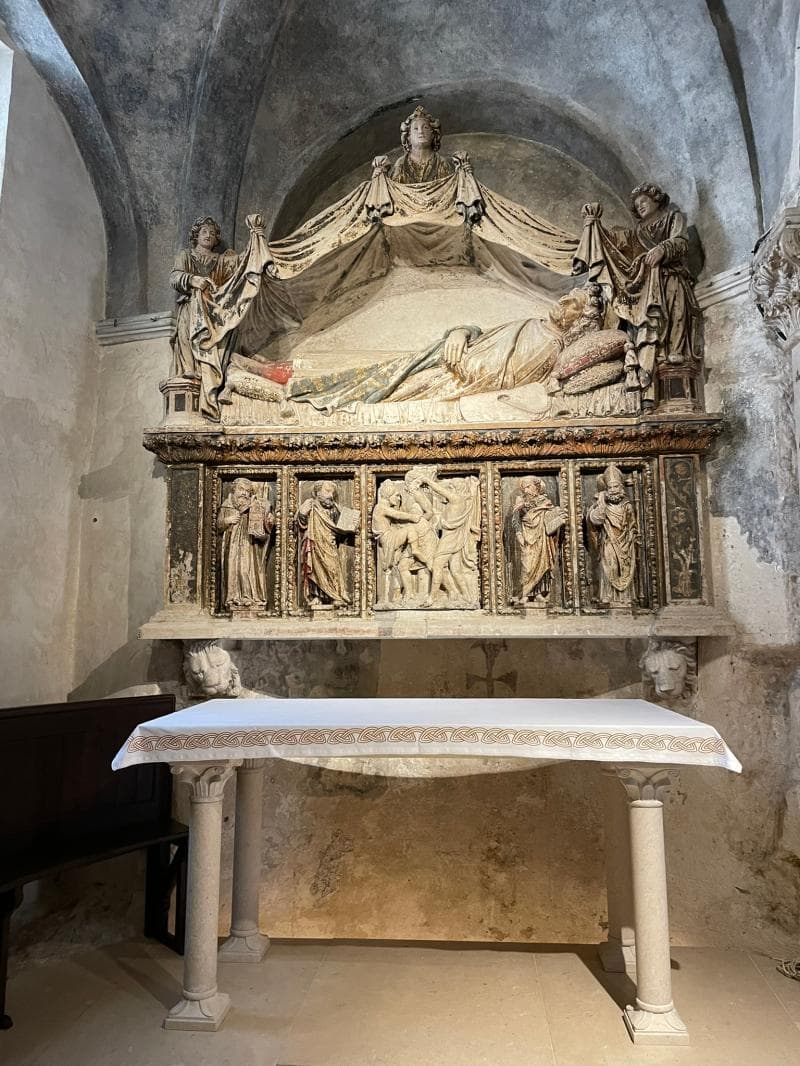
Explore the Mausoleum Interior, now the Cathedral of Saint Domnius, in Split, Croatia – an ancient Roman mausoleum transformed into a living Christian church.
Overview
Nestled within the ancient walls of Diocletian's Palace in Split, Croatia, the Mausoleum Interior, now functioning as the Cathedral of Saint Domnius, offers a truly unique journey through time. This remarkable structure began its life around 305 AD as the final resting place for the Roman Emperor Diocletian, the very ruler infamous for persecuting Christians. Today, it stands as one of the oldest Catholic cathedrals in the world still in continuous use within its original ancient edifice, serving as a powerful symbol of historical transformation and religious continuity.
Its striking octagonal exterior, encircled by 24 columns, gives way to a cylindrical interior crowned by an impressive dome. The cathedral is not merely an architectural marvel but a living testament to the ebb and flow of empires and beliefs, inviting visitors to ponder the profound irony of its evolution from pagan mausoleum to a Christian house of worship, consecrated to martyrs persecuted by its original owner.
History & Cultural Background
The story of the Mausoleum Interior begins with Emperor Diocletian, who, after his abdication in 305 AD, chose Split (then Spalatum) as the site for his grand retirement palace. Central to this sprawling complex was his mausoleum, designed to glorify his memory and serve as his eternal tomb, reflecting his imperial cult status. Diocletian was a staunch traditionalist and initiated one of the last and most severe persecutions of Christians in the Roman Empire.
However, the tides of history turned. Around the 7th century, following the destruction of the nearby Roman city of Salona by invading Avars and Slavs, refugees sought sanctuary within Diocletian's Palace. These Christian settlers repurposed the former emperor's tomb into a church, a move steeped in symbolic significance. Diocletian's sarcophagus, which once occupied the center of the octagonal chamber, was removed, its fate unknown, and the building was consecrated as a Christian cathedral. It was later dedicated to the Virgin Mary, and its bell tower to Saint Domnius (Sveti Duje), a bishop of Salona who was martyred during Diocletian's persecutions and became the patron saint of Split.
What Makes It Special
What truly sets the Mausoleum Interior apart is its unparalleled historical narrative and architectural resilience. It is celebrated as the world's oldest Catholic cathedral still operating within its initial structure, offering an extraordinary blend of Roman and early Christian design.
The interior retains many of its original Roman elements. Visitors can observe the finely preserved Corinthian columns and an intricate frieze that runs along the drum, which once featured portraits of Diocletian and his wife, Prisca—a subtle, enduring trace of its imperial past. The dome, originally adorned with dazzling mosaics, showcases an impressive construction technique with fan-shaped brickwork in its lower sections. Adding to its medieval charm are the exquisite 13th-century carved wooden doors at the main entrance, crafted by Master Andrija Buvina. These doors depict 28 detailed scenes from the life of Christ, considered a masterpiece of Romanesque sculpture.
Stories, Fun Facts & Local Details
The most compelling 'fun fact' about this site is its profound irony: the mausoleum of one of Christianity's fiercest persecutors was transformed into a cathedral dedicated to his victims. This act was not just practical, given the robust structure, but a powerful spiritual statement by the new Christian community. Legend has it that Diocletian's body was indeed removed from his sarcophagus by the Christians, and some sources suggest his remains were cast out, never to be found.
Inside, the relics of Saint Domnius and Saint Anastasius, both martyrs from Salona, found an honored resting place, completing the symbolic reversal. It's a place where history whispers tales of emperors and saints, persecution and faith, all under one ancient roof. The continuity of its use as a living liturgical space, with Sunday masses and the grand procession on Saint Domnius' feast day, highlights its enduring spiritual significance for the people of Split.
Visitor Perspective
For any curious traveler, stepping into the Mausoleum Interior is like entering a time capsule. Located directly off the bustling Peristyle of Diocletian's Palace, its majestic presence is undeniable. Inside, the atmosphere is one of profound historical depth and spiritual reverence. The ancient Roman architecture seamlessly blends with later Christian additions, creating a palpable sense of layered history.
While exploring the main octagonal chamber, visitors can marvel at the original Roman columns and the intricate details of the frieze. The sheer age of the structure, coupled with its transformation, evokes a strong emotional response, offering a unique perspective on the resilience of faith and the passage of time. A visit to this historical heart of Split is an essential part of understanding the city's rich heritage.
Coordinates: 16.4392, 43.5089
View on Google Maps💬 How Travelers Describe This Place
Based on community votes
Must See
569Unique
476Interesting
465Photogenic
276Beautiful
128
Traveler Stories
Discover memorable experiences shared by travelers who have visited this place.
No traveler stories yet.
Be the first traveler to share what made this place memorable.

Tour
By
Spot
Discover amazing places around the world. Your journey starts here.
Explore
© 2026 TourBySpot. All rights reserved.