Baptistery
Split, Croatia
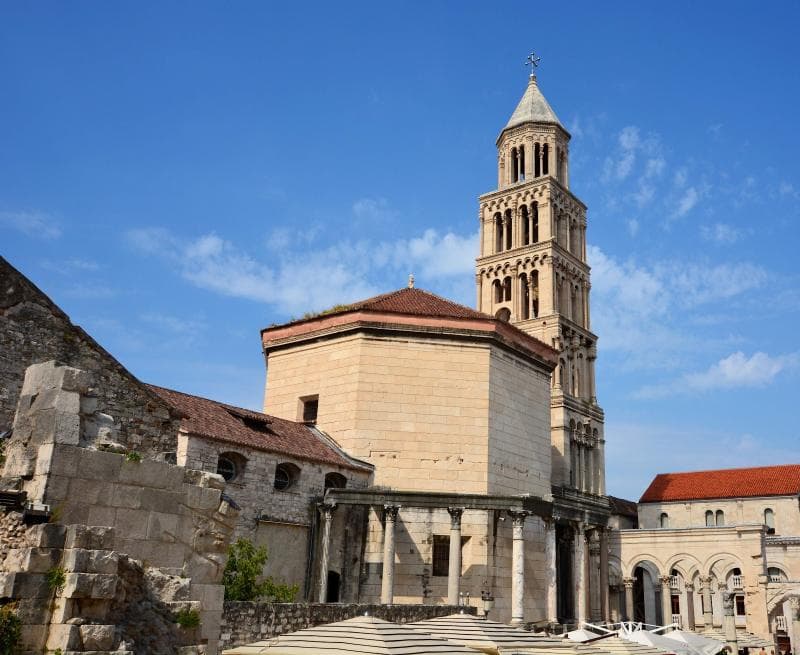
Explore the Baptistery of Saint John in Split, Croatia. Once Emperor Diocletian's Temple of Jupiter, now a Christian baptistery with rich history.
Overview
Nestled within the ancient walls of Diocletian's Palace in Split, Croatia, lies the Baptistery of Saint John, a remarkable architectural gem that tells a captivating story of transformation. Originally conceived as the Temple of Jupiter by Emperor Diocletian in the late 3rd and early 4th centuries AD, this structure was later repurposed and consecrated as a Christian baptistery in the 6th century. It stands today as a profound symbol of the shift from pagan Roman worship to early Christianity, offering visitors a tangible connection to over 1,700 years of history. Located conveniently close to the Cathedral of Saint Domnius, it forms an integral part of Split's rich historical core, inviting curious travelers to step back in time.
History & Cultural Background
The Baptistery's origins trace back to Emperor Diocletian, who ruled from 284 to 305 AD and famously built his sprawling palace in Split. As part of his grand design, he erected a temple dedicated to Jupiter, the supreme Roman god and Diocletian's 'divine father.' Construction of this Temple of Jupiter took place between 295 and 305 AD. Ironically, Diocletian was a notorious persecutor of Christians. However, centuries later, with the rise of Christianity, this very temple underwent a dramatic conversion. In the 6th century, it was transformed into a Christian baptistery dedicated to Saint John the Baptist. This act was a powerful statement, symbolizing the triumph of Christianity over the pagan traditions of the Roman Empire. The crypt beneath the temple was also dedicated to Saint Thomas, adding further layers of Christian significance to the ancient Roman edifice.
What Makes It Special
The Baptistery of Saint John is extraordinary for several reasons, primarily its remarkable state of preservation and the seamless blend of its pagan and Christian heritage. Its original Roman structure, including a magnificently preserved barrel-vaulted coffered ceiling adorned with ancient reliefs, remains largely intact. This ceiling, with its intricate details, influenced early Renaissance architecture in Dalmatia. Outside, a headless black granite sphinx, one of several brought from Egypt by Emperor Diocletian, guards the entrance, offering a mysterious link to ancient civilizations. Inside, visitors will find a significant medieval baptismal font from the 13th century, crafted from parts of an 11th-century altar screen. This font features what is considered the earliest known stone depiction of a Croatian king, either Petar Krešimir IV or Demetrius Zvonimir, alongside his subjects. Dominating the interior space is a bronze sculpture of Saint John the Baptist, a masterful work created in 1953 by the renowned Croatian sculptor Ivan Meštrović, which thoughtfully complements the historical setting.
Stories, Fun Facts & Local Details
Imagine standing where Roman emperors once worshipped Jupiter, a deity they believed to be their divine ancestor, only to have the space later dedicated to a Christian saint. The irony is palpable and makes the Baptistery a truly resonant place. The presence of the sphinx at the entrance is a direct testament to Diocletian's fascination with Egypt and his imperial ambitions. The fact that it is now headless is often attributed to early Christians who sought to remove symbols of paganism, adding a fascinating, albeit somewhat destructive, chapter to its story. The relief of the Croatian king on the baptismal font is a proud display of national heritage, marking a crucial moment in the development of the Croatian state and its artistic expression. This small, intimate space, once brimming with Roman ritual, then transformed by Christian faith, offers a profound sense of continuity and change. It's a place where every stone seems to whisper tales of empires, beliefs, and artistic evolution.
Visitor Perspective
Visiting the Baptistery of Saint John is an immersive journey through time. It provides a quiet, contemplative contrast to the bustling Peristyle outside. The compact interior allows for an intimate experience with its ancient and medieval artifacts. As you step inside, the cool stone and the soft light create an atmospheric setting perfect for reflecting on the millennia of history held within its walls. Viewing the detailed Roman vaulting, the ancient font, and the powerful Meštrović sculpture within such a historically charged environment is truly unforgettable. It is not merely a sight to be seen but a story to be felt. Typically, access to the Baptistery is included with a combined ticket for the Cathedral of Saint Domnius, making it a convenient and essential stop for anyone exploring Diocletian's Palace in Split. This ancient space, small in size but immense in historical weight, offers a unique opportunity to witness the layered past of Split, where every corner reveals a piece of a grand narrative.
Coordinates: 16.440407925042468, 43.508023562889434
View on Google Maps💬 How Travelers Describe This Place
Based on community votes
Interesting
965Must See
862Photogenic
629Beautiful
443Unique
184
Traveler Stories
Discover memorable experiences shared by travelers who have visited this place.
No traveler stories yet.
Be the first traveler to share what made this place memorable.

Tour
By
Spot
Discover amazing places around the world. Your journey starts here.
Explore
© 2026 TourBySpot. All rights reserved.