Türkmenbaşy Ruhy Mosque
Ashgabat, Turkmenistan
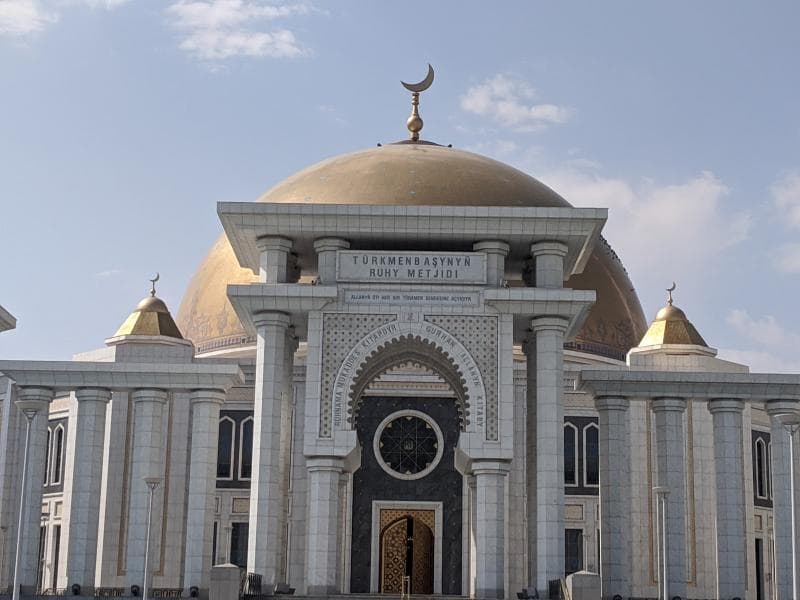
Explore the majestic Türkmenbaşy Ruhy Mosque in Ashgabat, Turkmenistan. Discover Central Asia's largest mosque, its unique architecture, and rich cultural history.
Overview
The Türkmenbaşy Ruhy Mosque, also known as Gypjak Mosque, stands as a monumental landmark just outside Ashgabat, Turkmenistan. Located in the village of Gypjak, approximately 7 to 11 kilometers west of the capital, this mosque is a profound symbol of national pride and a testament to impressive architectural ambition. Recognized as the largest mosque in Central Asia and notably the world's largest single-domed mosque, its striking white marble exterior, soaring minarets, and gleaming golden dome immediately capture attention against the Turkmen sky. The mosque seamlessly blends traditional Islamic architectural forms with elements that celebrate Turkmen heritage, creating a visually stunning and spiritually significant edifice. With a capacity to accommodate up to 10,000 worshippers, it is designed for grand congregational prayers.
History & Cultural Background
Constructed between 2002 and 2004, the Türkmenbaşy Ruhy Mosque was a visionary project initiated by Saparmurat Niyazov, Turkmenistan's first president, who adopted the title Türkmenbaşy, meaning 'Leader of the Turkmen'. It was built in his native village of Gypjak and was intended to serve not only as a grand place of worship but also as a permanent memorial to the 'Turkmenbashi' era. The mosque complex notably includes Niyazov's mausoleum, prepared in anticipation of his death, where he was interred in 2006. The construction, undertaken by the French company Bouygues, represented a significant national investment, costing approximately $100 million. The mosque's name itself, Türkmenbaşy Ruhy, translates to 'the mosque of Turkmenbashi’s spirituality' or 'spirit of Turkmenbashi', underscoring its deep connection to the former president's legacy.
What Makes It Special
What truly sets the Türkmenbaşy Ruhy Mosque apart is its scale and the meticulous detail of its design. Its defining architectural feature is the massive central dome, measuring 50 meters in height, which holds the distinction of being the largest single dome of any mosque globally. Surrounding this impressive dome are four elegant minarets, each soaring to a height of 91 meters, a deliberate symbolic gesture commemorating 1991, the year Turkmenistan gained independence. The entire exterior is clad in pristine white Italian marble, giving it a majestic and radiant appearance that shines under the desert sun. The approach to the mosque is equally grand, featuring numerous fountains that create the illusion of the structure floating on water, enhancing its serene beauty. Inside, the prayer hall is expansive, adorned with intricate calligraphy and a richly painted celestial blue dome. The floor is covered by a colossal, handmade Turkmen carpet, a spectacular piece of craftsmanship that adds to the mosque's grandeur and offers warmth in the colder months.
Stories, Fun Facts & Local Details
The Türkmenbaşy Ruhy Mosque carries a unique and at times controversial narrative. Unusually for a mosque, its walls are inscribed not only with verses from the Quran but also with quotations from the 'Ruhnama', a book on spirituality and morality authored by President Niyazov himself. This inclusion led to considerable controversy, with many Muslims considering the implied equivalence of the Ruhnama with the Quran as blasphemous, and consequently, the mosque is not recognized by some Islamic scholars. Niyazov even famously claimed that anyone who read his Ruhnama three times would be guaranteed a place in heaven. Adjacent to the main prayer hall is the mausoleum where Saparmurat Niyazov, his mother, and two brothers are laid to rest, making it a site of personal and national memory. This significant landmark is also featured on Turkmenistan's national currency, the 500-TMT banknote, further cementing its status as a national treasure.
Visitor Perspective
For those wishing to experience the majesty of the Türkmenbaşy Ruhy Mosque, it is generally open to visitors daily, outside of scheduled prayer times. It is essential for all visitors to dress modestly; women should bring a headscarf, and both men and women should wear clothing that covers their arms and legs as a sign of respect. While photography is usually permitted in the exterior areas, restrictions may apply inside the mosque, so it is always wise to inquire or observe local guidelines. Maintaining silence and reverence is paramount, especially as it is an active place of worship. Visiting during the early morning or late afternoon is often recommended to appreciate the mosque's serene atmosphere and to capture its beauty in the softest light, away from larger crowds. There is no entry fee, though donations are appreciated for the upkeep of this magnificent structure.
Coordinates: 58.2517, 38.0173
View on Google Maps💬 How Travelers Describe This Place
Based on community votes
Photogenic
910Interesting
755Must See
481Beautiful
183Unique
28
Traveler Stories
Discover memorable experiences shared by travelers who have visited this place.
No traveler stories yet.
Be the first traveler to share what made this place memorable.
Things to see at Türkmenbaşy Ruhy Mosque



Tour
By
Spot
Discover amazing places around the world. Your journey starts here.
Explore
© 2026 TourBySpot. All rights reserved.