Quran Inscriptions
Ashgabat, Turkmenistan
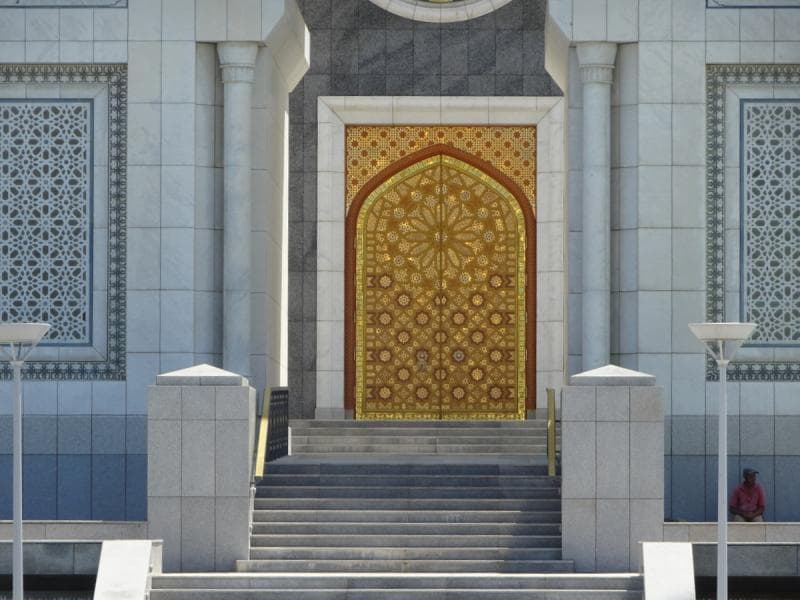
Explore the Türkmenbaşy Ruhy Mosque in Ashgabat, Turkmenistan, and its unique Quran inscriptions alongside passages from the Ruhnama.
Overview
Nestled in the village of Gypjak, just west of Ashgabat, Turkmenistan, stands the monumental Türkmenbaşy Ruhy Mosque, often referred to as the Gypjak Mosque. This majestic structure, completed in 2004, is not merely a place of worship but a profound symbol of national identity and architectural grandeur. As the largest mosque in Turkmenistan and one of the largest single-domed mosques globally, its sheer scale is awe-inspiring. Clad in pristine white Italian marble, topped with a gleaming golden dome, and flanked by four towering minarets, the mosque can accommodate between 10,000 and 20,000 worshippers within its expansive halls. Its interior is a showcase of intricate Islamic and Turkmen design, featuring detailed calligraphy, geometric patterns, and a colossal handmade Turkmen carpet that covers the prayer hall floor. What makes this site particularly noteworthy, and at times controversial, are the unique Quran inscriptions adorning its walls and minarets.
History & Cultural Background
The Türkmenbaşy Ruhy Mosque was the brainchild of Saparmurat Niyazov, Turkmenistan's first president, who adopted the title Türkmenbaşy, meaning 'Leader of the Turkmen'. Constructed in his native village of Gypjak between 2002 and 2004, the mosque opened its doors on October 22, 2004. The project, costing an estimated $100 million, was executed by the French company Bouygues, highlighting a blend of international expertise and national ambition. More than a religious edifice, the complex also serves as Niyazov's mausoleum, where he and members of his family are interred, creating a dual role as both a spiritual sanctuary and a significant site of national memory. The 91-meter-high minarets prominently symbolize 1991, the year of Turkmenistan's independence, weaving the nation's modern history directly into the mosque's architecture.
What Makes It Special
The Quran inscriptions at the Türkmenbaşy Ruhy Mosque are undeniably its most distinctive, and debated, feature. Unlike traditional mosques that exclusively feature verses from the Holy Quran, the walls and minarets of this mosque display a unique juxtaposition: passages from the Quran appear alongside excerpts from the 'Ruhnama,' a book written by President Niyazov himself. This controversial pairing sparked considerable outrage among many Muslims worldwide, who considered it blasphemous to equate a secular work with the divine sanctity of the Quran. A particularly provocative inscription at the mosque's entrance reads, 'The Ruhnama is the holiest book and the Quran is the book of Allah,' further fueling the controversy. While this practice was prevalent during Niyazov's rule, following his death, the display of 'Ruhnama' alongside the Quran in other Turkmen mosques was discontinued, making the Türkmenbaşy Ruhy Mosque a unique, enduring monument to his legacy and vision.
Stories, Fun Facts & Local Details
The story behind the 'Ruhnama' inscriptions is deeply intertwined with Saparmurat Niyazov's persona. He mandated the 'Ruhnama' as compulsory reading in schools and universities and even for passing driving tests. Perhaps most famously, Niyazov once proclaimed that anyone who read his book three times would be guaranteed a place in heaven, a statement that elevated its status to an unprecedented level within Turkmenistan. The mosque's image is also proudly featured on the 500-TMT banknote, solidifying its place as a national icon. In a testament to its ongoing significance, the mosque underwent a major modernization and reconstruction in 2024, reopening in September of that year, ensuring its continued grandeur for future generations. The vastness of the prayer hall, designed to accommodate thousands, is accentuated by perfect acoustics, making even a whisper resonate throughout the space, a testament to its architectural prowess.
Visitor Perspective
For those planning a visit to the Türkmenbaşy Ruhy Mosque, an experience of cultural immersion and architectural marvel awaits. Modesty in dress is essential: women are advised to cover their heads with a scarf, and both men and women should wear clothing that covers their arms and legs. While photography is generally permitted outside, it may be restricted within the mosque's interior, so it's always respectful to inquire before capturing images. To fully appreciate the serene atmosphere and avoid crowds, visiting during the early morning or late afternoon is recommended, as the natural light beautifully illuminates the white marble and golden dome. Entrance to the mosque is free, though donations are appreciated for its upkeep. Located approximately 7-11 kilometers west of Ashgabat, the mosque is easily accessible by car or taxi, offering a convenient journey to witness this extraordinary blend of spiritual devotion and national heritage.
Coordinates: 58.2517, 38.0173
View on Google Maps💬 How Travelers Describe This Place
Based on community votes
Photogenic
692Beautiful
674Must See
503Interesting
261Unique
49
Traveler Stories
Discover memorable experiences shared by travelers who have visited this place.
No traveler stories yet.
Be the first traveler to share what made this place memorable.

Tour
By
Spot
Discover amazing places around the world. Your journey starts here.
Explore
© 2026 TourBySpot. All rights reserved.