Marble Arcades
Ashgabat, Turkmenistan
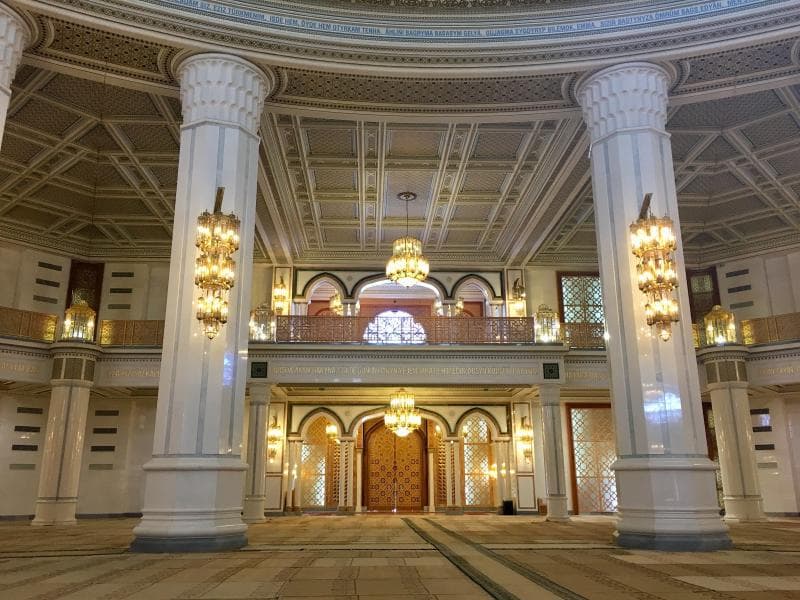
Explore the majestic Marble Arcades of Türkmenbaşy Ruhy Mosque in Ashgabat, Turkmenistan, an architectural marvel clad in white marble.
Overview
The Türkmenbaşy Ruhy Mosque, often referred to as the Gypjak Mosque, stands as Turkmenistan's largest and most iconic mosque, a truly monumental structure located just outside the capital city of Ashgabat. While not a formally designated sub-spot, the 'Marble Arcades' refer to the majestic architectural elements comprising the mosque's pristine white marble exterior and grand entrances, offering visitors a breathtaking introduction to its scale and splendor. Clad entirely in white marble, a hallmark of Ashgabat's distinct urban landscape, these arcades are an integral part of a design that seamlessly blends traditional Islamic architecture with unique Turkmen influences, making the mosque a striking symbol of national pride and identity.
This magnificent complex serves not only as a significant place of worship but also holds deep historical and cultural resonance, encompassing a mausoleum for the nation's first president. The visual impact of its gleaming white facade, punctuated by these impressive arched structures, sets a tone of reverence and grandeur for anyone approaching this spiritual and architectural marvel.
History & Cultural Background
The Türkmenbaşy Ruhy Mosque was commissioned by Turkmenistan's first president, Saparmurat Niyazov, also known as Türkmenbaşy (Leader of the Turkmen), and was constructed between 2002 and 2004 in his hometown of Gypjak. Its creation was a massive undertaking, costing an estimated $100 million, and was executed by the French construction firm Bouygues.
The mosque's design is rich with symbolism. Its four elegant minarets, each soaring to 91 meters, commemorate the year 1991, marking Turkmenistan's independence from the Soviet Union. The mosque's sprawling complex is a testament to the nation's post-independence era, reflecting a period of ambitious national development and the establishment of a distinct Turkmen identity. Notably, the mosque's interior walls bear inscriptions from both the Quran and the Ruhnama, a spiritual guide authored by Niyazov himself, a unique feature that has stirred both admiration and controversy.
What Makes It Special
The true distinction of the Türkmenbaşy Ruhy Mosque, and by extension its 'Marble Arcades,' lies in its unparalleled use of white marble. The entire exterior is meticulously clad in pristine white marble, sourced from Italy, giving it a majestic and radiant appearance that is particularly striking under the Central Asian sun.
The 'Marble Arcades' themselves are formed by the mosque's nine impressive archway entrances, which create a harmonious flow and a sense of inviting grandeur. These arches, crafted from the same brilliant marble, are not merely structural but contribute significantly to the aesthetic experience, framing views and leading visitors into the expansive prayer halls. The combination of its colossal size, the gleaming golden dome, and the sheer volume of white marble makes it a standout architectural achievement, capable of accommodating up to 10,000 congregants.
Stories, Fun Facts & Local Details
Ashgabat is widely known as the 'City of White Marble,' a title officially recognized by the Guinness World Records for having the highest concentration of white marble buildings in the world. The Türkmenbaşy Ruhy Mosque's extensive use of this material makes it a prime example of this unique urban aesthetic. The marble arcades, therefore, are not just a feature of the mosque but also embody a larger national architectural philosophy.
A fascinating, though controversial, detail is the coexistence of Quranic verses and excerpts from the Ruhnama inscribed on the mosque's walls. This blending of religious scripture with a text by the former president is a powerful reflection of the cultural and political narrative of the time of its construction. Furthermore, the mosque complex includes the mausoleum of Saparmurat Niyazov, where he is laid to rest alongside members of his family who perished in the 1948 Ashgabat earthquake. This proximity adds a layer of personal and national history to the sacred space.
Visitor Perspective
Approaching the Türkmenbaşy Ruhy Mosque, visitors are immediately struck by its colossal scale and the gleaming brilliance of its marble arcades. The feeling is one of awe and reverence, as the pristine white exterior reflects the sunlight, creating an almost ethereal glow. Walking through the monumental arches, one gains a sense of the immense space within and the intricate details that adorn its vast prayer halls. The serenity of the surroundings, often accompanied by the gentle sounds of nearby fountains, enhances the contemplative atmosphere.
Despite its remote location in Gypjak, about 7 kilometers west of Ashgabat, the journey to the mosque is well worth it for those seeking to experience a truly unique architectural wonder and delve into the modern history and culture of Turkmenistan. It offers a profound insight into the country's national identity, its architectural ambitions, and the lasting legacy of its first president.
Coordinates: 58.2517, 38.0173
View on Google Maps💬 How Travelers Describe This Place
Based on community votes
Interesting
931Beautiful
692Unique
491Photogenic
266Must See
261
Traveler Stories
Discover memorable experiences shared by travelers who have visited this place.
No traveler stories yet.
Be the first traveler to share what made this place memorable.

Tour
By
Spot
Discover amazing places around the world. Your journey starts here.
Explore
© 2026 TourBySpot. All rights reserved.