Main Prayer Hall
Ashgabat, Turkmenistan
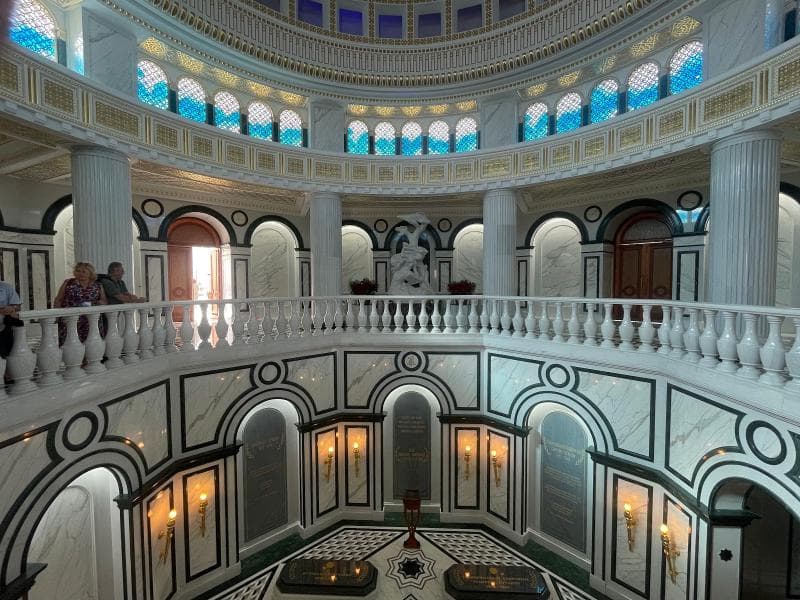
Explore the Main Prayer Hall of Türkmenbaşy Ruhy Mosque in Ashgabat, Turkmenistan. Discover its grand architecture and cultural significance.
Overview
The Main Prayer Hall, nestled within the magnificent Türkmenbaşy Ruhy Mosque in Gypjak, just outside Ashgabat, Turkmenistan, stands as a testament to grand architectural vision and profound cultural significance. Completed in 2004, this colossal structure is not only the largest mosque in Turkmenistan but is also distinguished as one of the largest single-domed mosques globally. Its striking white Italian marble exterior, towering minarets, and gleaming golden dome make it an unmissable landmark visible from a considerable distance. The prayer hall itself boasts an impressive capacity, designed to accommodate up to 10,000 worshippers within its expansive interior. Built by the French company Bouygues, the mosque was commissioned by Saparmurat Niyazov, Turkmenistan's first president, in his home village.
History & Cultural Background
The Türkmenbaşy Ruhy Mosque, whose name translates to 'Mosque of the Spirit of Turkmenbashi' or 'Mosque of Turkmenbashi's Spirituality', opened its doors on October 22, 2004. Its creation was spearheaded by Saparmurat Niyazov, who envisioned it as a powerful symbol of national pride and identity, blending traditional Islamic architecture with unique Turkmen heritage. The four elegant minarets, each standing 91 meters tall, symbolically commemorate Turkmenistan's independence from the Soviet Union in 1991. The mosque complex also holds a deeply personal significance, serving as the final resting place for Niyazov and his family; his mausoleum is situated either beneath or adjacent to the main prayer hall.
Historically, the mosque has been at the center of some controversy due to its unique wall inscriptions. Alongside verses from the Quran, the walls also feature passages from the 'Ruhnama', a spiritual guide penned by Niyazov himself. This controversial juxtaposition of religious and secular texts has been viewed as blasphemous by many devout Muslims, highlighting the complex interplay of faith and politics within the nation's recent history.
What Makes It Special
Beyond its sheer scale, the Main Prayer Hall distinguishes itself through its breathtaking interior and innovative design. It is renowned for being the largest single-domed mosque in the world, creating an awe-inspiring sense of space and grandeur within. The architecture is a stunning fusion of classical Islamic motifs and distinctive Turkmen styles. Inside, visitors are greeted by an opulent display of intricate calligraphy and shimmering gold leaf detailing. A magnificent 1,200-kilogram Austrian crystal chandelier descends from the celestial blue dome, illuminating the vast space.
The prayer hall's heated floor is covered by an enormous, meticulously hand-woven Turkmen carpet, a testament to the country's rich textile traditions. The acoustics within the dome are remarkable, transforming even quiet footsteps into resonant sounds, adding to the hall's serene and contemplative atmosphere. This blend of traditional craftsmanship with monumental scale makes the Main Prayer Hall a truly unique and immersive experience.
Stories, Fun Facts & Local Details
The Türkmenbaşy Ruhy Mosque is steeped in stories that reflect the unique period of Turkmenistan's modern history. Commissioned at a staggering cost of over $100 million, the mosque was a personal project of President Niyazov, who, in a foresightful act, had the adjacent mausoleum constructed in preparation for his own passing. He was eventually buried there in 2006, alongside his mother and brothers, who tragically perished in the 1948 Ashgabat earthquake. An empty sarcophagus is also present, symbolically honoring his father, who was buried elsewhere.
The inclusion of the 'Ruhnama' on the mosque's walls became a defining, albeit controversial, feature. Niyazov’s book, a blend of autobiography, moral guidance, and historical narrative, was elevated to an almost sacred status during his rule. The mosque's grandeur extends beyond its physical presence; its image can be found on Turkmenistan's national currency, the 500-TMT banknote, solidifying its status as a national treasure. Despite its immense capacity, the prayer hall is often sparsely visited, especially outside of significant prayer times, offering a remarkably quiet and reflective experience for those who do venture inside.
Visitor Perspective
For a curious traveler, visiting the Main Prayer Hall inside the Türkmenbaşy Ruhy Mosque offers a profound cultural encounter. Located approximately 7-11 kilometers west of Ashgabat in Gypjak, the mosque is easily accessible, though planning is advised as it sits slightly outside the city center. Entry to the mosque is free, but visitors are expected to adhere to a modest dress code, which includes covering arms and legs for both men and women, with women also required to cover their heads.
While the exterior and grounds offer ample opportunities for photography, taking pictures inside the prayer hall may be restricted, so it's always respectful to inquire first. To fully appreciate the serene ambiance and intricate details, visitors are encouraged to plan their visit outside of designated prayer times, particularly avoiding Friday prayers. The early morning or late afternoon often provide the best light, casting a warm glow on the pristine white marble and golden accents. Stepping into this vast, cool, and intricately decorated space provides a unique window into Turkmenistan's architectural prowess, cultural identity, and complex modern history.
Coordinates: 58.2517, 38.0173
View on Google Maps💬 How Travelers Describe This Place
Based on community votes
Photogenic
674Must See
585Beautiful
546Interesting
503Unique
92
Traveler Stories
Discover memorable experiences shared by travelers who have visited this place.
No traveler stories yet.
Be the first traveler to share what made this place memorable.

Tour
By
Spot
Discover amazing places around the world. Your journey starts here.
Explore
© 2026 TourBySpot. All rights reserved.