Golden Domes
Ashgabat, Turkmenistan
Explore the Golden Domes of Türkmenbaşy Ruhy Mosque in Ashgabat, Turkmenistan. Discover its unique history, architecture, and cultural significance.
Overview
Nestled just outside Ashgabat, Turkmenistan, in the village of Gypjak, stands the Türkmenbaşy Ruhy Mosque, an architectural marvel often simply known as the Gypjak Mosque. More than merely a place of worship, this grand edifice, completed in 2004, is recognized as the largest mosque in Central Asia, capable of accommodating up to 10,000 worshippers. Its dazzling white marble exterior, sourced from Italy, is instantly recognizable, crowned by its prominent Golden Domes that shimmer under the Turkmen sun. The mosque's design is a striking blend of traditional Islamic aesthetics and Turkmen national identity, symbolizing a unique chapter in the country's modern history.
The scale of the Türkmenbaşy Ruhy Mosque is truly breathtaking. Its massive central dome, measuring 50 meters in height, is a beacon visible from a considerable distance, embodying both spiritual and national grandeur. Surrounded by four elegant minarets, each soaring to 91 meters, the mosque stands as a testament to Turkmenistan's independence, with the height commemorating the year 1991 when the nation gained sovereignty.
History & Cultural Background
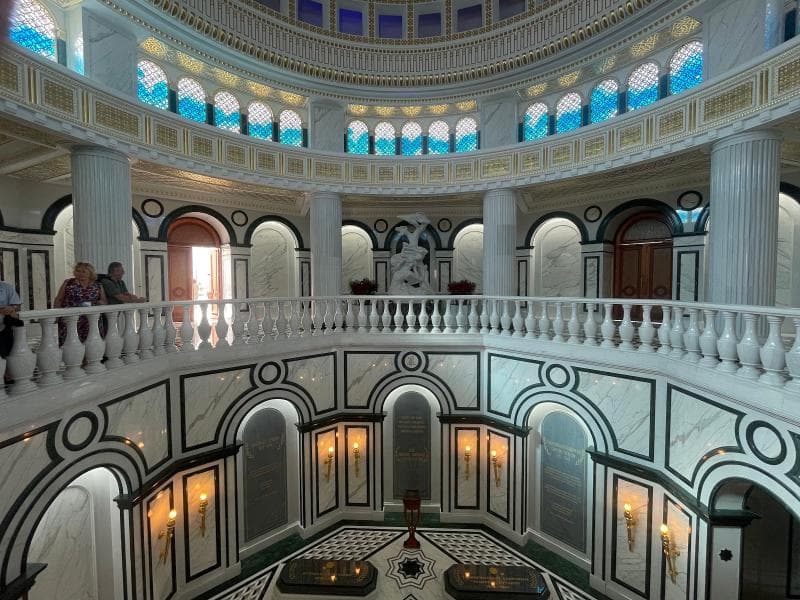
The Türkmenbaşy Ruhy Mosque was a visionary project of Turkmenistan's first president, Saparmurat Niyazov, who also adopted the title Türkmenbaşy, meaning 'Leader of the Turkmen'. Construction commenced in 2002 and concluded in 2004, meticulously carried out by the French company Bouygues. Its location in Gypjak holds profound personal significance, as it is President Niyazov's native village. The mosque was not only conceived as a spiritual center but also incorporated a mausoleum, built in anticipation of Niyazov's passing, where he was eventually laid to rest in 2006 alongside members of his family.
Culturally, the mosque presents a fascinating, albeit controversial, narrative. Its interior walls are inscribed with verses not only from the Quran but also from the Ruhnama, a spiritual guide written by President Niyazov himself. This unique juxtaposition of sacred Islamic texts with a secular leader's philosophical work sparked considerable debate and led some Muslims to consider the implied equality blasphemous. Despite this controversy, the mosque remains a powerful symbol of national pride and Niyazov's enduring legacy in Turkmenistan.
What Makes It Special
The ‘Golden Domes’ of the Türkmenbaşy Ruhy Mosque are undoubtedly one of its most distinctive features. The sheer scale and gleam of the main golden dome, reportedly the largest single-dome mosque in the world, create an unforgettable visual impact. This grand golden crown is complemented by the mosque's pristine white marble exterior, giving it an otherworldly appearance, especially against the clear desert sky.
Beyond its exterior, the mosque's interior is a marvel of craftsmanship. The vast prayer hall, designed to accommodate thousands, is adorned with intricate calligraphy and geometric patterns. A highlight is the enormous, hand-made Turkmen carpet that covers the heated floor, a testament to the country's rich weaving heritage. The blend of opulent materials, meticulous detail, and symbolic architecture makes the Türkmenbaşy Ruhy Mosque a unique monument where national identity and religious devotion converge in a spectacular display.
Stories, Fun Facts & Local Details
One of the most intriguing aspects of the Türkmenbaşy Ruhy Mosque revolves around its golden dome, a prominent feature that captures the eye and imagination. The choice of gold and white marble for its construction reflects a broader architectural trend in Turkmenistan, emphasizing grandeur and national aspiration.
A notable detail is the mosque's appearance on the national currency, specifically the 500-TMT banknote, further cementing its status as a national treasure. While built to host 10,000 worshippers, it's often noted by visitors that the mosque sees relatively few congregants outside of major religious holidays, contributing to a serene and almost surreal atmosphere for those who visit. The mausoleum adjacent to the mosque, where President Niyazov and his family are interred, also includes an empty sarcophagus dedicated to Niyazov's father, who died in World War II, adding a poignant, personal layer to the monument.
Visitor Perspective
For those planning to experience the grandeur of the Türkmenbaşy Ruhy Mosque, a few considerations will enhance your visit. As an active place of worship, respectful attire is essential: shoulders and knees should be covered, and women are advised to bring a headscarf. While photography is generally permitted outside, it may be restricted inside, so it's always best to inquire.
The mosque is open daily, and visiting during the early morning or late afternoon offers not only cooler temperatures but also the best light for photography, illuminating the Golden Domes in a warm glow. Entry is free, though donations for upkeep are appreciated. Located approximately 7 to 11 kilometers west of Ashgabat, hiring a taxi is the most convenient way to reach this magnificent landmark, which offers a profound glimpse into Turkmenistan's unique cultural and architectural landscape.
Coordinates: 58.2517, 38.0173
View on Google Maps💬 How Travelers Describe This Place
Based on community votes
Photogenic
692Beautiful
674Must See
503Interesting
261Unique
49
Traveler Stories
Discover memorable experiences shared by travelers who have visited this place.
No traveler stories yet.
Be the first traveler to share what made this place memorable.

Tour
By
Spot
Discover amazing places around the world. Your journey starts here.
Explore
© 2026 TourBySpot. All rights reserved.