Pha That Luang
Vientiane, Laos
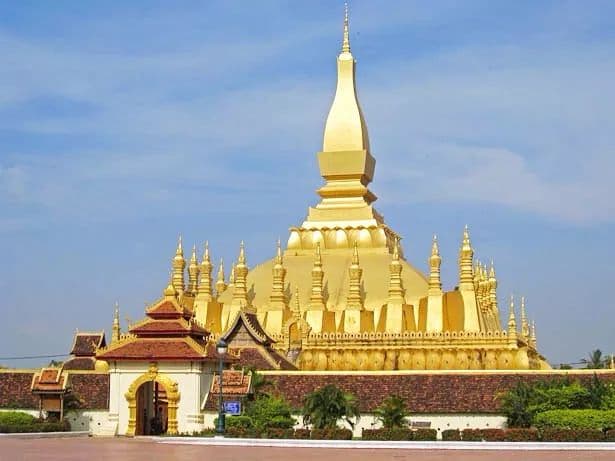
Discover Pha That Luang, Laos' iconic golden stupa in Vientiane. A national symbol enshrining Buddhist heritage, rich history, and vibrant culture.
Overview
Pha That Luang, often revered as the Great Golden Stupa, stands majestically in Vientiane, Laos, as the nation's foremost symbol of Buddhist faith, national identity, and cultural heritage. This iconic monument is not merely a structure; it is the spiritual heart of the country, embodying centuries of history and tradition. Its gleaming gold-covered facade makes it an unmistakable landmark, prominently featured on Laos' national emblem and currency, reflecting its profound significance to the Lao people.
As a sacred Buddhist stupa, Pha That Luang draws pilgrims and visitors alike, captivated by its striking architecture and serene grounds. Its very name, which translates to 'Great Stupa,' hints at its grandeur and importance. Nestled a few kilometers northeast of Vientiane's city center, it offers a powerful visual and spiritual experience, serving as a beacon of peace and prosperity for Laos.
History & Cultural Background
The origins of Pha That Luang are steeped in ancient lore and archaeological evidence, suggesting a history stretching back millennia. Legend has it that the site’s religious significance began as early as the 3rd century BC (or 1st century AD in some accounts), when Buddhist missionaries from the Mauryan Empire, dispatched by Emperor Ashoka, brought a sacred relic – believed to be a piece of the Buddha's breastbone – and enshrined it here.
Initially, a Hindu temple occupied the site, which was later rebuilt as a Khmer temple around the 13th century. However, the current magnificent structure primarily dates back to the 16th century. In 1566, King Setthathirat, after relocating the capital of the Lan Xang Kingdom from Luang Prabang to Vientiane, ordered the construction of the grand stupa that largely forms what we see today.
Over the centuries, Pha That Luang has endured a tumultuous history, suffering repeated damage and destruction during foreign invasions. Notably, it was severely damaged during the Siamese (Thai) invasion in 1828 and again during the Franco-Thai war in the 1940s. Each time, however, the unwavering spirit of the Lao people led to its reconstruction and restoration, including significant efforts in the 1930s and post-World War II, cementing its role as an enduring symbol of national resilience.
What Makes It Special
Pha That Luang's architectural design is a captivating blend of Buddhist symbolism and traditional Lao artistry. The stupa is renowned for its pyramid shape and its three distinct levels, which are not merely decorative but deeply symbolic. These tiers represent the Buddhist path to enlightenment, illustrating the ascent from the earthly realm through the perfections of Buddhism to the spiritual realm or the 'Kingdom of Heaven.'
Standing approximately 45 meters tall, with a base measuring around 69 meters on each side, the central stupa is an imposing sight. Its most striking feature is the radiant gold covering its surface. While the pinnacle of the stupa is adorned with real gold leaf, the rest of the structure shines brilliantly in golden color, giving it a breathtaking appearance. Sources indicate a significant amount of gold, with estimates ranging from hundreds of kilos to a thousand pounds, used to create this dazzling effect.
Surrounding the main stupa are 30 smaller stupas, which symbolize the 30 perfections of Buddhism. The complex also features elaborate carvings, sculptures, and architectural curves designed to resemble lotus blossoms, a powerful symbol of purity and spiritual enlightenment in Buddhism. The golden hue itself is often associated with the golden lotus, further enhancing its symbolic depth.
Stories, Fun Facts & Local Details
One of the most profound stories associated with Pha That Luang is the belief that it enshrines a sacred relic of the Buddha – specifically, his breastbone. This makes the stupa an exceptionally holy site and a focal point for veneration among Buddhists. This ancient relic is said to have been brought by missionaries from India during the 3rd century BC, establishing the site's sanctity long before the present stupa was built.
Beyond its ancient relics, Pha That Luang is a vibrant center for cultural life, most notably during the annual Boun That Luang Festival. Held during the full moon of the 12th lunar month (typically in October or November), this is the largest and most important Buddhist celebration in Laos. The festival attracts thousands of monks, pilgrims, and visitors from across the country and beyond for three days and nights of colorful parades, traditional music, carnival rides, religious ceremonies, and dazzling fireworks, honoring both the stupa and King Setthathirat.
Visitors to the complex will also find a statue of King Setthathirat in the Saysettha gardens, commemorating his pivotal role in the stupa's construction. Additionally, Naga statues, mythical semi-divine beings with human and serpent qualities, guard the base of the temple steps, a common protective symbol in Buddhist architecture. Within the expansive grounds, you can explore the surrounding gardens, cloisters adorned with paintings and sculptures, bell towers, and nearby temples like Wat That Luang Neua and Wat That Luang Tai, where a spectacular giant golden reclining Buddha can be found.
Visitor Perspective
Pha That Luang is conveniently located about four kilometers northeast of Vientiane's city center, making it an accessible destination for travelers. Getting there is easy; visitors can opt for a traditional tuk-tuk, a taxi, or even rent a motorbike or bicycle for a more immersive experience.
The best times to visit are typically in the early morning, when the weather is cooler and crowds are thinner, allowing for a more peaceful experience. Late afternoon is also highly recommended, as the setting sun illuminates the golden stupa, creating spectacular photographic opportunities as it 'literally glows.'
While the interior of the main stupa itself is not accessible, visitors can explore the vast surrounding complex, including the cloistered walkways, gardens, and adjacent temples. A modest entrance fee, typically around 5,000 to 10,000 Lao Kip, is usually required to enter the inner courtyard. The monument is generally open from 8:00 AM to 12:00 PM and from 1:00 PM to 4:00 PM daily. Remember to dress modestly out of respect for this sacred site.
Coordinates: 102.6343, 17.9762
View on Google Maps💬 How Travelers Describe This Place
Based on community votes
Photogenic
894Beautiful
748Interesting
304Must See
73Unique
35
Traveler Stories
Discover memorable experiences shared by travelers who have visited this place.
No traveler stories yet.
Be the first traveler to share what made this place memorable.
Things to see at Pha That Luang



Tour
By
Spot
Discover amazing places around the world. Your journey starts here.
Explore
© 2026 TourBySpot. All rights reserved.