Outer Courtyard
Vientiane, Laos
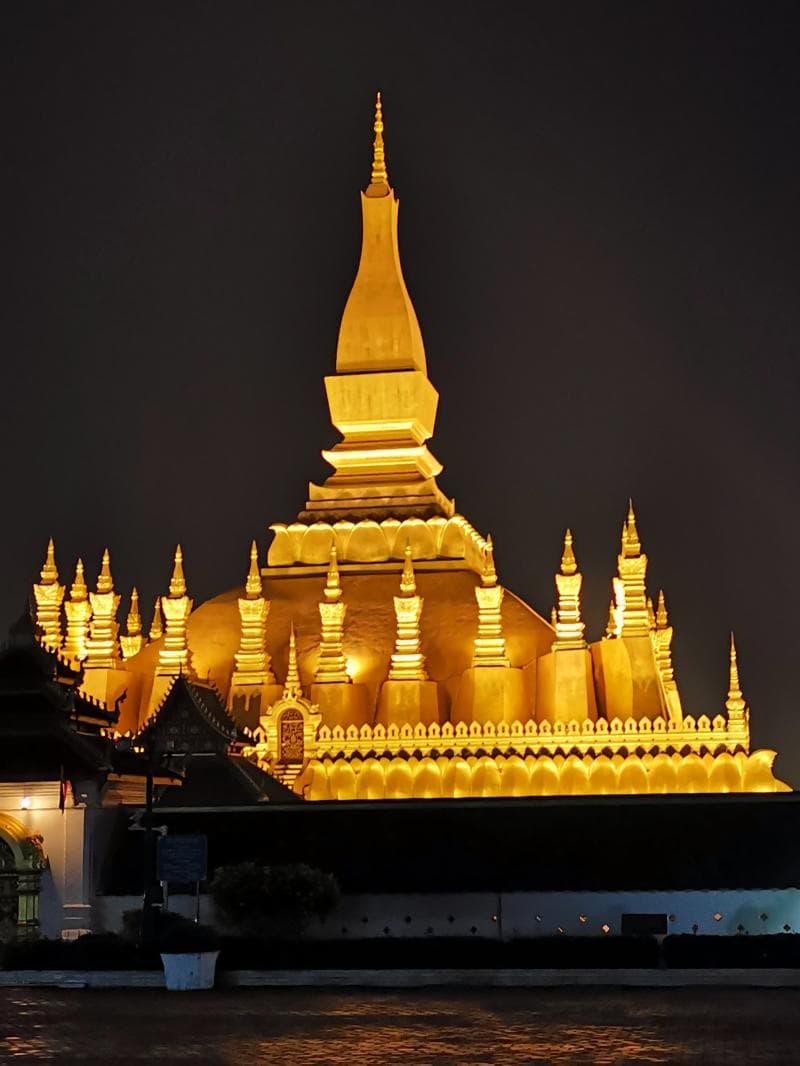
Explore the serene Outer Courtyard of Pha That Luang in Vientiane, Laos. Discover ancient temples, statues, and rich Buddhist history around this national symbol.
Overview
Stepping into the Outer Courtyard of Pha That Luang in Vientiane, Laos, immediately transports a traveler into a realm of deep spiritual significance and historical grandeur. This expansive outer area serves as the ceremonial gateway to the revered golden stupa, Pha That Luang itself, a national symbol shimmering under the tropical sun. Located approximately four kilometers northeast of Vientiane's city center, the Outer Courtyard offers a tranquil and spacious setting that gently guides visitors toward the magnificent main monument. It is not merely an approach but an integral part of the experience, offering glimpses into Lao culture and devotion before one even reaches the inner sanctuary. The vast grounds encompass gardens, monuments, and other significant temples, establishing a holistic sacred complex.
The entire complex is enclosed by sturdy walls, roughly 85 meters long on each side, adorned with subtle Lao and Khmer sculptures that hint at the region's rich artistic heritage. These outer gallery walls are punctuated by four main entrance gates, strategically placed to face each cardinal direction, inviting pilgrims and curious travelers alike to commence their journey of discovery.
History & Cultural Background
The origins of Pha That Luang, and by extension its surrounding courtyards, are steeped in centuries of history, reflecting the ebb and flow of empires and spiritual beliefs in Southeast Asia. While the current golden stupa was primarily constructed in 1566 under the command of King Setthathirat, who moved the capital of Lan Xang from Luang Prabang to Vientiane, the site's roots stretch back much further. Historical accounts suggest the presence of a Hindu temple as early as the 3rd century, later rebuilt as a Khmer temple in the 13th century.
King Setthathirat's vision for Pha That Luang included not just the central stupa, but also a surrounding complex, originally featuring four temples—one positioned on each side. Today, two of these historically significant temples remain within the Outer Courtyard: Wat That Luang Tai to the south and Wat That Luang Neua to the north. These temples are crucial components of the complex's enduring spiritual and cultural narrative, serving as active places of worship and study. The Outer Courtyard, therefore, has long been a witness to the nation's spiritual evolution and resilience, with the complex undergoing numerous reconstructions after being plundered and damaged during foreign invasions by the Burmese, Siamese, and Chinese over the centuries.
What Makes It Special
Beyond its function as an entryway, the Outer Courtyard holds its own unique attractions and cultural treasures. Most notably, it hosts two significant temples that offer distinct experiences. Wat That Luang Tai, the southern temple, is famous for its spectacular giant golden reclining Buddha statue, which is freely accessible to visitors. This temple’s elegant structure, with its golden facade and multi-tiered roof, exemplifies traditional Lao architecture. To the north, Wat That Luang Neua functions as an active monastery and is the residence of the Supreme Patriarch of Lao Buddhism, providing a living connection to the country's spiritual leadership. Visitors to Wat That Luang Neua can admire its tall columns and impressive statues, along with colorful images depicting the life of Buddha.
Another prominent feature within the Outer Courtyard is the majestic statue of King Setthathirat. Standing proudly in the Saysettha gardens, this monument honors the monarch who played a pivotal role in establishing Pha That Luang in its current glorious form and relocating the capital to Vientiane. The ornate temple gates, intricately decorated with traditional Lao patterns and guardian figures, serve as symbolic thresholds, elevating the sense of ceremony and reverence as one moves deeper into the sacred precinct.
Stories, Fun Facts & Local Details
The Outer Courtyard is alive with stories and cultural nuances that enrich the visitor experience. Perhaps the most vibrant local detail is the annual That Luang Festival, held during the full moon of the 12th lunar month, typically in November. This grand celebration transforms the entire complex, including the Outer Courtyard, into a bustling hub of activity. Thousands gather for elaborate parades, traditional music and dance performances, and deeply spiritual ceremonies, including almsgiving and candlelit processions. A unique highlight is the traditional Lao hockey game, adding a festive, communal spirit to the religious observance.
A profound cultural fact is that Pha That Luang's image is not just an architectural marvel; it is prominently featured on the national emblem of Laos and on the country's Kip banknotes. This underscores its status as the paramount symbol of Lao sovereignty and national identity. The name 'Pha That Luang' itself, meaning 'Great Stupa' or 'Royal Stupa,' reflects its immense importance. Legend also holds that the stupa enshrines a sacred breastbone relic of the Buddha, making it a site of profound pilgrimage.
Visitor Perspective
For the curious traveler, the Outer Courtyard serves as an essential preliminary experience before engaging with the main stupa. It offers ample space for reflection and observation, away from the more focused reverence of the inner enclosure. Strolling through the cloister, visitors can admire a collection of paintings, sculptures, and Buddha statues, each telling a piece of the rich Buddhist narrative. Numerous altars are found at the foot of the stupa, where locals and visitors respectfully place gifts and flowers, demonstrating their devotion.
Entry to the Outer Courtyard is generally free, though there is a modest fee to enter the inner enclosure of the main stupa (typically 5,000 to 10,000 Lao Kip). Modest attire, covering shoulders and knees, is required out of respect for the sacred site. The complex is open daily, usually from 8:00 AM to 12:00 PM and again from 1:00 PM to 4:00 PM. Getting to Pha That Luang is convenient, with tuk-tuks, taxis, motorbikes, or bicycles readily available from downtown Vientiane. The Outer Courtyard provides an ideal space to absorb the atmosphere and appreciate the historical and spiritual depth of this iconic Lao landmark.
Coordinates: 102.63425, 17.9761667
View on Google Maps💬 How Travelers Describe This Place
Based on community votes
Beautiful
894Unique
862Interesting
443Must See
304Photogenic
184
Traveler Stories
Discover memorable experiences shared by travelers who have visited this place.
No traveler stories yet.
Be the first traveler to share what made this place memorable.

Tour
By
Spot
Discover amazing places around the world. Your journey starts here.
Explore
© 2026 TourBySpot. All rights reserved.