Matenadaran
Yerevan, Armenia
Explore Matenadaran in Yerevan, Armenia, a world-renowned institute housing over 23,000 ancient manuscripts and historical documents. Discover Armenian culture and history.
Overview
The Mesrop Mashtots Institute of Ancient Manuscripts, famously known as Matenadaran, stands as a monumental repository of Armenia's rich cultural and historical legacy in Yerevan, Armenia. Perched majestically at the top of Mashtots Avenue, it is not merely a museum but also a scientific research institute dedicated to the preservation, study, and popularization of Armenian manuscripts. The term 'Matenadaran' itself, derived from ancient Armenian, translates to 'book-depository' or 'repository of manuscripts', aptly describing its profound role. Housing one of the world's largest collections of ancient manuscripts, Matenadaran is a beacon of national pride and a testament to the enduring power of the written word in Armenian history. Its distinctive building, constructed from local gray basalt stone, is a landmark in Yerevan, reflecting medieval Armenian architectural influences.
History & Cultural Background
The roots of Matenadaran stretch back to the historical manuscript collections of the Armenian Church, particularly those held at Etchmiadzin, which served as a crucial center for manuscript preservation for centuries. The collection at Etchmiadzin was often subject to pillaging, with the last significant instance occurring during the Russo-Persian War in 1804. However, the annexation of Eastern Armenia by the Russian Empire in the early 19th century provided a more stable environment for their safekeeping. In 1939, the entire collection was moved from Etchmiadzin to Yerevan, initially housed in the Public Library building. The construction of the current iconic building, designed by architect Mark Grigoryan, commenced in 1945 and was completed in 1957. Matenadaran was officially established as a distinct scientific research institute in 1959, based on the nationalized collection. In 1962, it was named after Mesrop Mashtots, the revered creator of the Armenian alphabet in the early 5th century, whose statue now greets visitors at the entrance. The institution's collection was further enriched by donations, particularly from the Armenian diaspora. Its global significance was recognized in 1997 when its collection was inscribed into the UNESCO Memory of the World Register. A new building was also constructed between 2007 and 2011 to accommodate its expanding activities and growing collection.
What Makes It Special
Matenadaran's distinctiveness lies in its unparalleled collection, boasting approximately 23,000 manuscripts and scrolls, including fragments, making it the largest collection of Armenian manuscripts worldwide. Beyond Armenian texts, it holds over 2,000 manuscripts in various languages such as Arabic, Persian, Greek, Latin, Syriac, Hebrew, and Russian, underscoring Armenia's historical role as a crossroads of cultures and scholarship. These manuscripts cover a vast array of subjects, from religious and theological works to texts on history, philosophy, medicine, literature, art history, mathematics, geography, astronomy, and even alchemy. Rare and invaluable items include the 5th-century 'Etchmiadzin Gospel' with its 6th-century illustrations and ivory-carved cover, and the 7th-century 'Mugni Gospels'. The Matenadaran is also unique for preserving many original texts that have been lost in their native languages, surviving only through medieval Armenian translations. Its restoration laboratories are vital, employing traditional techniques to conserve these fragile treasures for future generations.
Stories, Fun Facts & Local Details
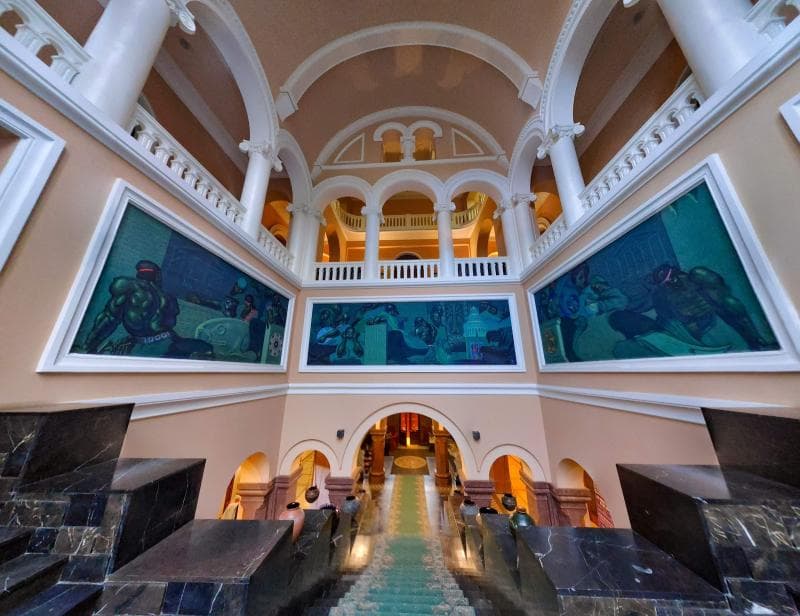
Among Matenadaran's many wonders are manuscripts of incredible scale and delicate intricacy. The 'Charentir of Mush', also known as the 'Homilies of Mush', is particularly famous for being the largest Armenian book, weighing a remarkable 27.5 kg (60 lbs) and measuring 70x55 cm (28x22 inches). On the other end of the spectrum is a tiny calendar from 1434, weighing a mere 19 grams (0.7 oz) and measuring only 4x3 cm (1.6x1.2 inches). Visitors are greeted by a sculptural ensemble featuring Mesrop Mashtots and his student Koryun, along with other influential Armenian figures like Movses Khorenatsi and Grigor of Tatevatsi, their statues standing guard over this intellectual sanctuary. Inside, a mosaic of the Avarayr Battle and frescoes depicting Armenian history further immerse visitors in the nation's narrative. The institution also houses the 'Urbatagirk' (Friday Book), the first printed Armenian book from 1512, and issues of the first Armenian magazine 'Azdarar'.
Visitor Perspective
Visiting Matenadaran is an immersive journey through Armenian intellectual history. Situated on a hill, it offers a prominent view at the end of Mashtots Avenue, and its location makes it easily accessible, with the Yerevan Cascade just a short downhill walk away. The museum's exhibition halls showcase only a curated selection of its vast treasures, but these provide a profound glimpse into the depth and artistry of the collection. Guides are available in multiple languages, including English, to enrich the experience with detailed explanations. The interior climate is carefully controlled to protect the delicate manuscripts, ensuring a comfortable visit for guests regardless of the weather outside. For many Armenians, Matenadaran is considered a national shrine, a place where the cultural identity and resilience of the nation are vividly displayed. Tactile display cases are even available for visually impaired visitors to appreciate the characteristics of medieval manuscript art. It is open from Tuesday to Saturday, offering ample opportunity for curious travelers to explore its invaluable heritage.
Coordinates: 44.52113, 40.19207
View on Google Maps💬 How Travelers Describe This Place
Based on community votes
Unique
995Beautiful
964Photogenic
929Interesting
730Must See
482
Traveler Stories
Discover memorable experiences shared by travelers who have visited this place.
No traveler stories yet.
Be the first traveler to share what made this place memorable.
Things to see at Matenadaran



Tour
By
Spot
Discover amazing places around the world. Your journey starts here.
Explore
© 2026 TourBySpot. All rights reserved.