Main Statue Area
Yerevan, Armenia
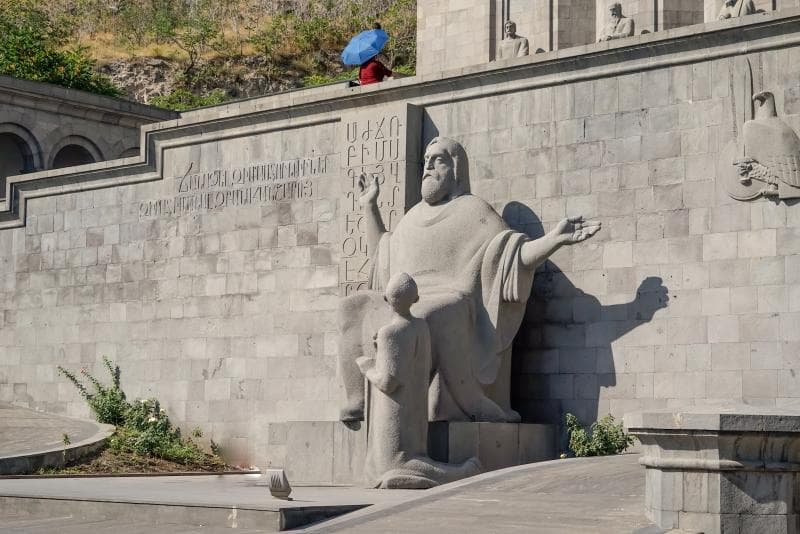
Explore the Main Statue Area at Matenadaran in Yerevan, Armenia, honoring Mesrop Mashtots and medieval Armenian scholars who shaped the nation's heritage.
Overview
The journey to understanding Armenia's profound intellectual legacy often begins before one even steps inside the Mesrop Mashtots Institute of Ancient Manuscripts, famously known as Matenadaran. Dominating a hill in Yerevan, Armenia's capital, the Matenadaran is heralded as a sanctuary of ancient texts. However, it is the magnificent 'Main Statue Area' that first captivates visitors, an open-air gallery dedicated to the nation's most revered scholars and luminaries. This collection of monumental basalt statues stands as a silent testament to the enduring power of the Armenian written word and the brilliant minds that shaped its culture and identity. The area serves as a majestic prelude to the priceless manuscripts housed within, inviting contemplation of Armenia's rich intellectual history.
History & Cultural Background
The Matenadaran, meaning 'repository of manuscripts' in ancient Armenian, was officially established in 1959, built upon the foundation of ancient manuscript collections, notably those from Etchmiadzin. It was later named after Mesrop Mashtots in 1962, the ingenious inventor of the Armenian alphabet in the early 5th century. The statues in the Main Statue Area were erected between 1962 and 1967, transforming the approach to the institution into a historical narrative told through sculpture. The central and most prominent sculpture features Mesrop Mashtots himself, accompanied by his disciple Koryun. This piece commemorates the pivotal moment in Armenian history when Mashtots created the alphabet, a monumental achievement that safeguarded the nation's language, faith, and cultural heritage during challenging times. Surrounding the path to the main entrance are six additional full-body statues, each representing a distinguished medieval Armenian scholar whose contributions spanned various fields of knowledge, from history and philosophy to poetry and science.
What Makes It Special
The Main Statue Area at Matenadaran is unique for its harmonious blend of historical significance and artistic expression. The sculptures, predominantly crafted from Armenian bluish-gray basalt, possess a unified aesthetic that complements the Matenadaran's imposing architecture. The large statue of Mesrop Mashtots and Koryun is particularly striking, depicting Mashtots as a wise teacher, guiding his kneeling student, with the 36 letters of the Armenian alphabet proudly displayed behind them. This visual representation powerfully conveys the transfer of knowledge and the foundational role of the alphabet in Armenian civilization. The six accompanying statues of scholars – Toros Roslin, Grigor Tatevatsi, Anania Shirakatsi, Movses Khorenatsi, Mkhitar Gosh, and Frik – are strategically placed to flank the building, each on its own pedestal. They symbolize the vast intellectual breadth and depth of medieval Armenian thought, making the area a comprehensive outdoor monument to the nation's intellectual giants.
Stories, Fun Facts & Local Details
One of the most captivating details in the Main Statue Area is an inscription on a wall near the Mashtots monument. It features the very first sentence ever written in the Armenian alphabet: 'To know wisdom and instruction; to perceive the words of understanding.' This quote from the Book of Proverbs eloquently encapsulates the Matenadaran's mission and Mashtots's legacy. Additionally, an eagle clutching a sword and shield, depicted alongside, serves as a powerful emblem of Armenian statehood and resilience, linking the written heritage to national identity. The student Koryun, portrayed with Mesrop Mashtots, is particularly noteworthy as he later became his teacher's biographer, penning 'The Life of Mashtots,' one of the earliest works of Armenian literature. Each of the six other scholars represents a specific domain: Movses Khorenatsi for history, Anania Shirakatsi for cosmology and science, Mkhitar Gosh for law, Grigor Tatevatsi for philosophy, Toros Roslin for manuscript illumination, and Frik for poetry. Their presence underscores the multidisciplinary nature of Armenian scholarship through the ages.
Visitor Perspective
Approaching the Matenadaran, visitors are immediately greeted by the majestic sight of the Main Statue Area. The statues evoke a profound sense of respect and admiration for the historical figures who laid the groundwork for Armenian culture and identity. The grandeur of the sculptures, set against the backdrop of the Matenadaran building and the Yerevan skyline, creates a memorable visual experience. Walking among these historical guardians, one can almost feel the weight of centuries of knowledge and resilience. It's an opportunity to connect with the origins of Armenian literacy and appreciate the intellectual heritage that the Matenadaran so meticulously preserves. The area offers a tranquil yet powerful space for reflection before delving into the world of ancient manuscripts, providing a meaningful introduction to the spirit of Armenia.
Coordinates: 44.52082, 40.19195
View on Google Maps💬 How Travelers Describe This Place
Based on community votes
Photogenic
926Must See
703Interesting
646Unique
380Beautiful
291
Traveler Stories
Discover memorable experiences shared by travelers who have visited this place.
No traveler stories yet.
Be the first traveler to share what made this place memorable.

Tour
By
Spot
Discover amazing places around the world. Your journey starts here.
Explore
© 2026 TourBySpot. All rights reserved.