Medieval Archives
Yerevan, Armenia
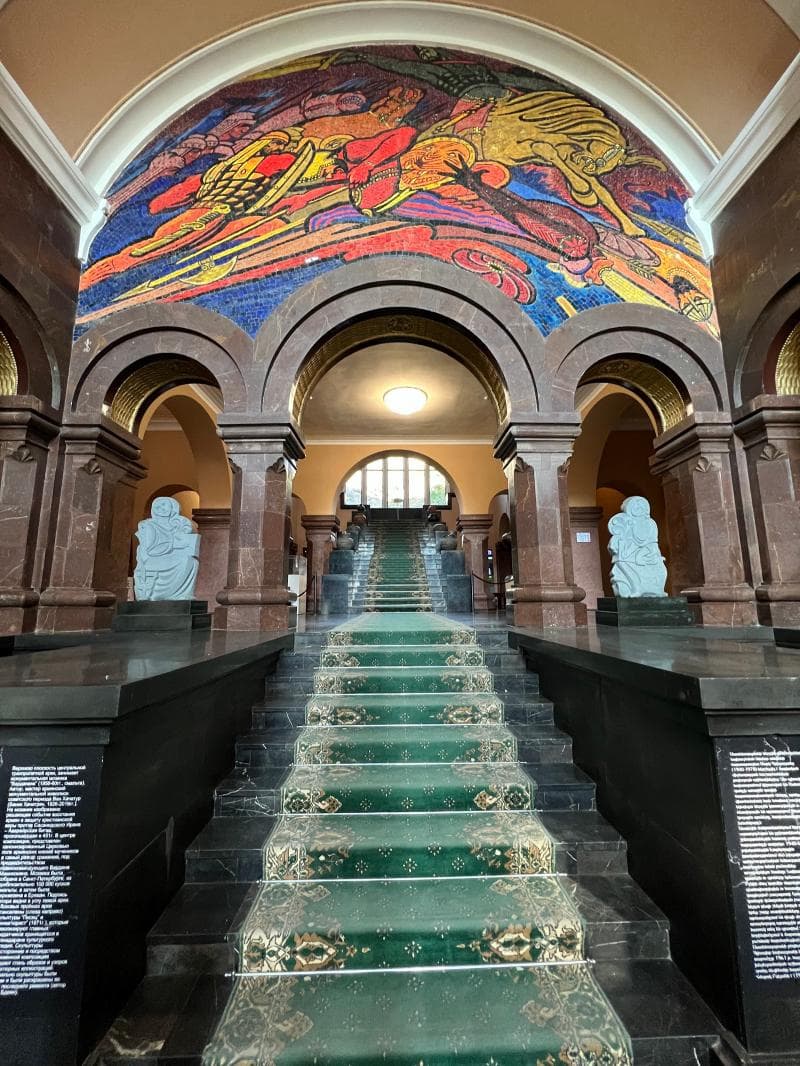
Explore the Matenadaran's Medieval Archives in Yerevan, Armenia, a UNESCO-listed institute housing over 23,000 ancient manuscripts.
Overview
The Matenadaran, officially known as the Mesrop Mashtots Institute of Ancient Manuscripts, is far more than just a library; it is a global treasure trove nestled in Yerevan, Armenia. Often referred to simply as the 'Medieval Archives' by curious travelers, this esteemed institution serves as a vital center for the storage, study, and popularization of ancient manuscripts. It combines the functions of a museum, an archive, and a scientific research institute, standing as a testament to Armenia's rich intellectual and cultural heritage.
Perched majestically on a hillside overlooking Yerevan, the Matenadaran houses an extraordinary collection of approximately 23,000 manuscripts and over 500,000 archival documents. While predominantly Armenian, its extensive holdings also include texts in numerous other languages, such as Greek, Arabic, Persian, Latin, and Syriac, reflecting centuries of cross-cultural exchange.
History & Cultural Background
The roots of the Matenadaran stretch back to the 5th century, aligning with the creation of the Armenian alphabet by Mesrop Mashtots in 405 AD. The concept of a 'matenadaran' – meaning 'repository of manuscripts' or 'library' in ancient Armenian – has existed for centuries, with significant collections historically maintained at places like the Catholicosate of Etchmiadzin.
The modern Matenadaran in Yerevan was officially established in 1959, built upon the nationalized collection of the Armenian Church. The institution was later named after Mesrop Mashtots in 1962, honoring the creator of the Armenian alphabet, whose statue now greets visitors outside the building. Its significance is globally recognized, having been inscribed on UNESCO's Memory of the World Register in 1997, affirming its invaluable contribution to human heritage.
What Makes It Special
What truly sets the Matenadaran's 'Medieval Archives' apart is the sheer volume, antiquity, and unique historical importance of its collection. It holds the largest collection of Armenian manuscripts in the world, with some fragments dating back to the 5th-6th centuries and the oldest complete manuscript, the Lazarus Gospel, from 887 AD. The manuscripts cover a vast array of subjects, from theology, philosophy, and history to medicine, mathematics, and cosmology, offering deep insights into medieval Armenian science and culture.
Beyond Armenian texts, the Matenadaran preserves critical works in other languages, often featuring Armenian translations of ancient texts whose originals have been lost, making them irreplaceable historical sources. The vivid miniature paintings and intricate bindings that adorn many of these manuscripts transform them from mere texts into exquisite works of art, showcasing the profound artistic skill of medieval Armenian scribes and illuminators.
Stories, Fun Facts & Local Details
Among the countless narratives held within these archives are compelling human stories. One such tale involves the 'Msho Charntir' (Homilies of Mush), the largest Armenian manuscript. During the Armenian Genocide, two women courageously divided this massive, heavy book into two parts to save it from destruction, ensuring its survival to this day. It stands as a powerful symbol of resilience and the enduring value placed on written heritage. On the other end of the spectrum, the Matenadaran also houses some of the world's smallest manuscripts, including a prayer book measuring just 19x14 mm.
The architectural grandeur of the Matenadaran building itself, inspired by 12th-13th century Armenian ecclesiastical styles, enhances the visitor's sense of stepping into history. The statues outside depict Mesrop Mashtots and other eminent Armenian scholars, inviting contemplation before one even enters.
Visitor Perspective
For visitors, the Matenadaran offers a journey through the evolution of Armenian written culture. The museum's permanent exhibition skillfully traces the development of manuscript art through various halls, which are often themed around specific historical periods, geographic regions, or subjects. You can explore halls dedicated to foreign-language manuscripts, delve into ancient maps, or even observe a laboratory that demonstrates the medieval techniques of manuscript production, from pigment preparation to parchment making.
The exhibits are designed to be engaging, with some featuring tactile display cases for visually impaired visitors, allowing a deeper appreciation of the manuscripts' unique characteristics. Knowledgeable guides are available to enrich the experience, unveiling the stories behind these ancient texts and their profound impact on Armenian and world history. A visit here is not just about seeing old books; it's about connecting with the intellectual heartbeat of a nation and the artistry of centuries past.
Coordinates: 44.52082, 40.19195
View on Google Maps💬 How Travelers Describe This Place
Based on community votes
Must See
948Beautiful
913Photogenic
499Unique
337Interesting
94
Traveler Stories
Discover memorable experiences shared by travelers who have visited this place.
No traveler stories yet.
Be the first traveler to share what made this place memorable.

Tour
By
Spot
Discover amazing places around the world. Your journey starts here.
Explore
© 2026 TourBySpot. All rights reserved.