Research Center
Yerevan, Armenia
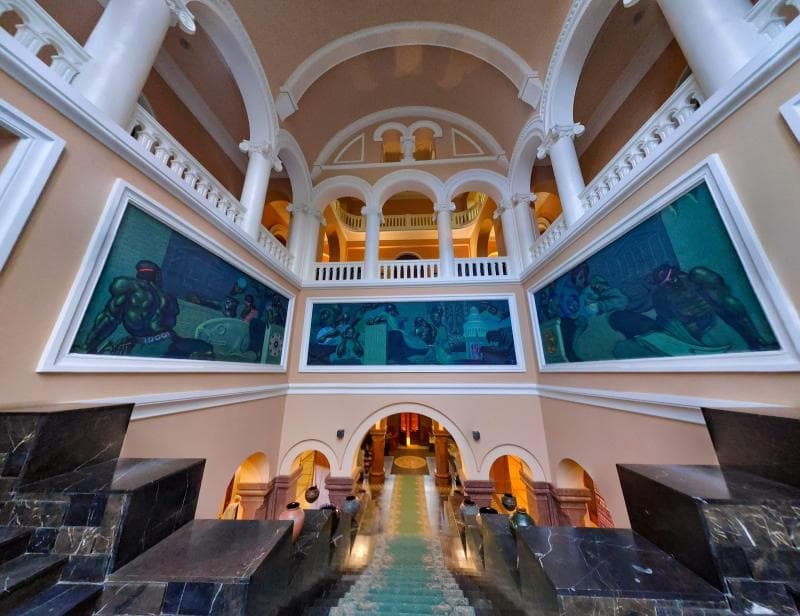
Explore Matenadaran in Yerevan, Armenia, a leading research institute and museum housing the world's largest collection of Armenian ancient manuscripts.
Overview
Perched majestically on a hillside in Yerevan, Armenia, the Mesrop Mashtots Institute of Ancient Manuscripts, universally known as Matenadaran, stands as a profound guardian of Armenian cultural heritage. More than just a museum, it is a dynamic institution that brilliantly combines the functions of a museum, a vast archive, and a leading scientific research center dedicated to the study and preservation of ancient manuscripts. Its imposing structure rises at the northeastern end of Mashtots Avenue, offering striking views of the city. The Matenadaran is home to the largest collection of Armenian manuscripts in the world, with approximately 23,000 manuscripts and scrolls, including fragments, and over 500,000 archival documents. While predominantly Armenian, its invaluable collection also includes significant texts in Greek, Arabic, Persian, Assyrian, Latin, Ethiopian, Georgian, Hebrew, and other languages, highlighting Armenia's historical role as a crossroad of civilizations. Named after Mesrop Mashtots, the ingenious inventor of the Armenian alphabet, the institute's collection is recognized globally and is inscribed on UNESCO's Memory of the World Register.
History & Cultural Background
The history of Matenadaran is deeply intertwined with the very fabric of Armenian written culture. Its origins trace back to the manuscript collections of the Armenian Church, particularly those preserved at Etchmiadzin, with a heritage that dates as far back as the 5th century. These precious manuscripts were meticulously guarded in monasteries and scriptoriums throughout the Middle Ages, serving as vital repositories of knowledge during periods of immense turmoil and invasion. In 1939, the Etchmiadzin collection was transferred to Yerevan, marking a pivotal moment in its institutionalization. The current monumental building, designed by architect Mark Grigorian, was constructed between 1945 and 1959. On March 3, 1959, the Soviet Armenian government officially established Matenadaran as an institute of scientific research, explicitly tasking it with the scientific preservation, study, translation, and publication of manuscripts. In 1962, it was formally named after Mesrop Mashtots, cementing its connection to the father of the Armenian alphabet. This establishment made it the first institute in the entire Soviet Union dedicated solely to the study and preservation of manuscripts. To accommodate its expanding activities and growing collection, a new, spacious scientific building, designed by Arthur Meschian, was completed between 2007 and 2011.
What Makes It Special
The Matenadaran's distinction lies not only in its sheer volume of manuscripts but also in its profound academic mission. It is a vibrant research institute with numerous specialized departments dedicated to unearthing and understanding the intellectual treasures within its walls. These include departments for Medieval Art Studies, Oriental Studies, Philology and the Study of Secular Literature, and Archival Studies. A dedicated group focuses on the biochemical research of manuscripts, employing modern scientific methods to analyze pigments, ink acidity, and the aging processes of paper and parchment, directly informing restoration practices. Another group specializes in medical and natural science texts, delving into ancient Armenian scientific knowledge. The Matenadaran’s Restoration Department is particularly renowned, serving as a crucial regional center for the conservation and restoration of delicate paper and parchment manuscripts, miniatures, and graphic works damaged by time, fire, or other elements. A remarkable aspect of the Matenadaran’s collection is its role in preserving works that would otherwise be lost to history; many ancient texts by foreign authors are known today only through their Armenian translations found here. Among its priceless holdings are fragments dating back to the 5th and 6th centuries, with the oldest illustrations found in the 6th-century Gospel of Etchmiadzin and the oldest complete manuscript being the Lazarus Gospel from 887.
Stories, Fun Facts & Local Details
The very name 'Matenadaran' carries a rich historical resonance, translating from ancient Armenian as 'repository of manuscripts' or 'book-depository,' perfectly encapsulating its enduring purpose. Among its most striking exhibits are the extremes of manuscript size: visitors can marvel at the gargantuan Charentir of Mush, a lectionary weighing a hefty 27.5 kilograms and measuring 70 by 55 centimeters, juxtaposed with a tiny 1434 Calendar, which measures a mere 4 by 3 centimeters and weighs just 19 grams. The main building itself is a work of art, with its facade and forecourt adorned with statues of influential Armenian thinkers and scholars, including Mesrop Mashtots, Movses Khorenatsi, and Anania Shirakatsi, paying homage to the intellectual lineage it preserves. Inside, a vibrant mosaic depicts the historic Avarayr Battle, a poignant symbol of Armenian resilience. The institute is also at the forefront of innovative preservation techniques, engaging in international collaborations, such as genomic analysis of parchments with Trinity College Dublin, to understand the origins and production methods of its ancient materials. Tactile display cases are thoughtfully incorporated within the museum, allowing visually impaired visitors to appreciate the intricate artistry of medieval manuscript illumination.
Visitor Perspective
For the curious traveler, Matenadaran offers a journey through Armenia's intellectual and spiritual past. It is conveniently located and accessible by public transport, with the Yeritasardakan metro station just a ten-minute walk away. The museum welcomes visitors from Tuesday to Saturday, typically between 10:00 and 17:50, though it remains closed on Sundays, Mondays, and public holidays. Entry fees are reasonable, and guided tours are highly recommended to fully appreciate the profound historical and cultural significance of the exhibits. These tours are offered in several languages, including English, French, German, Italian, Russian, and Spanish, ensuring an enriching experience for international guests. To enjoy a more serene visit and avoid larger crowds, arriving in the mornings is advisable, especially during the pleasant spring and summer months when Yerevan's weather is most inviting. While the main museum offers public access to many wonders, specialized departments, such as the Restoration Department, require prior written authorization for visits, catering to researchers and professionals interested in deeper insights. Beyond the profound artifacts, the Matenadaran's elevated position provides visitors with spectacular panoramic views of Yerevan, adding another layer of appreciation to this remarkable cultural landmark.
Coordinates: 44.52082, 40.19195
View on Google Maps💬 How Travelers Describe This Place
Based on community votes
Interesting
556Must See
394Beautiful
269Photogenic
254Unique
145
Traveler Stories
Discover memorable experiences shared by travelers who have visited this place.
No traveler stories yet.
Be the first traveler to share what made this place memorable.

Tour
By
Spot
Discover amazing places around the world. Your journey starts here.
Explore
© 2026 TourBySpot. All rights reserved.