Erebuni Fortress
Yerevan, Armenia
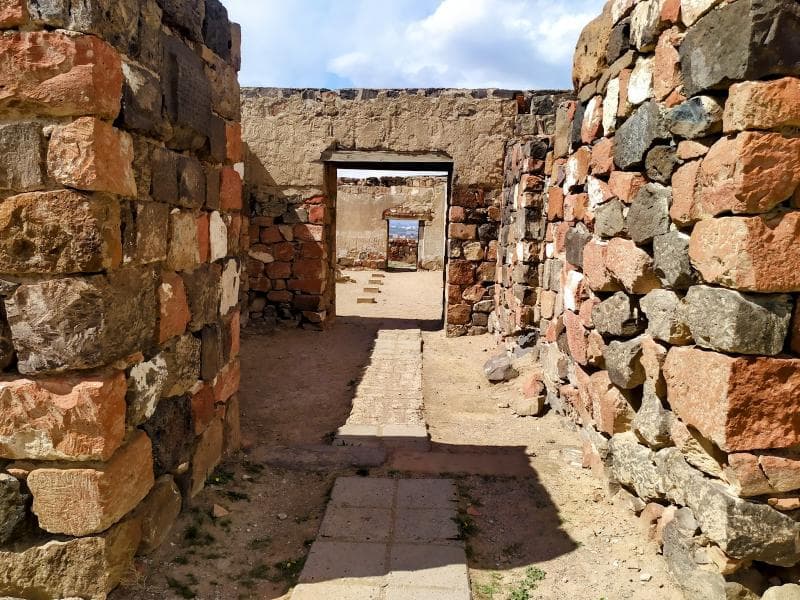
Discover Erebuni Fortress in Yerevan, Armenia – an ancient Urartian citadel, the birthplace of Yerevan. Explore its rich history and stunning views.
Overview
Perched atop the scenic Arin Berd hill in Yerevan, Armenia, Erebuni Fortress stands as a powerful testament to the ancient Urartian civilization. This fortified city, founded in 782 BCE by King Argishti I, is widely recognized as the historical birthplace of modern-day Yerevan, making the Armenian capital one of the world's oldest continuously inhabited cities. Its strategic location offered commanding views of the fertile Ararat Plain, serving as a crucial military, administrative, and cultural hub for the Urartian Kingdom.
Today, visitors can explore the archaeological site and its adjacent museum, which together narrate a compelling story of a powerful empire and the enduring legacy that shaped Armenia's capital.
History & Cultural Background
Erebuni's story begins with King Argishti I, the sixth known king of Urartu, who initiated its construction in the fifth year of his reign, 782 BCE. The fortress was designed as a formidable military stronghold to protect the kingdom's northern borders and served as a major administrative and religious center. The Urartian civilization, active from the 9th to 7th centuries BCE, was renowned for its advanced skills in construction, agriculture, metallurgy, and winemaking, aspects vividly reflected in Erebuni's design and discovered artifacts.
Following the decline of the Urartian Kingdom around the 6th century BCE, Erebuni did not lose its significance. It transitioned into an important administrative center under the Achaemenid Empire, with archaeologists finding evidence of alterations and reconstructions from this period, including the transformation of the Khaldi temple into a multi-columned hall. This continuous habitation and adaptation underscore Erebuni's enduring importance and its direct lineage to contemporary Yerevan.
What Makes It Special
Erebuni Fortress is particularly special due to several remarkable features. Foremost among them is the well-preserved cuneiform inscription, known as Erebuni's 'birth certificate,' which explicitly records its founding by King Argishti I. This inscription provides a precise, documented date for the city's origin, a rare find for ancient settlements. The site also boasts some of the most striking surviving examples of Urartian wall paintings, or frescoes. These vibrant murals, featuring human figures, deities, and natural scenes in dark blue and red on white backgrounds, offer a glimpse into the artistic sophistication and religious beliefs of the Urartians.
Furthermore, the engineering prowess of the Urartians is evident in Erebuni's sophisticated water supply system, which included stone pipes that transported water over significant distances, reportedly from as far as Garni. The fortress's triangular layout on Arin Berd hill, fortified with multiple rows of walls, highlights its strategic design and defensive capabilities.
Stories, Fun Facts & Local Details
The name 'Erebuni' itself is believed by some linguists to derive from the Urartian word 'erebu,' possibly meaning 'to seize,' 'capture,' or 'victory,' though other interpretations suggest 'city of freedom.' The enduring legacy of this ancient fortress is deeply intertwined with the identity of modern Yerevan, with the city's name being a direct linguistic descendant of Erebuni. King Argishti I reportedly settled Erebuni with 6,600 prisoners of war from conquered territories, a practice common in Urartian expansion.
A significant deity worshipped at Erebuni was Khaldi, the supreme god of the Urartian pantheon, whose temple was a central feature of the fortress. The importance of Erebuni to Armenia's national heritage was famously celebrated in 1968, marking the 2750th anniversary of Yerevan, and again in 2018 for its 2800th anniversary, underscoring its profound historical and cultural resonance.
Visitor Perspective
Visiting Erebuni Fortress offers a unique journey through time. The Erebuni Historical and Archaeological Museum-Reserve, located at the foot of Arin Berd hill, is the ideal starting point. Here, artifacts like cuneiform tablets, pottery, weapons, and jewelry provide essential context and bring the ancient civilization to life. After exploring the museum, a climb up the hill reveals the impressive ruins of the fortress itself, where you can trace the foundational walls of the palace, temples, and storage rooms.
While much of the original upper structures are gone, the extant foundations and partially reconstructed walls allow for a vivid imagination of its past grandeur. From the hilltop, visitors are rewarded with panoramic views of modern Yerevan and, on clear days, the majestic Mount Ararat. It's advisable to wear sturdy shoes due to uneven paths and to bring water, especially during warmer months, as the site has limited shade. Allow approximately 1.5 to 2.5 hours for a comprehensive visit to both the museum and the fortress.
Coordinates: 44.5381, 40.1406
View on Google Maps💬 How Travelers Describe This Place
Based on community votes
Interesting
995Unique
964Must See
926Photogenic
730Beautiful
482
Traveler Stories
Discover memorable experiences shared by travelers who have visited this place.
No traveler stories yet.
Be the first traveler to share what made this place memorable.
Things to see at Erebuni Fortress



Tour
By
Spot
Discover amazing places around the world. Your journey starts here.
Explore
© 2026 TourBySpot. All rights reserved.