Erebuni Museum
Yerevan, Armenia
Explore Erebuni Museum and Fortress in Yerevan, Armenia, the ancient Urartian site considered the birthplace of the capital city.
Overview
The Erebuni Museum, nestled at the foot of Arin Berd hill in Yerevan, Armenia, serves as the custodian of a profound ancient legacy. It is an integral part of the larger Erebuni Fortress archaeological site, collectively forming the Erebuni Historical and Archaeological Museum-Reserve. This significant site is often referred to as the 'birthplace' of modern-day Yerevan, bearing witness to over 2800 years of continuous history. The museum and the fortress together offer an unparalleled journey into the heart of the Urartian Kingdom, a powerful civilization that predates many European cultures.
Established in 1968, coinciding with Yerevan's 2750th anniversary, the Erebuni Museum was created to house and display the extraordinary artifacts unearthed during the extensive excavations of the ancient fortress. It stands as a vital center for Urartian studies, preserving and presenting thousands of objects that tell the story of a sophisticated ancient society.
History & Cultural Background
The story of Erebuni begins in 782 BC, when King Argishti I of the powerful Urartian Kingdom ordered the construction of a formidable fortress. Positioned atop the strategic Arin Berd hill, overlooking the fertile Ararat Plain, Erebuni was designed as a crucial military stronghold to protect the kingdom's northern borders and control vital trade routes. Beyond its defensive purpose, it also functioned as a significant administrative and religious center, a true royal capital of its time.
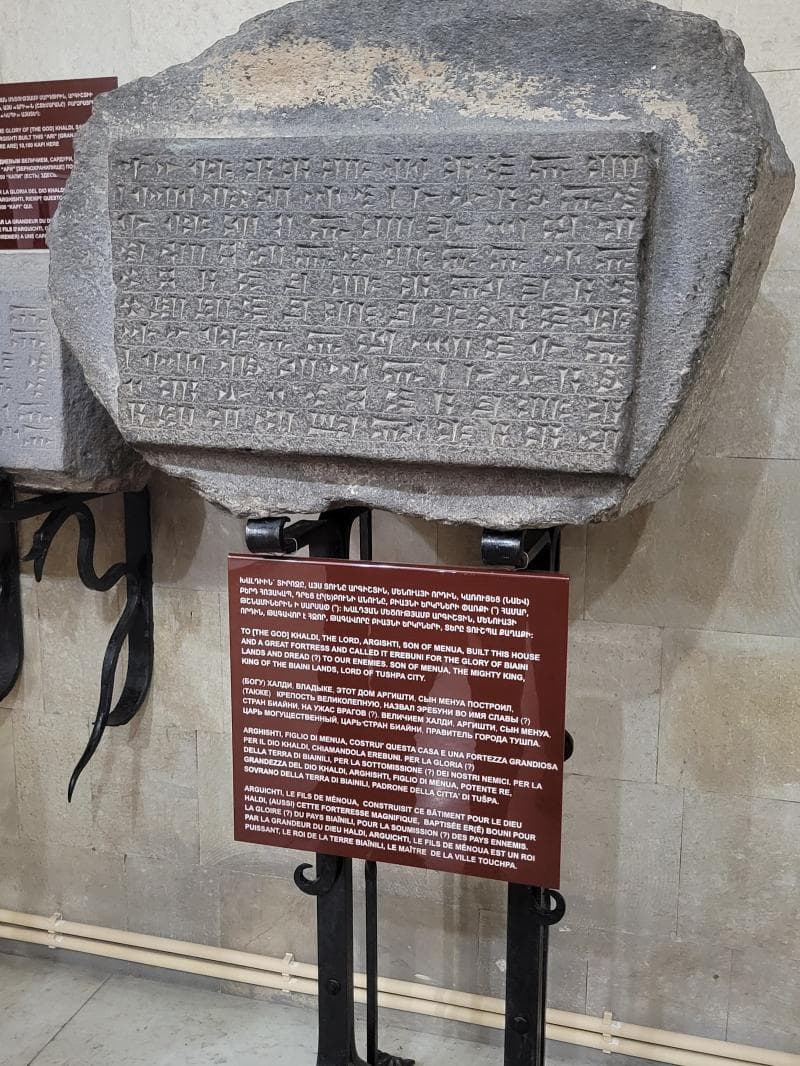
Archaeological excavations, particularly those initiated in the 1950s, brought the forgotten grandeur of Erebuni back to light. These efforts uncovered cuneiform inscriptions, notably one by King Argishti I himself, proudly proclaiming the fortress's foundation. The fortress complex included a grand palace, a royal assembly hall, the revered temple of the supreme Urartian god Khaldi, as well as living quarters, dormitories, and extensive storerooms. Even after the decline of the Urartian Kingdom in the 6th century BC, Erebuni continued to exist as a city through the Achaemenid, Hellenistic, and early Armenian periods, demonstrating remarkable continuity.
What Makes It Special
What truly sets the Erebuni Museum and Fortress apart is its direct connection to the origins of Yerevan, making it one of the world's oldest continuously inhabited capital cities. The museum's collection boasts an impressive array of over 12,000 to 20,000 archaeological objects, spanning pre-Urartian, Urartian, Achaemenid, Hellenistic, and early Armenian periods.
Visitors can marvel at remarkably preserved artifacts such as intricate pottery, ancient weaponry, bronze jewelry, and delicate agate and glass beads. Among the most compelling exhibits are the 23 cuneiform inscriptions, including the foundational tablet that explicitly details Yerevan's birth. The fortress site itself reveals stunning remnants of original wall paintings with vibrant religious and secular scenes, offering a rare glimpse into Urartian artistry and daily life.
Stories, Fun Facts & Local Details
- The Name 'Yerevan': Perhaps the most fascinating detail is the etymological link between the ancient name 'Erebuni' and modern 'Yerevan'. Scholars widely believe that the name of Armenia's capital directly evolved from the Urartian 'Erebuni', highlighting a profound historical continuity.
- Ancient Engineering Marvels: The Urartians were master engineers. Excavations revealed sophisticated water supply systems, including stone pipes that transported water from as far as Garni, showcasing their advanced hydraulic knowledge.
- Architectural Echoes: The museum's building itself was thoughtfully designed to reflect the grandeur of an Urartian palace, featuring external soundproof walls and a flat roof surrounding an internal courtyard, mirroring ancient construction principles.
- A Capital's Birthday Gift: The Erebuni Museum was intentionally opened on October 19, 1968, as a significant celebration of Yerevan's 2750th anniversary, underscoring the city's ancient roots.
- Fortress Defenses: The Erebuni Fortress was incredibly well-protected, featuring strong walls, in some places built in three rows, and strategically incorporating the natural slopes of Arin Berd hill for defense.
Visitor Perspective
A visit to the Erebuni Museum and Fortress offers a deeply immersive historical experience. Travelers typically begin their journey in the museum, where expertly curated exhibits provide essential context to the Urartian civilization and the artifacts discovered. Here, you can stand before the very cuneiform inscription that announces Yerevan's founding, feeling a direct connection to ancient history.
After exploring the museum's indoor galleries, the adventure continues with a climb up Arin Berd hill to the fortress ruins. Walking amidst the preserved foundations, original walls, and partially restored structures, you can envision the bustling life of this ancient city. The panoramic views of Yerevan and the Ararat Plain from the fortress are breathtaking, allowing you to appreciate the strategic foresight of King Argishti I. It's a place where the stones whisper tales of kings, warriors, and a civilization that laid the foundation for modern Armenia, offering a profound sense of stepping back in time.
Coordinates: 44.5381, 40.1406
View on Google Maps💬 How Travelers Describe This Place
Based on community votes
Photogenic
556Must See
422Beautiful
394Unique
269Interesting
145
Traveler Stories
Discover memorable experiences shared by travelers who have visited this place.
No traveler stories yet.
Be the first traveler to share what made this place memorable.

Tour
By
Spot
Discover amazing places around the world. Your journey starts here.
Explore
© 2026 TourBySpot. All rights reserved.