Tuol Sleng Genocide Museum
Phnom Penh, Cambodia
Explore Tuol Sleng Genocide Museum in Phnom Penh, Cambodia, a former Khmer Rouge prison (S-21) now a haunting memorial to genocide victims.
Overview
The Tuol Sleng Genocide Museum, located in the heart of Phnom Penh, Cambodia, stands as a profoundly somber and crucial testament to one of the 20th century's darkest periods: the Cambodian genocide. This site, once a peaceful high school known as Tuol Svay Prey, was tragically transformed into 'Security Prison 21,' or S-21, by the Khmer Rouge regime between 1975 and 1979. Today, it serves as a memorial, a museum, and a stark reminder of the atrocities committed under Pol Pot's rule, encouraging visitors to reflect on history and become messengers of peace.
A visit to Tuol Sleng is an intense and deeply moving experience, designed to educate and prevent such horrors from recurring. The museum meticulously preserves the physical evidence and stories of those who suffered within its walls, offering a powerful, unvarnished look at the past.
History & Cultural Background
Before its transformation, the buildings that now comprise the Tuol Sleng Genocide Museum were part of a high school built in 1962. Following the Khmer Rouge's capture of Phnom Penh in April 1975, the city's inhabitants were evacuated, and this former school was converted into a secret interrogation, torture, and execution center. It became the central hub of a vast prison system, used to detain, interrogate, torture, and exterminate anyone deemed an 'enemy of the state' by the Communist Party of Kampuchea, also known as the Khmer Rouge.
Between 1975 and 1979, an estimated 20,000 people were imprisoned at S-21. Many prisoners were held for months, enduring brutal torture designed to extract confessions for fabricated crimes. The regime's policy of 'guilt-by-association' often led to entire families being incarcerated. When Vietnamese forces liberated Phnom Penh in January 1979, they discovered the horrors of S-21. The site was then opened as a museum in 1980, on the anniversary of the Khmer Rouge's conquest of Phnom Penh, to preserve the evidence and educate the world about the genocide.
What Makes It Special
What sets Tuol Sleng apart is its remarkable preservation as a crime scene. The buildings have been largely maintained as they were found in 1979, with some rooms still displaying rusted iron beds and instruments of torture, alongside photographs of the victims and their gruesome deaths.
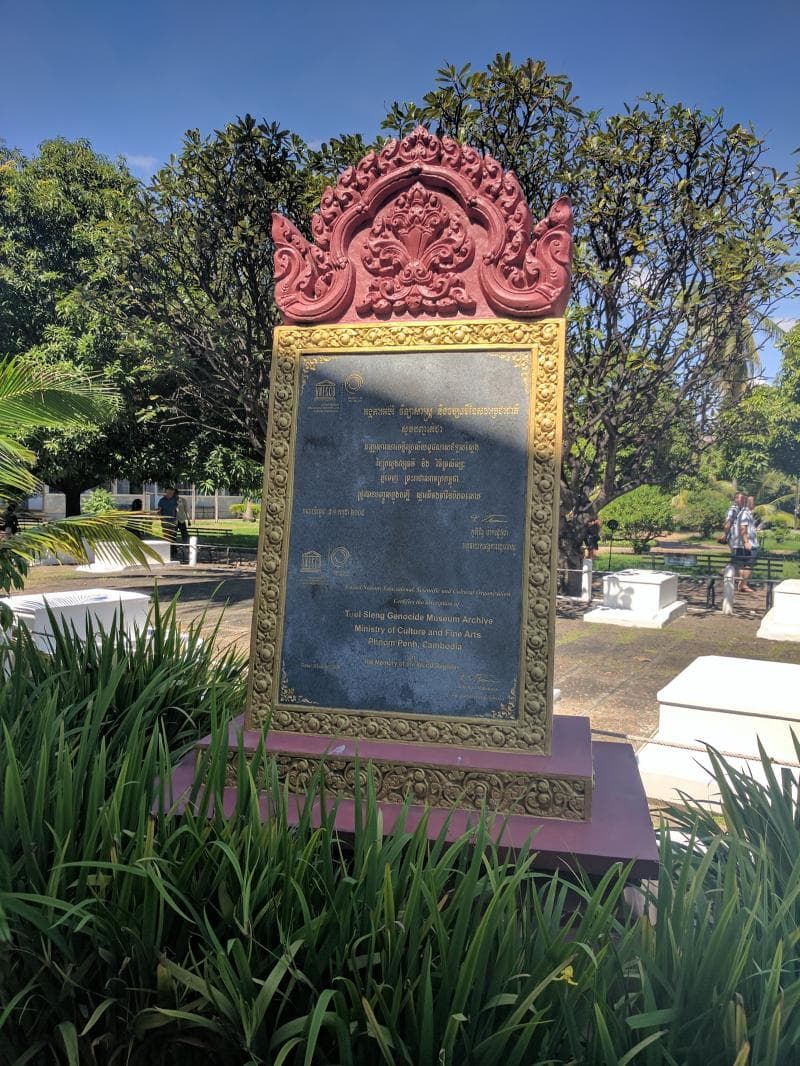
The museum houses an extensive archive, including thousands of black-and-white photographs of prisoners—men, women, and children—taken upon their arrival at S-21. These haunting portraits line the walls of several rooms, creating an overwhelming visual record of the sheer scale of the tragedy. The site's significance is further recognized by its inscription on the UNESCO Memory of the World Register in 2009, highlighting its vital role in documenting and remembering the Cambodian genocide.
Stories, Fun Facts & Local Details
The name 'Tuol Sleng' itself translates to 'Hill of Poisonous Trees,' a tragically fitting name given its history. While the museum is a site of immense sorrow, it also features stories of resilience. Out of an estimated 20,000 prisoners, only a handful of individuals survived S-21. Two notable survivors, Chum Mey and Bou Meng, an artist and a mechanic respectively, were spared due to their practical skills deemed useful by their captors. They have often returned to the museum to share their first-hand accounts, offering invaluable human perspectives on the atrocities.
In the museum's courtyard, the graves of the last 14 victims discovered at the site are protected, alongside a monument honoring all victims of the Khmer Rouge. Religious ceremonies, such as the Pchum Ben festival, are held at the museum, serving as a space for education, reflection, and remembrance for Cambodians and international visitors alike.
Visitor Perspective
Visiting Tuol Sleng is described as a profoundly depressing and impactful experience. The sheer ordinariness of the former school buildings, juxtaposed with the evidence of systematic brutality, creates a chilling atmosphere. The museum's aim is to foster peace by preserving memory and encouraging reflection on the past. Visitors are encouraged to dress appropriately, covering their legs and arms, as a sign of respect for the victims and the solemnity of the memorial site.
Audio guides are available in multiple languages and are highly recommended to provide context and narratives as you move through the site. The museum is open daily from 8:00 AM to 5:00 PM, with admission fees for international visitors helping to maintain this critical historical site.
Coordinates: 104.91778, 11.54944
View on Google Maps💬 How Travelers Describe This Place
Based on community votes
Beautiful
961Photogenic
710Must See
555Unique
448Interesting
156
Traveler Stories
Discover memorable experiences shared by travelers who have visited this place.
No traveler stories yet.
Be the first traveler to share what made this place memorable.
Things to see at Tuol Sleng Genocide Museum



Tour
By
Spot
Discover amazing places around the world. Your journey starts here.
Explore
© 2026 TourBySpot. All rights reserved.