Prison Buildings A–D
Phnom Penh, Cambodia
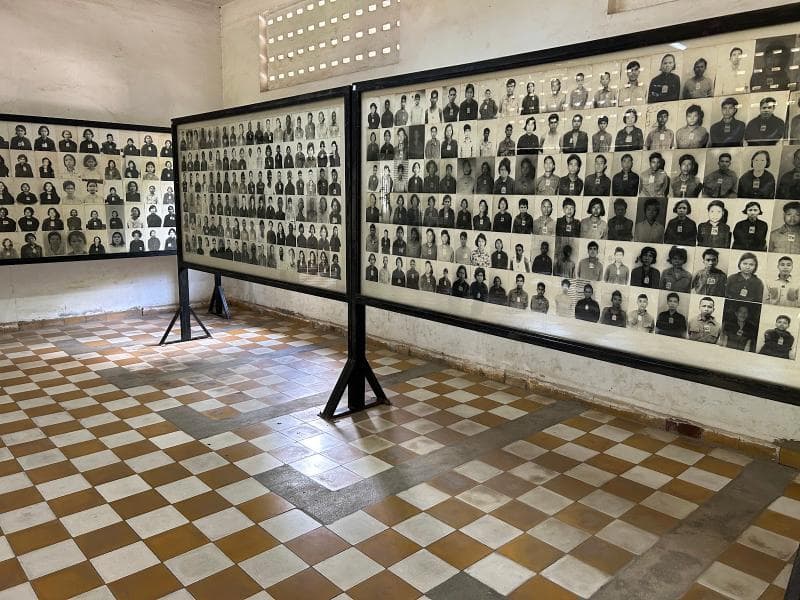
Explore Prison Buildings A–D at Tuol Sleng Genocide Museum in Phnom Penh, Cambodia, a preserved site detailing the chilling history of the Khmer Rouge's S-21 prison.
Overview
The Tuol Sleng Genocide Museum, located in the heart of Phnom Penh, Cambodia, stands as a chilling and essential memorial to a tragic chapter in human history. Once known as Tuol Svay Prey High School, this complex of buildings was transformed by the Khmer Rouge regime into Security Prison 21, infamously known as S-21, between 1975 and 1979. Today, its 'Prison Buildings A–D' serve as a stark reminder of the atrocities committed during that period, preserving evidence and stories to encourage visitors to be messengers of peace.
History & Cultural Background
The Khmer Rouge, led by Pol Pot, seized power in Cambodia in April 1975, initiating a brutal regime that lasted until January 1979. During this time, they sought to transform Cambodia into an agrarian, classless society, resulting in the deaths of an estimated 1.7 to 2 million people through forced labor, starvation, lack of medical care, and executions. S-21 was one of the regime's most notorious interrogation and detention centers, playing a central role in this genocidal campaign.
Originally a high school built in 1962, the Tuol Sleng complex was converted into a secret facility for the detention, interrogation, torture, and extermination of those deemed 'political enemies' of the regime. The transformation involved enclosing the buildings in electrified barbed wire, converting classrooms into tiny cells and torture chambers, and barring windows to prevent escapes or suicides. It is estimated that between 14,000 and 20,000 people passed through S-21, with only a handful known to have survived. The prison was discovered by invading Vietnamese forces in 1979, and shortly thereafter, it was reopened as a museum to memorialize the victims and educate the public.
What Makes It Special
The profound impact of Tuol Sleng lies in its preservation as it was found, offering a raw and unflinching look at the prison's grim reality. The complex consists of four main buildings, simply named A, B, C, and D, arranged around a former school courtyard. Each building holds distinct and harrowing exhibits that contribute to the museum's powerful narrative.
- Building A: This building housed the torture facilities, and it is here that the bodies of the last victims were discovered when the site was liberated. The rooms still display some of the equipment used, presenting a visceral sense of the suffering endured.
- Building B: Dedicated to the victims, Building B displays thousands of black-and-white photographs of prisoners taken upon their arrival at S-21. These haunting portraits capture expressions of shock, resignation, and fear, serving as a powerful testament to the individuals lost.
- Building C: Former classrooms in this building were converted into rudimentary prison cells and holding rooms. Visitors can see the small, makeshift brick or wooden cells where prisoners were chained, often in horrific, overcrowded, and unsanitary conditions, awaiting interrogation or execution.
- Building D: This building features a display of the various torture instruments used by the interrogators, alongside a space dedicated to the words of both victims and perpetrators, offering crucial context and perspectives on the atrocities.
The site's authenticity, including rusting bars, barbed wire, and visible bloodstains, ensures that the museum is not a polished exhibit but a preserved historical site, leaving a lasting impression on visitors.
Stories, Fun Facts & Local Details
Despite the harrowing nature, the museum also highlights extraordinary stories of resilience and the meticulous, albeit disturbing, record-keeping of the Khmer Rouge. The regime was obsessed with documentation, photographing nearly every prisoner and coercing detailed confessions.
Among the tens of thousands imprisoned, only a handful survived. Notable survivors include artists Vann Nath and Bou Meng, whose skills were exploited by their captors. Vann Nath's powerful paintings, depicting scenes of torture and prison life, are displayed within the museum, offering an eyewitness account of the horrors. Bou Meng, another survivor, also contributed to the narrative through his art and testimony, providing crucial insights into the daily brutalities and forced confessions at S-21. These testimonies, alongside those of other survivors, are invaluable in understanding the regime's 'guilt-by-association' policy, which often led to entire families being imprisoned.
The museum actively works as a space for education and reflection, with events like Remembrance Day ceremonies held to honor the victims and promote peace. Its inclusion in the UNESCO Memory of the World Register underscores its global significance.
Visitor Perspective
Visiting the Prison Buildings A–D at Tuol Sleng is a profoundly moving and emotionally demanding experience. Many visitors describe a physical and emotional heaviness that lingers long after their visit. To fully grasp the historical context and personal stories, an audio guide is highly recommended, as it provides detailed explanations and survivor testimonies that enrich the visit. Personal guides, some of whom may have personal connections to the period, also offer invaluable insights.
Due to the sensitive nature of the site, visitors are expected to behave with solemnity and respect, dressing appropriately with covered legs and arms, similar to other commemorative and religious sites in Cambodia. Many travelers combine a visit to Tuol Sleng with the Choeung Ek Genocidal Centre, also known as the Killing Fields, to gain a comprehensive understanding of the Khmer Rouge era's impact. This dual visit offers a fuller, albeit deeply upsetting, picture of Cambodia's recent history, making it an essential journey for anyone seeking to understand the resilience of the Cambodian people.
Coordinates: 104.91778, 11.54944
View on Google Maps💬 How Travelers Describe This Place
Based on community votes
Beautiful
710Must See
156Interesting
102Photogenic
102Unique
87
Traveler Stories
Discover memorable experiences shared by travelers who have visited this place.
No traveler stories yet.
Be the first traveler to share what made this place memorable.

Tour
By
Spot
Discover amazing places around the world. Your journey starts here.
Explore
© 2026 TourBySpot. All rights reserved.