Survivor Exhibits
Phnom Penh, Cambodia
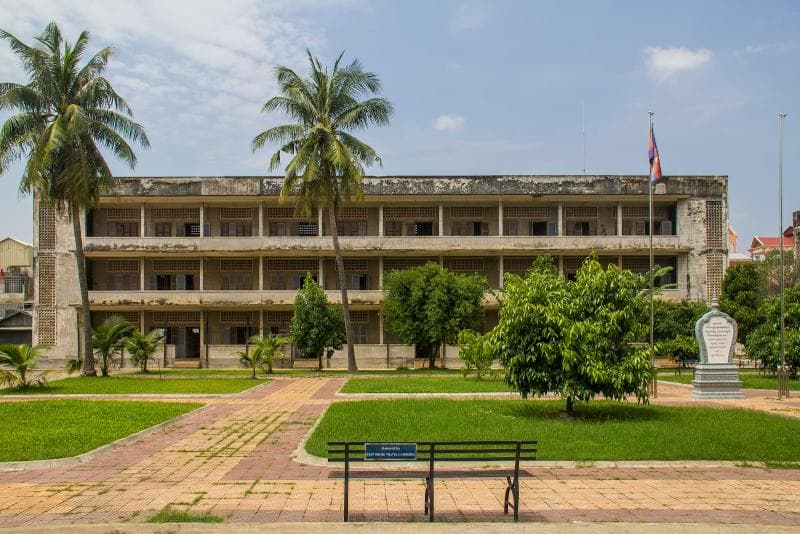
Explore the Survivor Exhibits at Tuol Sleng Genocide Museum in Phnom Penh, Cambodia, featuring harrowing testimonies of S-21 survivors.
Overview
The Tuol Sleng Genocide Museum, located in Phnom Penh, Cambodia, stands as a stark and essential memorial to the atrocities committed during the Khmer Rouge regime (1975-1979). Within this harrowing site, the 'Survivor Exhibits' serve as a poignant testament to the human spirit's resilience amidst unimaginable horror. Once known as Security Prison 21 (S-21), this former high school became the epicenter of a brutal system of detention, interrogation, torture, and execution. While an estimated 14,000 to 20,000 individuals passed through its gates, only a tiny handful emerged alive, making their stories exceptionally rare and powerful.
These exhibits go beyond mere historical records, offering a deeply personal and emotional connection to the past. They highlight the experiences of those few who endured the systematic brutality of S-21, providing invaluable first-hand accounts that ensure the world remembers this dark chapter of Cambodian history. The narratives woven through these displays are not just about survival, but about bearing witness, healing, and fostering a collective commitment to peace.
History & Cultural Background
From 1975 to 1979, the Khmer Rouge regime, led by Pol Pot, transformed Cambodia into 'Democratic Kampuchea,' implementing radical agrarian policies that led to the deaths of approximately 1.7 million people through forced labor, starvation, lack of medical care, and executions. S-21 was a central component of this genocidal machinery, one of nearly 200 such centers across the country. It was established in 1976, converting a former high school into a high-security prison.
The prison's purpose was to identify and eliminate perceived 'enemies' of the regime, ranging from former government officials and intellectuals to ordinary citizens accused of disloyalty. Prisoners were subjected to relentless torture until they confessed to fabricated crimes, often implicating family members and associates. These 'confessions' would then lead to further arrests and, ultimately, execution at sites like the Choeung Ek extermination center (the 'Killing Fields'). The museum opened in 1980, preserving the site as a memorial and educational institution, with its archives now recognized on UNESCO's Memory of the World Register.
What Makes It Special
The Survivor Exhibits are uniquely powerful because they represent the voices of those who defied the odds. The Khmer Rouge meticulously documented their victims, taking mug shots of every prisoner, but few lived to tell their tales. The survival of even a handful of individuals was often due to specific skills deemed useful by their captors. These included the ability to repair machinery or, in the case of artists, to paint portraits of Pol Pot for propaganda purposes.
The museum showcases tangible evidence of these stories, including photographs of thousands of victims, original prison cells, torture instruments, and the haunting artwork of survivor Vann Nath, which graphically depicts the brutal conditions and torture methods within S-21. These elements combine to create an immersive, yet deeply disturbing, experience that underscores the individual human cost of the genocide and the profound courage of those who survived to share their truths.
Stories, Fun Facts & Local Details
Among the most recognized survivors are Bou Meng and Chum Mey, whose personal narratives form the bedrock of the 'Survivor Exhibits.' Bou Meng, an artist, was imprisoned in 1976. He endured weeks of torture, but his life was spared when he was compelled to paint propaganda portraits of Pol Pot. He never saw his wife or children again after their arrest. In his later years, he dedicated himself to sharing his experiences at the museum, often creating and selling paintings that illustrated the horrors he witnessed. Sadly, Bou Meng passed away on August 14, 2026, marking the loss of a crucial historical witness.
Chum Mey, a motor mechanic, was arrested in 1978. His mechanical skills, specifically his ability to repair sewing machines, saved him from execution. He too suffered immense personal loss, with his wife and son killed by the Khmer Rouge. Chum Mey has been a steadfast presence at the museum, offering his testimony to visitors and ensuring that the memory of those lost and the lessons learned are never forgotten. His deep emotional connection to the site is evident, often shedding tears when recalling the events of S-21. These individuals' willingness to relive their trauma for the sake of education and remembrance is a profound aspect of the museum's offerings.
Visitor Perspective
Visiting the Survivor Exhibits at Tuol Sleng is a profoundly moving, albeit challenging, experience. It requires visitors to confront the darkest aspects of human history. The raw, unfiltered accounts and preserved environments evoke a strong emotional response, offering a visceral understanding of the suffering endured. Many visitors find the opportunity to hear a survivor's testimony, often available on weekday afternoons, to be particularly impactful.
The museum encourages a reflective atmosphere, emphasizing the importance of learning from the past to prevent future atrocities. Visitors are advised to dress respectfully and prepare themselves emotionally for the graphic content. The exhibits are designed not to sensationalize, but to educate and memorialize, fostering a deep appreciation for peace and human rights. It's a place that stays with you long after you leave, a testament to the power of memory and the resilience of the human spirit in the face of unimaginable cruelty.
Coordinates: 104.917778, 11.549444
View on Google Maps💬 How Travelers Describe This Place
Based on community votes
Unique
710Must See
448Beautiful
156Photogenic
102Interesting
87
Traveler Stories
Discover memorable experiences shared by travelers who have visited this place.
No traveler stories yet.
Be the first traveler to share what made this place memorable.

Tour
By
Spot
Discover amazing places around the world. Your journey starts here.
Explore
© 2026 TourBySpot. All rights reserved.