Tsitsernakaberd Armenian Genocide Memorial Complex
Yerevan, Armenia
Explore Tsitsernakaberd Armenian Genocide Memorial Complex in Yerevan, Armenia. A poignant site of remembrance, history, and the resilience of a nation.
Overview
The Tsitsernakaberd Armenian Genocide Memorial Complex stands as a profoundly significant landmark in Yerevan, Armenia, dedicated to the 1.5 million victims of the Armenian Genocide. Perched atop Tsitsernakaberd Hill, also known as 'Swallow's Fortress', the memorial overlooks the city, offering a serene yet powerful space for remembrance and reflection. This site is not merely a monument; it is Armenia's official tribute and a focal point for national identity and collective memory.
Every year, on April 24th, thousands of Armenians and visitors from across the globe gather here to commemorate Armenian Genocide Remembrance Day, laying fresh flowers around the eternal flame in a solemn act of respect. The complex encompasses several key architectural elements, each imbued with deep symbolic meaning: the Memorial Hall with its eternal flame, twelve inward-leaning basalt slabs, a towering 44-meter stele, and the Memorial Wall inscribed with names of towns affected by the tragedy. Adjacent to the memorial is the Armenian Genocide Museum-Institute, providing comprehensive historical context through extensive exhibits.
History & Cultural Background
The genesis of Tsitsernakaberd traces back to the mid-1960s, a period marked by a growing desire within Armenia to publicly acknowledge and mourn the genocide. The decision to build the memorial came after the 1965 Yerevan demonstrations, where a million people gathered to commemorate the 50th anniversary of the genocide, pushing Soviet authorities to approve the monument's construction. Completed in 1967, the complex was designed by architects Arthur Tarkhanyan and Sashur Kalashyan, with Hovhannes Khachatryan as an artist.
The Armenian Genocide, orchestrated by the Ottoman Empire between 1915 and 1923, saw the systematic extermination of 1.5 million Armenians. For decades under Soviet rule, open discussion of the genocide was largely suppressed. The establishment of Tsitsernakaberd marked a pivotal moment, transforming what was once a privately observed grief into a nationally recognized day of mourning and remembrance. The Armenian Genocide Museum-Institute, which opened in 1995 on the 80th anniversary of the genocide and was later expanded in 2015, plays a crucial role in documenting these events and educating future generations.
What Makes It Special
Tsitsernakaberd's power lies in its profound symbolism and austere beauty. The twelve inward-leaning basalt slabs, arranged in a circle, represent the twelve lost provinces of Western Armenia, creating a sense of inward-folding sorrow around the eternal flame. This eternal flame, burning 1.5 meters deep, symbolizes the undying spirit of the Armenian people and the collective memory of the victims. Standing prominently nearby is the 44-meter stele, a needle-like monument symbolizing the national rebirth and resilience of Armenia.
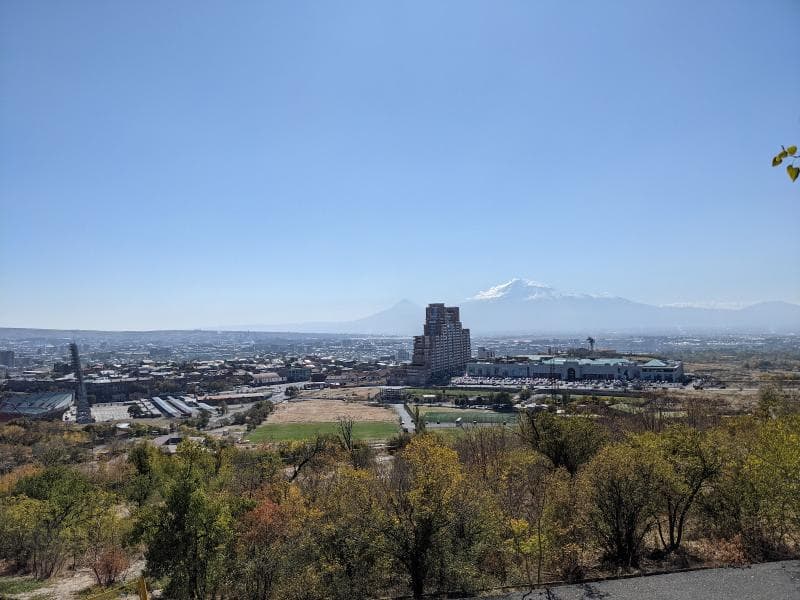
The Memorial Wall features the names of towns and villages where massacres and deportations occurred, serving as a tangible reminder of the widespread devastation. The complex's design is intentionally impactful without being theatrical, allowing visitors to engage in personal contemplation. Its elevation on Tsitsernakaberd Hill symbolically protects the memory of the lost Armenian provinces and offers a poignant view, often including the majestic Mount Ararat across the border.
Stories, Fun Facts & Local Details
The name 'Tsitsernakaberd' itself carries a unique story, translating to 'Swallow's Fortress'. According to an ancient legend, the hill was home to the palace of Astghik, the Armenian goddess of love. Swallows served as messengers, carrying news between Astghik and her beloved god Vahagn, hence the name. The swallow's characteristic return to its nest, even after destruction, is often referenced as a metaphor for the Armenian people's enduring spirit and return to their homeland.
Interestingly, archaeological investigations reveal that Tsitsernakaberd Hill has a much older history, having been a continuously inhabited fortress site since the Bronze Age, dating back to the 12th–9th centuries BC. This ancient heritage adds another layer of historical depth to the site. The museum building itself is subtly integrated into the hillside, with its roof designed not to detract from the imposing presence of the memorial above, an architectural choice that emphasizes the monument's primacy.
Visitor Perspective
Visiting Tsitsernakaberd is consistently described as a deeply moving and emotionally impactful experience. Travelers are encouraged to approach the site with a sense of reverence and an open mind to understand a pivotal chapter in Armenian history. The solemn atmosphere encourages quiet reflection as visitors walk around the memorial, observe the eternal flame, and explore the museum's comprehensive exhibits. Many find the museum's historical documents, photographs, and personal accounts profoundly educational, offering a crucial understanding of the Armenian Genocide and the unwavering resilience of the Armenian people.
The memorial serves as a powerful reminder of the importance of historical awareness and human rights, solidifying its status as an essential visit for anyone seeking to comprehend Armenia's past and its enduring national spirit. While the subject matter is inherently painful, the visit leaves a lasting impression, fostering a deeper appreciation for the nation's struggle and its determination to remember and prevent similar tragedies.
Coordinates: 44.4877, 40.1848
View on Google Maps💬 How Travelers Describe This Place
Based on community votes
Unique
556Photogenic
470Must See
269Interesting
254Beautiful
145
Traveler Stories
Discover memorable experiences shared by travelers who have visited this place.
No traveler stories yet.
Be the first traveler to share what made this place memorable.
Things to see at Tsitsernakaberd Armenian Genocide Memorial Complex



Tour
By
Spot
Discover amazing places around the world. Your journey starts here.
Explore
© 2026 TourBySpot. All rights reserved.