Skopje Fortress
Skopje, North Macedonia
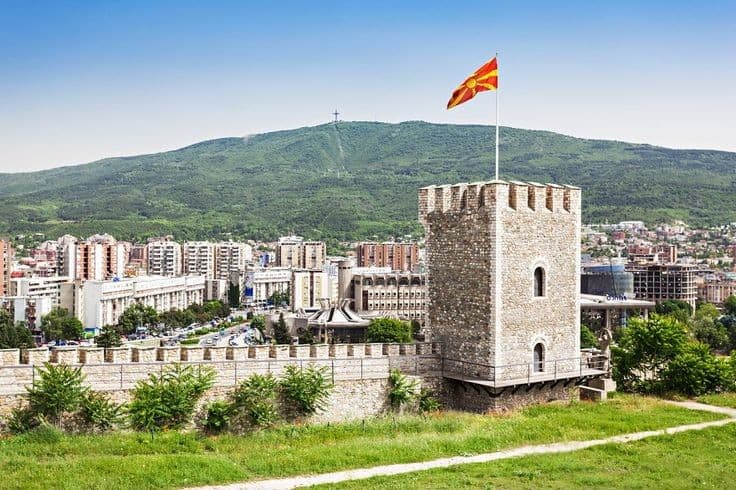
Explore Skopje Fortress (Kale Fortress) in Skopje, North Macedonia, a historic citadel offering panoramic views and millennia of history.
Overview
Perched majestically atop the highest point in Skopje, North Macedonia, the Skopje Fortress, locally known as Kale Fortress, is a silent sentinel overseeing the city and the winding Vardar River. This historic landmark is not merely a collection of ancient stones; it is the very heart and soul of Skopje, offering a tangible connection to millennia of history. Its strategic location made it a crucial defensive stronghold and a witness to the rise and fall of empires, embodying the resilience and rich cultural tapestry of the region. Today, the fortress stands as a powerful symbol, even being depicted on the coat of arms and flag of Skopje.
As you approach, the imposing walls invite you to step back in time, promising panoramic vistas and a journey through layers of civilization. The name 'Kale' itself is derived from the Turkish word for 'fortress', a testament to centuries of Ottoman influence.
History & Cultural Background
The story of Skopje Fortress begins long before any fortifications stood on its hill. Archaeological evidence reveals that this strategic site has been continuously inhabited since the Neolithic period, with findings dating back as far as the 4th millennium BC. Remains of early settlements from the Copper Age, Bronze Age, and Iron Age show a consistent human presence.
The first substantial fortress was constructed in the 6th century AD, during the reign of Byzantine Emperor Justinian I. It was strategically built using massive yellow limestone and travertine blocks, many of which were salvaged from the Roman city of Skupi, completely devastated by a powerful earthquake in 518 AD. Over subsequent centuries, the fortress underwent numerous reconstructions and modifications under various rulers. It was a significant stronghold during the First Bulgarian Empire between 992 and 1015, and later fell under Norman and then Serbian rule. A pivotal moment occurred in 1346 when Stefan Dušan was crowned Emperor at the Skopje Fortress, designating Skopje as the capital of the Serbian Empire. With the Ottoman conquest in the 14th century, the fortress continued to be a focal point, although its military significance diminished over time, serving later as barracks, warehouses, and even a prison in the 19th century. Earthquakes have repeatedly shaped its destiny, notably the catastrophic event in 1963 which severely damaged much of the structure, followed by restoration efforts that continue to this day.
What Makes It Special
The Kale Fortress offers a unique window into Skopje's enduring past, built upon layers of history. Its very construction tells a story, with materials like limestone and travertine bearing fragments of Latin inscriptions, repurposed from earlier Roman structures. The strategic positioning on a hill overlooking the Vardar River and the entire city plain provides unparalleled panoramic views, a highlight for any visitor.
What truly sets it apart is the blend of visible historical remnants and ongoing archaeological discovery. Visitors can explore segments of the ancient walls, some reaching impressive heights, and observe the twelve tall square towers that once guarded the city. The vast interior, though largely open space today, is an active archaeological site where excavations have unearthed significant finds, from prehistoric artifacts to a large stash of Byzantine coins discovered in 2010. The fortress's continuous existence as a human settlement site for over six millennia underscores its profound historical importance and its role as a bedrock of Skopje's identity.
Stories, Fun Facts & Local Details
Beyond its ancient stones, Skopje Fortress carries a wealth of stories and local charm. The very name 'Kale' is a direct link to the Ottoman era, and its dual usage as 'Skopje Fortress' and 'Kale Fortress' sometimes leads to the pleonastic 'Kale Fortress', meaning 'Fortress Fortress'. Legend suggests that the fortress was initially built with materials from the Roman city of Skupi, giving it a recycled and resilient character.
During its long history, the fortress has been a stage for significant events, such as Stefan Dušan's coronation, which elevated Skopje's status in the medieval world. In more recent times, archaeological findings have occasionally sparked cultural debates, such as the discovery of a 13th-century church foundation and subsequent plans for restoration that encountered differing community claims. This highlights the complex identity and multi-ethnic heritage of North Macedonia.
Today, the fortress serves as a popular gathering spot for locals. It's not uncommon to see wedding parties taking photos against its historic backdrop, adding a touch of modern romance to its ancient grandeur. It also occasionally hosts cultural events and medieval reenactments, breathing life back into its formidable walls.
Visitor Perspective
Visiting Skopje Fortress is an immersive journey into the city's past, and perhaps one of its greatest appeals is its accessibility. There is no admission fee, and visitors are welcome to explore its grounds at their leisure. The approach to the fortress often begins with a pleasant walk through Skopje's Old Bazaar, winding uphill towards its ancient walls.
While the terrain can be uneven and involves some climbing, the effort is amply rewarded with breathtaking views across the modern city, the Vardar River, and the surrounding mountains. You can walk along portions of the walls and climb some of the square towers, offering different vantage points. It's important to note that while rich in history, the fortress offers limited on-site interpretive signage, so bringing a guide or doing some preliminary research can greatly enhance the experience. Combining your visit with exploration of the nearby Old Bazaar and Mustafa Pasha Mosque creates a comprehensive cultural outing.
Coordinates: 21.4344, 42
View on Google Maps💬 How Travelers Describe This Place
Based on community votes
Photogenic
623Must See
363Interesting
302Beautiful
250Unique
88
Traveler Stories
Discover memorable experiences shared by travelers who have visited this place.
No traveler stories yet.
Be the first traveler to share what made this place memorable.
Things to see at Skopje Fortress



Tour
By
Spot
Discover amazing places around the world. Your journey starts here.
Explore
© 2026 TourBySpot. All rights reserved.