Shwedagon Pagoda
Yangon, Myanmar
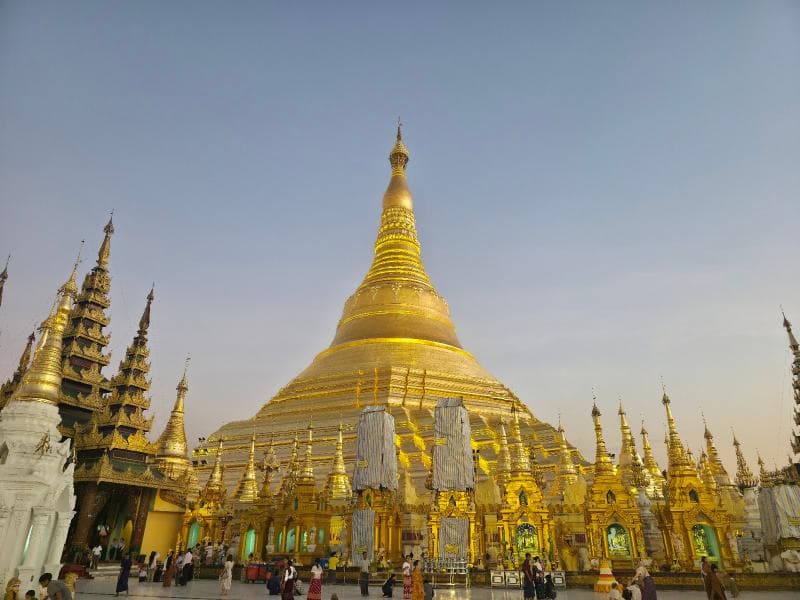
Explore Shwedagon Pagoda in Yangon, Myanmar, a golden stupa housing sacred relics. Discover its rich history, dazzling jewels, and profound cultural significance.
Overview
The Shwedagon Pagoda, an iconic golden stupa in Yangon, Myanmar, stands as the most sacred Buddhist site in the country and a profound symbol of national identity. Perched majestically atop Singuttara Hill, its gleaming spire dominates the city's skyline, visible from many vantage points. This magnificent monument is revered globally for its immense spiritual significance, primarily as it is believed to enshrine relics from four previous Buddhas.
History & Cultural Background
Legend tells that the Shwedagon Pagoda's origins trace back over 2,500 years, making it potentially the oldest stupa in the world. The narrative recounts how two merchant brothers, Tapussa and Bhallika, received eight sacred strands of Gautama Buddha's hair directly from the Buddha himself. These precious relics, along with those of three preceding Buddhas, were then enshrined at the site where the pagoda now stands.
Historically, archaeologists and scholars suggest that the construction of the Shwedagon Pagoda was initiated by the Mon people, an ethnic group from Myanmar, between the 6th and 10th centuries CE. Over the centuries, the pagoda has undergone numerous renovations and expansions by various monarchs. Notable contributions include those by King Binnya U in the 14th century and Queen Binnya Thau in the 15th century, who significantly increased its height. Following a severe earthquake in 1768, King Hsinbyushin rebuilt it to its current towering stature. The pagoda's enduring presence, despite surviving multiple natural disasters and serving as a focal point for social and political movements, underscores its deep cultural and spiritual importance to the people of Myanmar.
What Makes It Special
The Shwedagon Pagoda's unparalleled spiritual significance stems from the sacred relics it contains: the staff of Kakusandha, the water filter of Konagamana, a piece of Kassapa's robe, and, most famously, eight strands of hair from Gautama Buddha himself. Visually, its most striking feature is its resplendent golden exterior, covered in many tons of genuine gold leaf. This gold, continually donated by devotees and monarchs throughout history, symbolizes the purity of Buddhist teachings and the path to enlightenment.
At its very pinnacle, the stupa is crowned by a 'hti', a ceremonial umbrella lavishly encrusted with thousands of precious jewels, including diamonds, rubies, and sapphires. A remarkable 76-carat diamond glitters at the apex. The sheer scale of the pagoda, reaching approximately 99 meters or 112 meters in height depending on the measurement, ensures its prominence. Yangon's strict zoning regulations, which cap building heights, guarantee that the Shwedagon Pagoda remains the undisputed centerpiece of the city's skyline.
Stories, Fun Facts & Local Details
According to ancient lore, a powerful 'nat' spirit named Sularata played a pivotal role in guiding King Okkalapa to the exact spot on Singuttara Hill where the relics of the previous Buddhas were interred, thus determining the sacred location for the Shwedagon. The extraordinary value of the precious metals and gemstones adorning the pagoda is immense, with some estimates placing the worth of the gold alone at over $100 million.
Beyond its spiritual role, the Shwedagon Pagoda has historically served as a central gathering place for significant social and political events, including pro-democracy protests, highlighting its role as a unifying symbol for the nation. A testament to the enduring devotion of the Burmese people is the continuous practice of 'regilding', where worshippers donate even a single sheet of gold leaf, ensuring the pagoda's perpetual brilliance. Twice a year, coinciding with important Buddhist festivals, the Shwedagon Pagoda Festival draws countless pilgrims, transforming the grounds into an even more vibrant spiritual hub.
Visitor Perspective
The Shwedagon Pagoda welcomes visitors daily from 4 AM to 10 PM, with the final admission at 9:45 PM. To honor the sanctity of the site, visitors are expected to adhere to a modest dress code, ensuring knees and shoulders are covered. For those unprepared, traditional 'longyi' garments are often available for rent at the entrances. It is also customary and required to remove shoes before entering the sacred grounds.
Many travelers find the early morning or late evening hours to be the most rewarding times to visit. During these periods, the cooler temperatures are more comfortable for walking barefoot, and the changing light offers breathtaking views as the pagoda's golden surfaces reflect the dawn or are illuminated against the night sky. Exploring the complex provides a unique opportunity to immerse oneself in a living spiritual tradition, observing monks, families, and devotees engaged in prayer, offerings, and quiet meditation.
Coordinates: 96.14951, 16.79879
View on Google Maps💬 How Travelers Describe This Place
Based on community votes
Must See
540Photogenic
252Unique
147Beautiful
114Interesting
19
Traveler Stories
Discover memorable experiences shared by travelers who have visited this place.
No traveler stories yet.
Be the first traveler to share what made this place memorable.
Things to see at Shwedagon Pagoda



Tour
By
Spot
Discover amazing places around the world. Your journey starts here.
Explore
© 2026 TourBySpot. All rights reserved.