Sarajevo City Hall
Sarajevo, Bosnia and Herzegovina
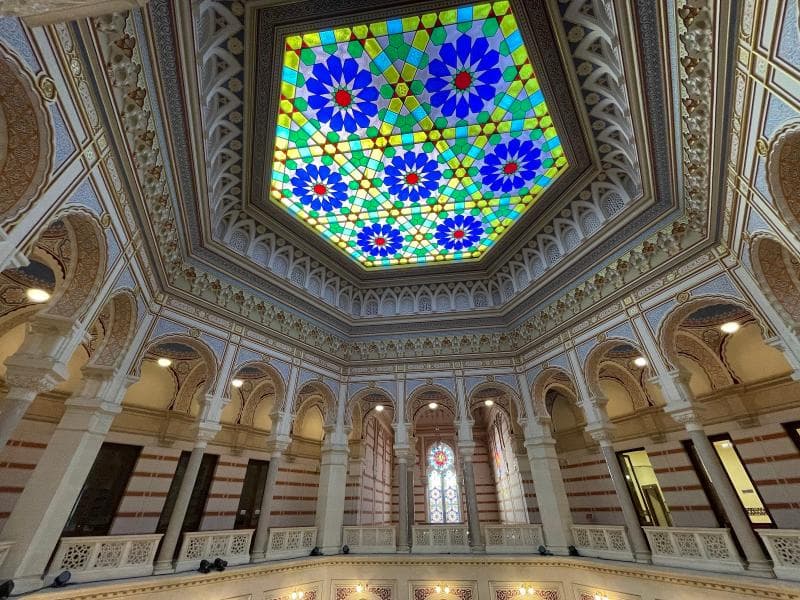
Discover Sarajevo City Hall, or Vijećnica, a stunning Pseudo-Moorish architectural gem in Sarajevo, Bosnia and Herzegovina, symbolizing resilience and rich history.
Overview
Standing majestically on the banks of the Miljacka River, Sarajevo City Hall, known locally as Vijećnica, is an architectural marvel and a profound symbol of Sarajevo's enduring spirit and rich cultural tapestry. Its striking Pseudo-Moorish design, with vibrant patterns and intricate details, immediately captures the imagination, resembling a fairytale Oriental palace amidst the Bosnian mountains. More than just a building, Vijećnica is a living testament to the city's complex history, from its Austro-Hungarian origins to its tragic destruction and phoenix-like rebirth. Today, it serves not only as a functional city hall but also as a vibrant cultural center, housing exhibitions and the National and University Library, inviting curious travelers to delve into its compelling story.
History & Cultural Background
The story of Sarajevo City Hall begins in the late 19th century, amidst the modernization efforts of the Austro-Hungarian administration. Construction commenced in 1892, with its grand opening on April 20, 1896. The initial design was conceived by Czech architect Karel Pařík, but after some revisions were requested, Alexander Wittek, who meticulously studied Mamluk-period architecture in Cairo, largely developed the project. Tragically, Wittek did not live to see its completion, and the work was finalized by Ćiril M. Iveković. The choice of the Pseudo-Moorish style was deliberate, aiming to acknowledge the region's Islamic heritage while asserting Austro-Hungarian influence, creating a distinctive blend of Eastern and Western architectural traditions.
For decades, Vijećnica served as Sarajevo's administrative heart, housing the municipal government, city council, and city court. Its place in world history was cemented on June 28, 1914, when Archduke Franz Ferdinand and his wife, Sophie, attended a reception here moments before their assassination nearby, an event that triggered World War I. After World War II, in 1949, the building's function shifted dramatically, becoming the National and University Library of Bosnia and Herzegovina, a vital repository of national heritage boasting a collection of up to two million books, rare manuscripts, and documents.
However, Vijećnica faced its darkest chapter during the Siege of Sarajevo. On the night of August 25-26, 1992, the City Hall was hit by incendiary artillery shells, resulting in a devastating fire that consumed approximately 90% of the library's priceless collection. This act of cultural devastation left the building a hollowed-out shell, a stark symbol of war's destruction.
The journey to rebirth began in 1996, with meticulous restoration efforts lasting nearly two decades. Thanks to international support and dedication, the building was painstakingly reconstructed based on original documentation and photographs, reviving every intricate detail. On May 9, 2014, Vijećnica officially reopened, on Europe Day and the Day of Victory over Fascism, symbolizing resilience and hope.
What Makes It Special
Vijećnica's allure lies in its captivating Pseudo-Moorish architecture, a harmonious fusion of styles that stands as a unique architectural statement. The exterior's ochre-and-maroon stripes and ornate arches hint at the splendor within. Inside, visitors are greeted by a breathtaking central atrium, rising under a magnificent glass roof, with arcades on three levels. The intricate white, yellow, turquoise, and brown Islamic painting, plaster decoration, and vibrant stained-glass windows create an atmosphere of unparalleled elegance.
Beyond its aesthetic beauty, Vijećnica is profoundly special for its multifaceted identity. It has been a city hall, a parliament house, and a national library, witnessing pivotal historical moments and embodying the cultural exchanges that have shaped Sarajevo. Its meticulous restoration after near-total destruction in the 1990s cemented its status as a powerful symbol of resilience, cultural memory, and the city's unwavering spirit in the face of adversity. Today, it continues to serve as a meeting point for civilizations, hosting city administration, cultural events, exhibitions, and the revitalized National and University Library.
Stories, Fun Facts & Local Details
One fascinating detail surrounding Vijećnica's construction involves its original architect, Alexander Wittek. He traveled twice to Cairo to immerse himself in Mamluk architecture, drawing inspiration for the Pseudo-Moorish design. However, the ambitious project took a toll, and Wittek reportedly suffered from mental illness, tragically taking his own life before its completion.
The building's relocation during its planning stages also led to a local legend. The original site chosen for the city hall was occupied by a man's house. When offered money to move, the stubborn owner refused until the Austro-Hungarian authorities agreed to dismantle his house brick by brick and rebuild it across the Miljacka River. This house, known as 'Inat Kuća' or 'House of Spite,' still stands today, directly opposite Vijećnica, serving as a quirky reminder of Bosnian defiance and a testament to the City Hall's significant presence in the urban landscape.
The inferno of 1992 was a catastrophic loss, consuming not just books, but centuries of written history and cultural heritage. It's estimated that between 1.2 and 2 million volumes, including rare 16th-century manuscripts and a unique collection of Bosnian serial publications, were lost forever. The painstaking restoration relied on surviving documents and old photographs, transforming a symbol of destruction into a beacon of hope and cultural preservation. The reopening on May 9, Europe Day, underscored its significance as a triumph of cultural vitality and reconciliation.
Visitor Perspective
Visiting Sarajevo City Hall offers an immersive journey through history and architecture. The building is generally open daily from 9 AM to 5 PM, with an admission fee that grants access to its stunning interiors and various exhibitions. To truly appreciate its beauty and avoid crowds, an early morning or late afternoon visit is recommended, as the natural light beautifully illuminates the facade and the grand central atrium.
Allowing one to two hours provides ample time to explore the main hall, admire the intricate details of the stained glass, carved wood, and painted ceilings, and delve into the permanent museum exhibition in the basement. This exhibition, often titled 'Sarajevo 1914-2014,' chronicles a century of the city's life and the building's restoration. Situated at the eastern edge of the historic Baščaršija district and near the iconic Latin Bridge, Vijećnica is perfectly positioned for a leisurely walk through Sarajevo's vibrant Old Town, making it an essential stop for anyone seeking to understand the soul of this remarkable city.
Coordinates: 18.4333, 43.8591
View on Google Maps💬 How Travelers Describe This Place
Based on community votes
Beautiful
1.0kPhotogenic
563Must See
309Unique
100Interesting
63
Traveler Stories
Discover memorable experiences shared by travelers who have visited this place.
No traveler stories yet.
Be the first traveler to share what made this place memorable.
Things to see at Sarajevo City Hall



Tour
By
Spot
Discover amazing places around the world. Your journey starts here.
Explore
© 2026 TourBySpot. All rights reserved.