Riverside Facade
Sarajevo, Bosnia and Herzegovina
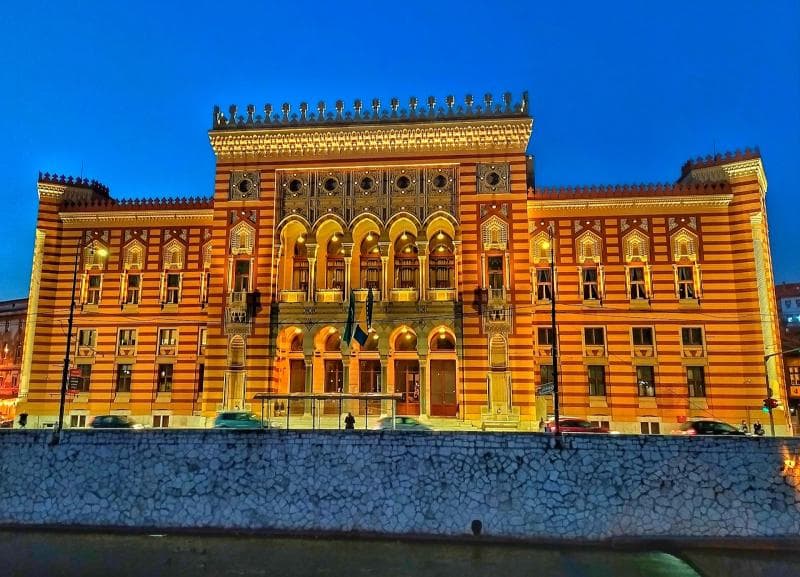
Explore the Riverside Facade of Sarajevo City Hall (Vijećnica), a stunning Neo-Moorish masterpiece in Sarajevo, Bosnia and Herzegovina, rich in history and culture.
Overview
The Riverside Facade of Sarajevo City Hall, known locally as Vijećnica, stands majestically on the banks of the Miljacka River in Sarajevo, Bosnia and Herzegovina. This architectural masterpiece, celebrated for its distinctive Neo-Moorish style, is a prominent landmark that beautifully blends Eastern and Western influences. Completed in 1896, it was designed to be the most representative building of the Austro-Hungarian period in Sarajevo. Its vibrant, striped exterior, with bold geometric patterns and pointed arches, creates a visually striking presence that captivates onlookers from the riverbanks and bridges. Today, the building serves as the city council's seat, a national library, and a museum, embodying Sarajevo's enduring spirit and cultural richness.
History & Cultural Background
The construction of Sarajevo City Hall began in 1892 and was completed in 1894, with its grand opening held on April 20, 1896. The initial design was by Czech architect Karel Pařík, but it was later taken over and significantly influenced by Alexander Wittek, who was inspired by Mamluk-period buildings in Cairo. After Wittek's illness and death, Ćiril M. Iveković completed the project. The Austro-Hungarian administration intended for the building to symbolize the city's European character while acknowledging its Ottoman heritage, leading to its unique pseudo-Moorish style. From its inception as the city hall, the building transitioned to house the National and University Library of Bosnia and Herzegovina in 1949. Tragically, during the Siege of Sarajevo in August 1992, the City Hall was heavily shelled and set ablaze, resulting in the loss of approximately two million books, manuscripts, and documents, a significant portion of Bosnia's cultural heritage. The images of the burning building became a poignant symbol of the conflict's cultural devastation. A painstaking and extensive restoration process, funded by various European countries, began in 1996 and culminated in its grand reopening in May 2014, marking the centenary of World War I.
What Makes It Special
The Riverside Facade of Sarajevo City Hall is particularly special due to its captivating Pseudo-Moorish architectural style, which features a vibrant interplay of warm colors, pointed arches, and intricate geometric patterns. This design, inspired by Islamic art and architecture, notably from Mamluk-period buildings in Cairo, allows the building to harmoniously stand out along the Miljacka River. Its strategic location on the riverbank offers stunning reflections in the water, especially during the early morning or late afternoon light, enhancing its fairytale-like appearance. The building's resilience is also a testament to its special character; having risen from the ashes of war, it stands as a symbol of rebirth and hope for Sarajevo.
Stories, Fun Facts & Local Details
One of the most famous historical connections to the City Hall involves Archduke Franz Ferdinand, who attended a reception there on June 28, 1914, shortly before his assassination near the Latin Bridge, an event that triggered World War I. Another local detail tied to the City Hall's construction is the 'Inat Kuća,' or 'House of Spite,' located directly across the river. Legend has it that an old man refused to sell his house to make way for the City Hall, so the Austro-Hungarian authorities dismantled it brick by brick and rebuilt it on the opposite bank. Today, it operates as a restaurant, defiantly facing the grand City Hall. The architectural design process itself involved three architects: Karel Pařík, Alexander Wittek, and Ćiril M. Iveković, each leaving their mark on this iconic structure. The reconstruction after the 1992 fire involved meticulous efforts to restore every detail based on surviving documentation and architectural fragments, costing millions and taking nearly two decades.
Visitor Perspective
For visitors, the Riverside Facade offers some of the most iconic photographic opportunities of Sarajevo. Standing across the Miljacka River on the south bank provides the best full-frame shot, capturing the building's striking exterior with the river as a foreground. Early morning before 11 AM, when sunlight shines directly on the facade, or late afternoon, when the sandstone glows with warm light, are ideal times for photography. Inside, the City Hall, now functioning as the seat of the Mayor and City Council, a national library, and a cultural venue, hosts various exhibitions, concerts, and events. Visitors can explore its beautifully restored interiors, admire the grand staircase, and view exhibitions detailing Sarajevo's rich and tumultuous history, including the story of its destruction and rebirth.
Coordinates: 18.4333, 43.8592
View on Google Maps💬 How Travelers Describe This Place
Based on community votes
Unique
912Beautiful
820Must See
718Interesting
479Photogenic
181
Traveler Stories
Discover memorable experiences shared by travelers who have visited this place.
No traveler stories yet.
Be the first traveler to share what made this place memorable.

Tour
By
Spot
Discover amazing places around the world. Your journey starts here.
Explore
© 2026 TourBySpot. All rights reserved.