San Agustin Church
Manila, Philippines
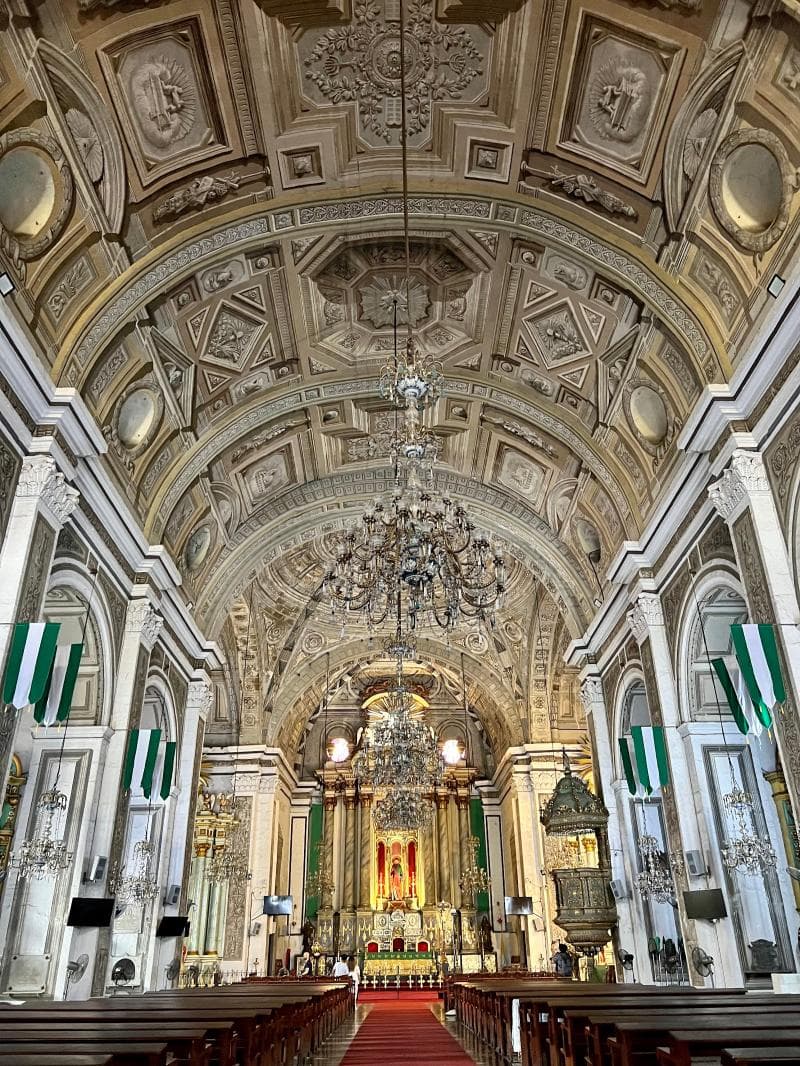
Explore San Agustin Church in Manila, Philippines – the oldest stone church, a UNESCO World Heritage Site, and a symbol of resilience.
Overview
Nestled within the historic walls of Intramuros, Manila, the San Agustin Church stands as a profound testament to the Philippines' rich colonial past and enduring spiritual legacy. Completed in 1607, it proudly holds the distinction of being the oldest stone church in the entire country. Officially known as the Archdiocesan Shrine of Our Lady of Consolation and Cincture and also serving as the Immaculate Conception Parish, this magnificent structure is more than just a place of worship; it is a living museum. Its historical and architectural significance is recognized globally, having been inscribed as a UNESCO World Heritage Site in 1993, as part of the collective 'Baroque Churches of the Philippines'. It was also declared a National Historical Landmark by the Philippine government in 1976. Adjacent to the church, the San Agustin Museum further enriches the visitor experience, housing a vast collection of religious artifacts that span centuries.
History & Cultural Background
The story of San Agustin Church is one of remarkable resilience. The current stone edifice is actually the third Augustinian church built on this very site. The first, constructed from temporary materials like nipa and bamboo in 1571, was unfortunately destroyed by fire during the Limahong invasion in 1574. A second wooden structure met a similar fate in 1583, again consumed by fire. Learning from these calamities, the Augustinian friars embarked on building a more permanent structure using stone. Construction of the present church began in 1586, following the designs of Juan Macías, and reached completion in 1607. This robust design proved crucial, as the church has famously withstood numerous major earthquakes that have devastated Manila over the centuries, including those in 1645, 1699, 1754, 1796, 1825, 1852, 1863, and 1880. It served as a hospital during the 1863 earthquake, highlighting its role beyond just a spiritual center.
The church has also borne witness to pivotal moments in Philippine history. In 1898, it was the site where Spanish Governor-General Fermin Jaudenes negotiated the terms for the surrender of Manila to the United States during the Spanish-American War. During World War II, under Japanese occupation, the church was tragically used as a concentration camp. Despite the intense Battle of Manila in 1945, which left much of Intramuros in ruins, San Agustin Church was the only one of the seven churches within the walled city to remain largely intact, a testament to its formidable construction.
What Makes It Special
San Agustin Church's enduring presence and intricate design are what truly set it apart. Its designation as a UNESCO World Heritage Site underscores its outstanding universal value. The church exemplifies the unique 'Earthquake Baroque' architectural style, characterized by robust construction designed to withstand the Philippines' seismic activity, notably its elliptical foundation. While its facade has sometimes been described as understated, the interior is a breathtaking display of artistry. The vaulted ceilings are adorned with spectacular trompe l'oeil murals, painted in 1875 by Italian artists Cesare Alberoni and Giovanni Dibella, creating an illusion of depth and grandeur.
Further enhancing its unique character are the elaborately carved wooden doors, showcasing detailed Baroque motifs, and its 14 side chapels. The choir loft is another marvel, featuring 17th-century hand-carved molave seats, a tropical hardwood known for its durability. The church also serves as the final resting place for several prominent Spanish conquistadors, including Miguel López de Legazpi, Juan de Salcedo, and Martín de Goiti, their remains interred in a communal vault near the main altar. The adjacent museum, housed in the former monastery, complements the church's narrative, offering a rich collection of colonial-era artifacts, religious vestments, and artworks.
Stories, Fun Facts & Local Details
Beyond its grand history, San Agustin Church holds many intriguing details. A fun fact is the presence of granite sculptures of lions guarding the church courtyard, believed to be gifts from early Chinese converts to Catholicism. These elements symbolize the early cultural fusion that characterized the colonial period. The Baroque pulpit, usually a focal point in itself, features an unusual and charming motif: native pineapples, a local touch incorporated into the European design. Structurally, the church is remarkable for being one of the few buildings in the Philippines to be constructed with true barrel vaulting, a complex architectural technique that speaks to the skill of its builders. The church is also home to the venerated image of Nuestra Señora de la Consolacion y Correa (Our Lady of Consolation and Cincture). This Marian image was canonically crowned in 2000 and, more recently in 2024, was declared the patroness of Intramuros, solidifying her spiritual importance to the walled city. The vast library within the adjoining monastery is said to hold ancient documents, with some volumes reportedly dating back to 1522, offering a tangible link to centuries of scholarship and religious life.
Visitor Perspective
Visiting San Agustin Church offers more than just a glimpse into history; it provides an immersive cultural experience. As an active religious center, visitors have the opportunity to attend masses and witness local Catholic traditions firsthand within its historic setting. The serene atmosphere, combined with the grandeur of the architecture, can transport one back to a bygone era. When exploring this sacred space, it is advisable to dress modestly and be mindful of any ongoing religious services to show respect. For a deeper understanding of the church's extensive history and its countless treasures, guided tours are often available. The adjacent San Agustin Museum is an absolute must-visit, offering a quiet journey through rooms filled with religious relics, colonial furniture, and priceless paintings, providing context and insight into the Christianization of the Philippines. Being located within Intramuros, the walled city itself encourages exploration on foot, making San Agustin Church a central, enriching stop in any historical tour of Manila.
Coordinates: 120.97528, 14.58889
View on Google Maps💬 How Travelers Describe This Place
Based on community votes
Beautiful
963Unique
723Photogenic
482Must See
463Interesting
274
Traveler Stories
Discover memorable experiences shared by travelers who have visited this place.
No traveler stories yet.
Be the first traveler to share what made this place memorable.
Things to see at San Agustin Church



Tour
By
Spot
Discover amazing places around the world. Your journey starts here.
Explore
© 2026 TourBySpot. All rights reserved.