Palace Of The Parliament
Bucharest, Romania
Explore the monumental Palace Of The Parliament in Bucharest, Romania. Discover its incredible history, immense scale, and unique architectural grandeur.
Overview
The Palace of the Parliament, known in Romanian as Palatul Parlamentului, stands as an imposing and unforgettable landmark in the heart of Bucharest, Romania. Originally conceived as the 'People's House' (Casa Poporului) during the communist era, it is now the seat of the Romanian Parliament, housing both the Chamber of Deputies and the Senate, alongside several museums and international conference facilities. Its monumental scale and distinctive architecture make it one of the world's most recognizable buildings. Located atop Dealul Spirii, also known as Arsenal Hill, the Palace dominates the city's skyline, offering a stark reminder of Romania's complex past and its enduring spirit.
History & Cultural Background
The story of the Palace of the Parliament is deeply intertwined with the ambition and ideology of Romania's last communist dictator, Nicolae Ceaușescu. Construction began on June 25, 1984, as the centerpiece of Ceaușescu's vast 'Project Bucharest,' an ambitious urban renewal plan intended to replicate the monumental scale seen in cities like Pyongyang. To make way for this colossal structure, approximately 7 square kilometers of Bucharest's historic center were demolished, resulting in the forced relocation of 40,000 residents and the destruction of cherished neighborhoods, including churches, synagogues, and hospitals. The project involved a team of around 700 architects, led by the then 28-year-old chief architect Anca Petrescu, and an estimated 20,000 to 100,000 workers who toiled day and night over 13 years, often under harsh conditions. The Palace was envisioned as a grand symbol of communist power and a lavish home for the Ceaușescu family, with every element meticulously designed to showcase the prestige of the Romanian state.
What Makes It Special
The Palace of the Parliament holds numerous staggering world records, making it a truly unique architectural marvel. It is widely recognized as the world's heaviest building, weighing approximately 4,098,500 tonnes, and is also considered the most expensive administrative building globally, valued at an estimated €4 billion. By floor area, it ranks as the second-largest administrative building in the world, surpassed only by the Pentagon in the United States, covering an immense 365,000 square meters. Its sheer volume is equally impressive, measuring 2,550,000 cubic meters, a figure that exceeds the volume of the Great Pyramid of Giza. The building's architectural style blends modernist Neoclassical forms with elements of socialist realism, resulting in a distinctly grand and imposing aesthetic. It boasts over 1,100 rooms, 12 stories above ground, and eight underground levels, including a nuclear bunker with 1.5-meter-thick concrete walls, designed to be impervious to radiation.
Stories, Fun Facts & Local Details
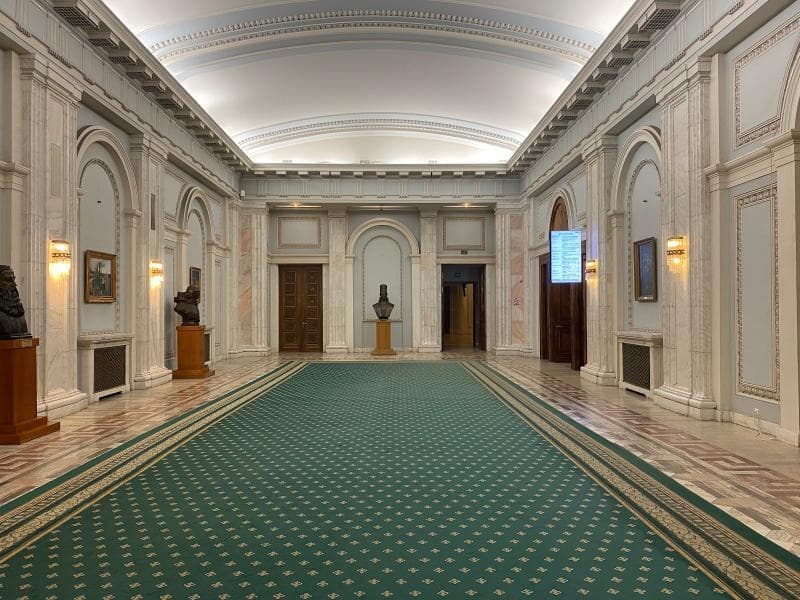
Many fascinating details surround this colossal structure. Despite its immense size and thousands of rooms, an estimated 70% of the building remains empty or unused, a testament to its original oversized ambitions. All the materials used in its construction were sourced entirely from within Romania, showcasing the country's rich natural resources and craftsmanship. This includes a million cubic meters of marble, 3,500 tonnes of crystal, 900,000 cubic meters of wood, and 220,000 square meters of carpets. The only exceptions are two mahogany doors in the Nicolae Balcescu Hall, which were a gift to Ceaușescu. Another intriguing fact is that the Palace sinks approximately 6 millimeters each year due to its colossal weight. Locally, Romanians hold conflicting opinions about the building; while many acknowledge its architectural grandeur, others view it as a painful reminder of a dictatorial regime that inflicted immense suffering and loss on the city.
Visitor Perspective
For curious travelers, visiting the Palace of the Parliament offers a profound journey into Romanian history and a chance to witness architectural grandiosity firsthand. Public access is available through guided tours, which are mandatory to explore the interior. These tours typically last between 1 to 1.5 hours and are offered in various languages, including English. Visitors are advised to book tours at least 24 hours in advance, especially for groups, as it remains an active government building and parts may be closed for official events. Tours typically cover some of the main reception halls and conference rooms, allowing visitors to marvel at the opulent decorations, vast marble expanses, and countless crystal chandeliers. Security checks, similar to airport procedures, are in place, and visitors must arrive a few minutes before their scheduled tour. The experience provides a unique opportunity to understand the scale of Ceaușescu's vision and the legacy it left on Bucharest.
Coordinates: 26.0875, 44.4275
View on Google Maps💬 How Travelers Describe This Place
Based on community votes
Photogenic
953Unique
695Beautiful
396Must See
286Interesting
22
Traveler Stories
Discover memorable experiences shared by travelers who have visited this place.
No traveler stories yet.
Be the first traveler to share what made this place memorable.
Things to see at Palace Of The Parliament



Tour
By
Spot
Discover amazing places around the world. Your journey starts here.
Explore
© 2026 TourBySpot. All rights reserved.