Conference Rooms
Bucharest, Romania
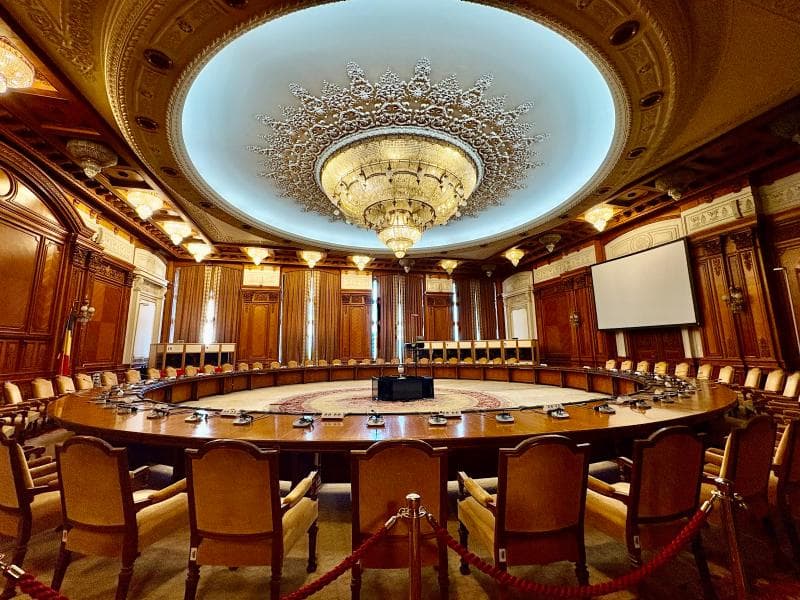
Explore the opulent conference rooms within Bucharest's Palace of the Parliament, Romania. Discover their history, grand architecture, and unique details.
Overview
Deep within the colossal structure known as the Palace of the Parliament in Bucharest, Romania, lie numerous conference rooms that are far more than just functional spaces. These rooms are integral to one of the world's largest administrative buildings, serving as vital hubs for national and international political discourse, cultural events, and diplomatic gatherings. Each conference room, while serving a practical purpose, is a testament to the immense scale and elaborate design of the entire edifice, reflecting a bygone era of grand ambition and monumental construction.
These specialized spaces contribute to the Palace's multifaceted role today, hosting Romania's Parliament, an international conference center, and several museums. Visitors venturing inside are often struck by the sheer volume and intricate detailing of these halls, which offer a tangible connection to Romania's complex history.
History & Cultural Background
The story of the Palace of the Parliament, and by extension its conference rooms, is inextricably linked to Romania's communist past and the vision of its former leader, Nicolae Ceaușescu. Construction began in 1984, part of a massive urban reconstruction project after the 1977 earthquake, conceived to showcase the nation's power and Ceaușescu's personal authority.
Originally known as the ‘House of the Republic’ and later informally as the ‘People's House,’ the building was intended to be a symbol of communist triumph. The project mobilized an astonishing workforce, including over 20,000 workers and 700 architects led by Anca Petrescu. A defining cultural aspect is that the entire structure, including the lavish interiors of the conference rooms, was built exclusively with materials sourced from Romania. This includes marble from Transylvania and Dobrogea, crystal from Mediaș, wood from the Carpathian Mountains, and hand-woven wool carpets from Moldova and Oltenia, embodying a nationalist vision.
What Makes It Special
The conference rooms within the Palace of the Parliament are characterized by their monumental proportions and opulent decorations. They blend neoclassical grandeur with socialist realist aesthetics, featuring soaring ceilings, marble columns, intricate plasterwork, and massive crystal chandeliers.
The ‘Union Hall’ (Sala Unirii), for instance, spans over 2,200 square meters, designed for large national and international gatherings, and is notable for its immense skylight. The ‘Human Rights Hall’ (Sala Drepturilor Omului) combines classical symmetry with softer decorative elements, featuring warm wooden paneling and large windows, and houses a crystal chandelier weighing 2.5 tons. The ‘Nicolae Bălcescu Hall’ is distinguished by its pink marble columns, a unique feature among the Palace's rooms, chosen for its neutral color that is not associated with any national flag. Meanwhile, the ‘Al.I. Cuza Hall’ stands out as one of the highest conference halls in the building, boasting an 18-meter ceiling.
Stories, Fun Facts & Local Details
Beyond their formal functions, these conference rooms hold fascinating anecdotes. The ‘Nicolae Titulescu Hall,’ for example, was acoustically engineered to produce a euphoric effect when audiences applauded, a design choice meant to amplify the reception for Ceaușescu during public events. This detail offers a glimpse into the psychological manipulation intended by the regime.
The scale of the Palace leads to many interesting facts: some of the chandeliers in the rooms, made from Romanian crystal, are so massive that they can weigh over a ton, with some having as many as 7,000 light bulbs. It is said that four people are needed to change a single light bulb in the enormous, five-ton chandelier of the 'Chearoseti Cupola' Hall. Many rooms and halls are named after significant Romanian historical personalities or leaders, linking the modern state functions to the nation's past figures. Despite its monumental size and over 1,000 rooms, a significant portion—reportedly around 70%—of the Palace remains unused, giving the already vast spaces an even more expansive, almost echoing, quality.
Visitor Perspective
For the curious traveler, exploring the conference rooms of the Palace of the Parliament is an immersive journey into Romania's powerful and controversial past. Guided tours typically lead visitors through a selection of the most impressive reception halls and conference spaces, offering a firsthand experience of the overwhelming grandeur. Walking through corridors stretching for kilometers and entering rooms of immense scale, one can truly appreciate the ambition and resources poured into this architectural marvel.
The experience is often described as thought-provoking, balancing the appreciation for an architectural and engineering feat with the somber understanding of the human cost and political circumstances under which it was built. Visitors are required to present a valid ID, such as a passport or national ID card, for entry, reflecting its continued function as an active government building. These rooms, though now serving a democratic purpose, retain an undeniable aura of their totalitarian origins, making a visit a unique and memorable encounter with history.
Coordinates: 26.0877, 44.4278
View on Google Maps💬 How Travelers Describe This Place
Based on community votes
Must See
872Beautiful
684Unique
363Interesting
250Photogenic
88
Traveler Stories
Discover memorable experiences shared by travelers who have visited this place.
No traveler stories yet.
Be the first traveler to share what made this place memorable.

Tour
By
Spot
Discover amazing places around the world. Your journey starts here.
Explore
© 2026 TourBySpot. All rights reserved.