Senate Hall
Bucharest, Romania
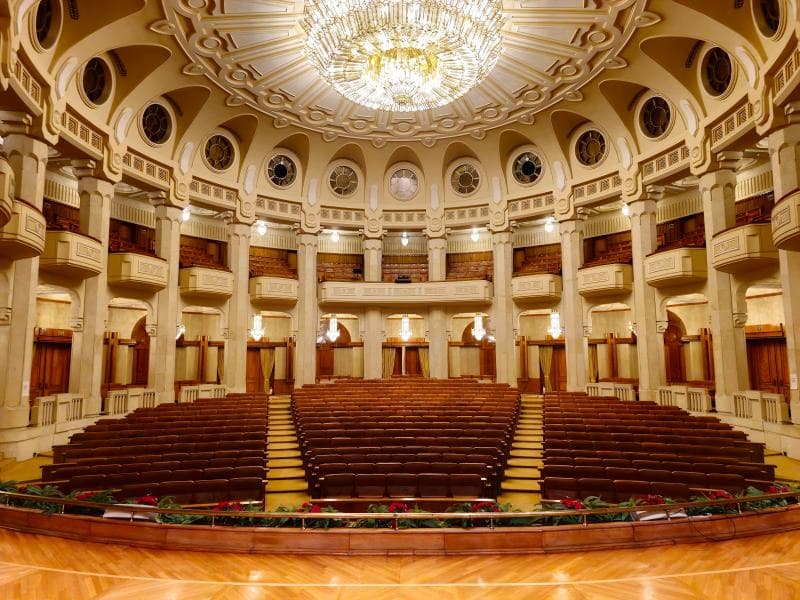
Explore Senate Hall within Bucharest, Romania's Palace of the Parliament. Discover its legislative role, grand architecture, and rich, complex history.
Overview
The Senate Hall, a distinguished sub-spot within the colossal Palace of the Parliament in Bucharest, Romania, serves as a vital chamber for the country's legislative body. This monumental structure, also known as the People's House or Casa Poporului, is not only a symbol of Romania's complex history but also an architectural marvel, recognized globally for its immense scale. The Palace of the Parliament, the world's heaviest building and the largest administrative building for civilian use after the Pentagon, houses both the Chamber of Deputies and the Senate, alongside museums and an international conference center. Since 2004, the Senate of Romania has been headquartered within this impressive edifice, making the Senate Hall a place where contemporary Romanian democracy unfolds amidst a backdrop of grandeur.
History & Cultural Background
The story of the Palace of the Parliament, and by extension its Senate Hall, is deeply intertwined with Romania's Communist era. Construction began in 1984 under the dictatorial regime of Nicolae Ceaușescu, who envisioned it as a grand demonstration of communist power and the triumph of socialism. Originally named the 'House of the Republic', and later popularly known as the 'People's House', its creation came at an immense human and material cost. A significant portion of historic Bucharest was demolished, displacing tens of thousands of people and destroying churches and cultural landmarks. Designed by a team of 700 architects led by Anca Petrescu, the building's architectural style blends neoclassical grandeur with elements of socialist realism, characterized by colossal dimensions and opulent interiors. After the Romanian Revolution in 1989 and Ceaușescu's downfall, the building's purpose shifted, evolving from a symbol of totalitarian ambition to the seat of Romania's democratic Parliament.
What Makes It Special
The Senate Hall, particularly the Senate Plenary Hall, is a key chamber within the Palace, where the legislative work of Romania's upper house unfolds. While specific internal details of every room are vast, the Hall embodies the Palace's signature grandeur. Visitors can expect to see the rich use of indigenous Romanian materials, including vast quantities of marble, different types of wood, and elaborate crystal light fixtures, all crafted by local artisans. The immense scale and opulent design, characterized by large supporting columns, elegant arches, and lavish staircases, are prevalent throughout the building's important meeting spaces, reflecting the blend of neoclassical and socialist realism architectural styles. This environment underscores the Senate's significant role in the nation's governance, set against a backdrop of historical ambition and architectural prowess.
Stories, Fun Facts & Local Details
The construction of the Palace of the Parliament involved an astonishing consumption of resources, reflecting Ceaușescu's desire for unparalleled extravagance. The building contains vast quantities of materials, including 1,000,000 cubic meters of marble, 700,000 tonnes of steel, 900,000 cubic meters of wood, and 3,500 tonnes of crystal used for light fixtures and mirrors. Some of the larger carpets were so immense that weaving machines had to be moved inside the building to produce them. A lesser-known fact is that the Palace is so massive that it reportedly sinks by 6mm each year due to its immense weight. The building also features eight underground levels, the deepest housing a nuclear bunker with 1.5-meter-thick concrete walls, designed to be impervious to radiation, connected by 20 km of tunnels to key state institutions, a testament to Ceaușescu's paranoia about nuclear war. While the Senate Hall itself doesn't have widely circulated urban legends, the Palace as a whole is rich with stories, such as Ceaușescu's alleged desire for a retractable roof in the Union Hall for helicopter landings, or the fact that portraits of him and his wife never made it to the designated empty arched spaces.
Visitor Perspective
Visiting the Palace of the Parliament offers a breathtaking encounter with history and architectural excess, and the opportunity to see the Senate Hall provides a glimpse into Romania's political heart. Guided tours are essential for exploring this vast complex, allowing visitors to navigate its expansive hallways, conference rooms, and official chambers. To ensure entry, especially for specific tours that may include the Senate Plenary Hall, it is advisable to make reservations in advance. Visitors should be prepared for security checks, similar to airport procedures, and are required to present a valid ID. The sheer scale, opulent decorations, and the rich narrative behind every corner make the experience both impressive and thought-provoking. It is a journey through a significant period of Romanian history, offering insights into the country's past and present.
Coordinates: 26.08729, 44.42753
View on Google Maps💬 How Travelers Describe This Place
Based on community votes
Photogenic
996Must See
953Beautiful
658Interesting
585Unique
69
Traveler Stories
Discover memorable experiences shared by travelers who have visited this place.
No traveler stories yet.
Be the first traveler to share what made this place memorable.

Tour
By
Spot
Discover amazing places around the world. Your journey starts here.
Explore
© 2026 TourBySpot. All rights reserved.