Union Hall
Bucharest, Romania
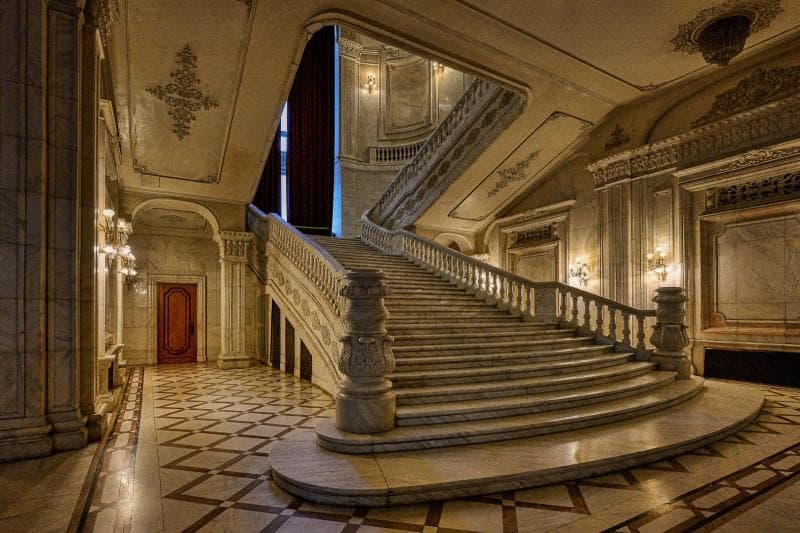
Explore Union Hall in Bucharest, Romania's Palace of the Parliament. Discover its grand architecture, historical context, and fascinating details.
Overview
Deep within the colossal structure known as the Palace of the Parliament in Bucharest, Romania, lies the magnificent Union Hall, or ‘Sala Unirii’. This particular space embodies the grandeur and ambitious vision that characterizes the entire building. As the largest hall inside the Palace, it serves as a powerful symbol of the nation's history and its intricate architectural heritage. Visitors stepping into this immense chamber are immediately struck by its scale and the meticulous craftsmanship that went into its creation, reflecting both the aspirations and the controversial past of its origins.
History & Cultural Background
The Palace of the Parliament, originally conceived as the ‘People's House’ (Casa Poporului), was the brainchild of Romania's former communist leader, Nicolae Ceaușescu. Construction began in 1984, driven by Ceaușescu's desire for a monumental administrative center that would showcase the strength and unity of socialist Romania. The project was an immense undertaking, requiring an estimated 20,000 workers and 700 architects, led by chief architect Anca Petrescu. Its construction came at a tremendous cost, both human and financial. Large sections of Bucharest's historic center were demolished, displacing tens of thousands of residents and razing churches, synagogues, and homes. Despite the devastating impact on the urban landscape and the immense economic strain on the country, Ceaușescu pushed for completion, using only materials sourced from within Romania to emphasize national pride and self-sufficiency. The building was nearly finished by the time of the 1989 Romanian Revolution, and Ceaușescu never saw its full completion. After the revolution, the Palace's future was debated, but it ultimately found a new purpose, housing the Romanian Parliament and serving as a venue for international events.
What Makes It Special
The Union Hall stands out within the Palace of the Parliament for its staggering dimensions and opulent detailing. Covering an area of over 2200 square meters, it is a testament to the grand architectural style prevalent during its construction. The hall features towering arched spaces, originally intended to frame large portraits of Nicolae and Elena Ceaușescu, which were never installed. The interiors exhibit a blend of neoclassical and socialist realist aesthetics, characterized by imposing columns, symmetrical designs, and an abundance of luxurious materials. One of its most striking features is a massive crystal chandelier, a true masterpiece weighing over 3 tons and composed of thousands of crystals. The floor is often adorned with a soft pink carpet, itself a remarkable piece, measuring 1100 square meters and weighing 3 tons. This immense carpet was so large it had to be woven directly inside the room, as it could not be transported through the building's entrances. The sheer scale of the Union Hall, like the Palace itself, aims to impress and often overwhelms visitors with its sheer magnitude and intricate, handcrafted details.
Stories, Fun Facts & Local Details
Beyond its visual splendor, the Union Hall holds intriguing stories and fascinating details. The empty arched spaces, once designated for the supreme leaders' portraits, serve as a silent reminder of the regime's fall and unfulfilled ambitions. A popular, though mythical, story suggests that the Union Hall's glass ceiling could slide open to allow Ceaușescu's helicopter to land or depart in case of emergency. While an engaging anecdote, it remains a testament to the dictator's perceived megalomania rather than an architectural fact. All materials used in the Palace, including those in the Union Hall, were domestically sourced – marble from Transylvania, crystal from local factories, wood from Moldavian forests, and wool for carpets from across the country. This commitment to national resources underscores the ideological underpinnings of the project. The meticulous craftsmanship extended to every element, with thousands of artisans employing traditional techniques, creating everything from intricate decorations to vast hand-woven carpets.
Visitor Perspective
Visiting the Union Hall within the Palace of the Parliament is an experience that elicits a complex range of emotions. Travelers often describe a sense of awe at the immense scale and luxurious finishings, simultaneously contemplating the controversial history and human cost behind its construction. It is a place that invites reflection on power, ambition, and resilience. Walking through its vast expanse, past the towering columns and beneath the glittering chandeliers, provides a unique glimpse into a significant chapter of Romania's past. The sheer architectural grandeur, coupled with the historical narrative, makes it a profoundly thought-provoking destination for any curious traveler seeking to understand Bucharest's unique heritage.
Coordinates: 26.0875, 44.4275
View on Google Maps💬 How Travelers Describe This Place
Based on community votes
Must See
684Beautiful
363Photogenic
302Unique
250Interesting
88
Traveler Stories
Discover memorable experiences shared by travelers who have visited this place.
No traveler stories yet.
Be the first traveler to share what made this place memorable.

Tour
By
Spot
Discover amazing places around the world. Your journey starts here.
Explore
© 2026 TourBySpot. All rights reserved.