Balcony Viewpoint
Bucharest, Romania
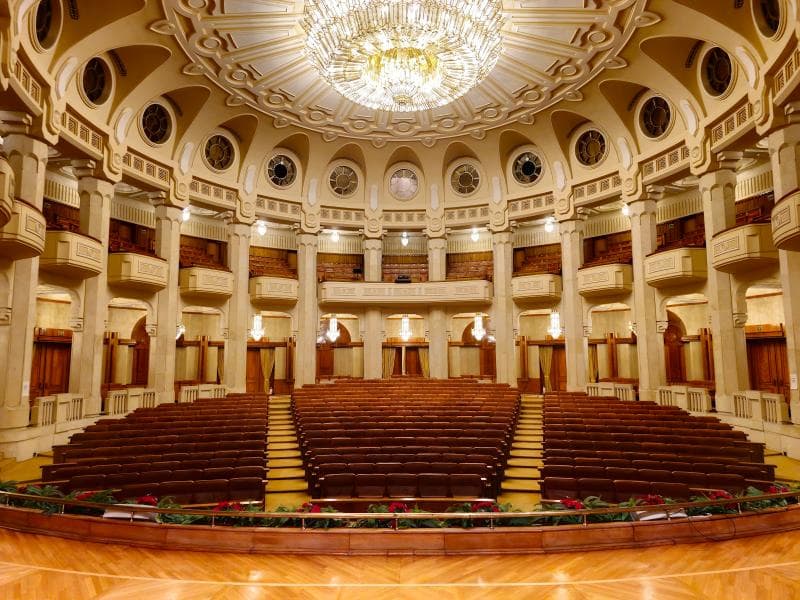
Discover the Balcony Viewpoint at the Palace of the Parliament in Bucharest, Romania, offering stunning panoramas of the city and its monumental history.
Overview
Perched majestically within the colossal Palace of the Parliament in Bucharest, Romania, the Balcony Viewpoint offers an unparalleled perspective of the city's grand, yet complex, urban landscape. While not a distinct, officially named attraction, it refers to the specific outdoor vantage point included in most guided tours of the Palace. From this elevated position, visitors are treated to sweeping vistas of Bulevardul Unirii (Union Boulevard) and Constitution Square, revealing the imposing scale of Nicolae Ceaușescu's vision for Romania's capital. It is a moment of pause during the extensive palace tour, allowing contemplation of the vastness of the structure and the ambition behind its creation.
The Palace itself, originally known as the Casa Poporului or 'People's House', stands as the world's heaviest building and the second-largest administrative building, a testament to its monumental proportions. The Balcony Viewpoint encapsulates the essence of this landmark, providing a tangible connection to its history and the city it overlooks.
History & Cultural Background
The Palace of the Parliament, and consequently its viewpoints, cannot be understood without delving into its controversial genesis. Construction began in 1984 under the authoritarian regime of Nicolae Ceaușescu, inspired by his visits to North Korea and his desire to transform Bucharest into a showcase of communist power. The project was an immense undertaking, requiring the demolition of a significant portion of Bucharest's historic urban fabric, displacing over 40,000 people and razing churches, synagogues, and other cultural landmarks. More than 20,000 workers and 700 architects, led by Anca Petrescu, contributed to its construction, which continued even as the country faced severe economic hardship and rationing.
Built almost entirely from Romanian materials, including marble, crystal, and wood, the palace was intended to be a symbol of national achievement and Ceaușescu's personal legacy. Its opulence and staggering scale, however, stood in stark contrast to the daily struggles of the Romanian people. Although largely completed by the time of the 1989 revolution, Ceaușescu himself never had the chance to fully inhabit or formally address the public from this very balcony. Today, it serves as the seat of the Romanian Parliament and houses several museums and conference facilities, continuously welcoming visitors from around the world.
What Makes It Special
What truly makes the Balcony Viewpoint special is the sheer, overwhelming perspective it offers. Stepping out onto this terrace, one grasps the full magnitude of Ceaușescu's urban planning ambitions. The view directly down the wide, symmetrical Bulevardul Unirii, flanked by uniform apartment blocks, was designed to create an impressive, almost cinematic, approach to the 'People's House'. It is a panoramic vista that visually explains the dictator's megalomania, providing an unobstructed gaze across a part of Bucharest meticulously reshaped to fit his vision.
Beyond the boulevard, the viewpoint offers glimpses of Constitution Square and other parts of the city center, providing a dynamic backdrop for understanding Bucharest's layered history. It's not just a beautiful view; it's a powerful historical statement, allowing visitors to stand in a place that embodies a pivotal, and often painful, era in Romania's past. The architectural dominance of the Palace itself is also never far from mind, reminding one of its status as one of the world's largest and heaviest buildings.
Stories, Fun Facts & Local Details
One common misconception often clarified by guides at the Balcony Viewpoint relates to a famous historical event. Many visitors mistakenly believe this is the balcony from which Nicolae Ceaușescu gave his last public speech before his downfall. However, that iconic moment actually occurred at the former Central Committee building in what is now Revolution Square.
Despite this, the balcony here offers a profound symbolic experience, allowing one to imagine the vast scale of the former dictator's ambitions. It's a striking reminder that the building, though immense, was largely unfinished by the time of the revolution, and Ceaușescu never truly got to enjoy his grand creation. The Palace contains an astonishing 2,800 chandeliers, with some weighing over a ton, and was constructed with approximately one million cubic meters of marble. Its sheer weight, estimated at 4.1 million tons, is so immense that the building is said to be gradually sinking.
Visitor Perspective
A visit to the Balcony Viewpoint is often cited as a highlight of the Palace of the Parliament tour. After traversing endless opulent halls and grand staircases, the outdoor air and expansive panorama provide a welcome change of pace. Visitors describe feeling a sense of awe at the sheer scale of the building and the organized layout of the boulevard below. It's a moment for reflection on the historical context of the site, prompting thoughts about the immense human and material cost of its construction.
From this vantage point, the city unfolds, showcasing a unique blend of historical complexity and modern life. While the grandeur is undeniable, the viewpoint also subtly communicates the heavy legacy of the communist era. It is a place that evokes mixed emotions, combining admiration for architectural ambition with a somber understanding of the political circumstances that brought it into being. Capturing photos from here is a must, as it provides the clearest, most encompassing shot of the Palace's exterior design and its direct relationship with Ceaușescu's vision for Bucharest.
Coordinates: 26.0875, 44.4275
View on Google Maps💬 How Travelers Describe This Place
Based on community votes
Beautiful
996Interesting
673Must See
585Unique
143Photogenic
80
Traveler Stories
Discover memorable experiences shared by travelers who have visited this place.
No traveler stories yet.
Be the first traveler to share what made this place memorable.

Tour
By
Spot
Discover amazing places around the world. Your journey starts here.
Explore
© 2026 TourBySpot. All rights reserved.