Imperial Mosque
Pristina, Kosovo
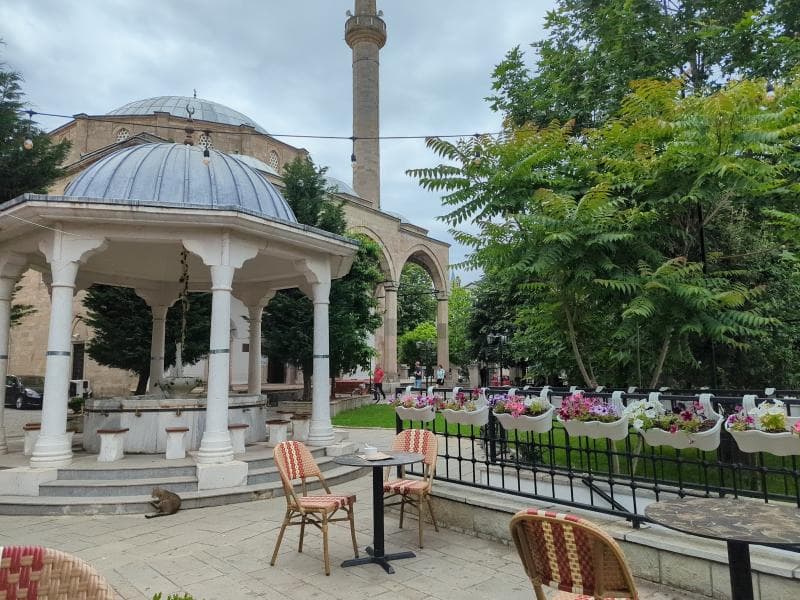
Explore Pristina's historic Imperial Mosque, a 15th-century Ottoman masterpiece built by Sultan Mehmed the Conqueror in Kosovo. Discover its rich history, stunning architecture, and cultural significance.
Overview
The Imperial Mosque, often referred to as the King's Mosque or Sultan Mehmet Fatih Mosque, stands as a magnificent testament to Ottoman architecture and a cornerstone of Pristina's rich cultural heritage in Kosovo. Built in 1461 by Sultan Mehmed the Conqueror, this historic edifice has commanded the city's landscape for centuries, embodying a blend of deep historical roots and ongoing spiritual significance. Its prominent location in the old city, near other historical landmarks such as the Great Hamam and the Clock Tower, makes it a central point of interest for anyone seeking to understand Pristina's past and present.
Recognized as one of the most important buildings of Islamic architecture in Eastern Europe, the mosque showcases classical Ottoman design, characterized by its impressive central dome, a graceful, slender minaret, and a welcoming representative porch. Beyond its architectural grandeur, the Imperial Mosque is a living monument, serving as an active place of worship and a hub for community life, reflecting centuries of tradition and resilience.
History & Cultural Background
The construction of the Imperial Mosque in 1461 was a pivotal moment in Pristina's development under Ottoman rule, commissioned by Sultan Mehmed II, known as Fatih or 'the Conqueror', just eight years after his conquest of Constantinople. An inscription in Arabic at the entry portal precisely dates its completion to the Gregorian year 1461 (Hijra 865). The mosque's placement was strategic, anchoring the city's center and becoming a nucleus around which streets, markets, and educational institutions radiated, shaping Pristina into an urban Muslim core. It functioned not merely as a place of prayer but also as a legal space, a social hub for charity, and an educational node tied to madrasas, profoundly embedding Islamic life into the city's fabric.
Over its long history, the mosque has witnessed significant events and undergone several transformations. During the Austro-Turkish wars in the late 17th century, it was temporarily converted into a Catholic church, and the prominent Albanian writer Pjetër Bogdani was even buried within its walls before his remains were exhumed after the Ottomans regained control. The mosque has also endured natural disasters, notably an earthquake in 1955, necessitating restoration efforts. Significant conservation work took place between 1682-1683 during the reign of Sultan Mehmed IV and again following the 1955 earthquake, with further restoration studies initiated in 2004. Its historical and cultural value led to its declaration as a Monument of Culture of Exceptional Importance in 1990, and it was placed under state protection as early as 1953.
What Makes It Special
The Imperial Mosque distinguishes itself through its classic Ottoman architectural style and its enduring historical significance as one of the oldest and most important Islamic monuments in Kosovo and Eastern Europe. Constructed primarily from carved yellow sandstone, its robust structure features a magnificent central dome, measuring approximately 13.5 to 14 meters in diameter, which was once among the largest domes of 15th-century buildings in the region. A tall, slender minaret, reaching about 17 meters in height with 120 steps, gracefully punctuates the city's skyline.
The interior of the mosque is a captivating display of artistry, adorned with intricate decorative paintings, geometric patterns, and plant motifs rendered in the al Seko technique. Visitors can admire a finely crafted wooden pew and a marble mihrab and minbar, elements that reflect the exquisite craftsmanship of its era. With 37 windows, the prayer hall is bathed in natural light, creating an atmosphere of serenity. These architectural and decorative elements ensure that the building retains all the features of its construction time, making it a unique example of its kind.
Stories, Fun Facts & Local Details
One fascinating aspect of the Imperial Mosque's history is its temporary conversion into a Catholic church during the Austro-Turkish wars. This period saw the esteemed Albanian writer Pjetër Bogdani buried within its confines, only for his remains to be controversially exhumed by Ottoman soldiers after their reconquest in 1690. This tumultuous episode highlights the mosque's role as a silent witness to centuries of geopolitical shifts in the Balkans.
The mosque's architecture also holds intriguing details. The single, grand dome was a remarkable feat of engineering for its time, and its minaret, a reconstructed version after the original was damaged by an earthquake, stands as a beacon. Locals sometimes refer to it as 'Xhamia e Mbretit' (King's Mosque), reflecting its royal patronage and central importance. Adjacent to the mosque, the Great Hamam, an Ottoman bathhouse, was built slightly later, and local legend suggests Sultan Mehmed II was so insistent on hygiene that he required builders to perform ablutions twice daily there to ensure the purity of their work. This connection underscores the integrated nature of Ottoman urban planning, where mosques, bathhouses, and markets formed coherent cultural complexes.
Visitor Perspective
Visiting the Imperial Mosque offers a unique opportunity to step back in time and immerse oneself in Pristina's rich Ottoman heritage. As an active place of worship, visitors are encouraged to observe modest dress and are welcome to explore the mosque outside of prayer times. The serene atmosphere within the prayer hall, with its elegant calligraphy and delicate motifs, provides a tranquil contrast to the bustling city outside.
Outside, the adjacent courtyard offers a peaceful space for reflection and photography, especially when bathed in daylight, which highlights the ancient stonework. Many travelers find that a visit to the Imperial Mosque pairs perfectly with exploring nearby historical sites, such as the Great Hamam and the historic Clock Tower, allowing for a comprehensive understanding of Pristina's historical core. The experience provides not just architectural appreciation but also a meaningful connection to the spiritual and cultural heart of Kosovo.
Coordinates: 21.16701, 42.666986
View on Google Maps💬 How Travelers Describe This Place
Based on community votes
Must See
722Interesting
595Unique
358Photogenic
196Beautiful
19
Traveler Stories
Discover memorable experiences shared by travelers who have visited this place.
No traveler stories yet.
Be the first traveler to share what made this place memorable.
Things to see at Imperial Mosque



Tour
By
Spot
Discover amazing places around the world. Your journey starts here.
Explore
© 2026 TourBySpot. All rights reserved.