Hanoi Opera House
Hanoi, Vietnam
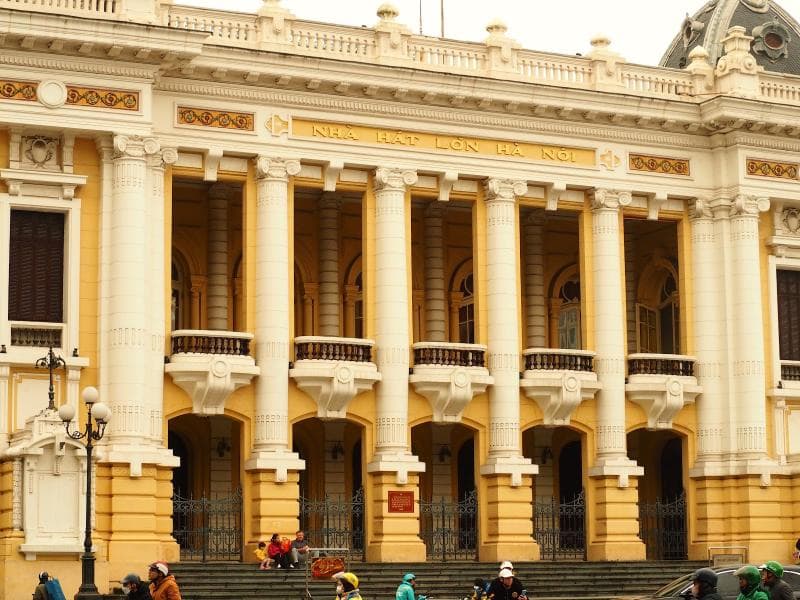
Explore the Hanoi Opera House, a stunning French colonial masterpiece in Hanoi, Vietnam, a cultural and historical landmark hosting diverse arts.
Overview
The Hanoi Opera House, known locally as Nhà hát Lớn Hà Nội, stands as a magnificent cultural landmark in the heart of Vietnam's capital city. Completed in 1911, this architectural jewel was built by the French colonial administration and draws significant inspiration from the Palais Garnier, Paris's older opera house. Located prominently at 1 Trang Tien Street in the Hoan Kiem District, its distinctive yellow facade is easily recognizable and makes it a focal point for both history enthusiasts and art lovers. The Opera House is not merely a stunning edifice; it is a vibrant center for performing arts, hosting a rich array of cultural events and serving as a historical witness to many pivotal moments in Vietnamese history.
History & Cultural Background
The story of the Hanoi Opera House began in 1901 when its construction commenced under the direction of French architects Broyer, V. Harley, and later François Lagisquet. The French colonial government envisioned it as a sophisticated cultural hub, primarily catering to the European elite and the Vietnamese upper-class. An intriguing detail from its construction is that the foundation was laid on what was once a large pond, requiring an estimated 30,000 hard bamboo stakes to secure the ground before building began.
During the colonial era, the Opera House was a symbol of French influence, showcasing European performing arts and culture. However, its role dramatically transformed following Vietnam's independence. On August 19, 1945, the square in front of the Opera House became the site of a momentous mass meeting, which ignited the August Revolution and marked a turning point in Vietnam's struggle for self-determination. Subsequently, it hosted the first session of the National Assembly of the Democratic Republic of Vietnam in 1946, and President Ho Chi Minh himself addressed the public from its grounds. These events cemented its place as a significant site of Vietnamese national heritage. The building underwent a substantial renovation between 1995 and 1997 to restore its grandeur and upgrade its facilities, and in 2011, it was officially recognized as a National Relic on its 100th birthday.
What Makes It Special
The Hanoi Opera House is celebrated for its exquisite French Neoclassical architectural style, which subtly integrates elements of Roman Ionic, Baroque, and even Art Nouveau. Its exterior is characterized by grand Ionic columns, intricate balconies, and decorative friezes that contribute to its symmetrical and imposing appearance. The interior is equally impressive, featuring a sweeping T-shaped white marble staircase, dazzling crystal chandeliers, large wall mirrors, and elegant Corinthian columns. Some connoisseurs even suggest that its interior aesthetic surpasses that of its Parisian counterpart, the Palais Garnier. The entire structure spans an area of approximately 2600 square meters and reaches a height of 34 meters.
Beyond its architectural beauty, the Opera House remains a vital cultural artery for Hanoi. It actively hosts a diverse calendar of performances, ranging from Western classical opera, ballet, and symphony concerts to traditional Vietnamese music and dance. This blend of international and local artistry reinforces its role as a premier venue and a symbol of Hanoi's rich and evolving cultural heritage.
Stories, Fun Facts & Local Details
- A notable engineering feat during its construction was building the foundation on a former pond, requiring the strategic placement of around 30,000 hard bamboo stakes to stabilize the ground.
- The August Revolution's pivotal mass meeting in 1945 took place right in front of the Opera House, transforming it into a site of immense political and national significance.
- On its centenary in 2011, the Hanoi Opera House was officially designated a National Relic, recognizing its profound historical and cultural value.
- The building's distinctive yellow facade is a characteristic feature seen in many colonial-era buildings throughout the region, reflecting a specific architectural aesthetic of the period.
Visitor Perspective
The Hanoi Opera House is conveniently located at 1 Trang Tien Street, Hoan Kiem District, making it easily accessible for visitors. It's just a short walk, approximately 500 to 700 meters, from the iconic Hoan Kiem Lake, and also within comfortable walking distance of Hanoi's historic Old Quarter.
Travelers interested in exploring its interiors can opt for guided architectural tours, which typically offer access to the grand foyer, the ornate Mirror Room, and the main auditorium. These tours provide a deep dive into the building's history and design. For those seeking a richer experience, attending a performance is highly recommended, with a diverse schedule including classical concerts, opera, ballet, and traditional Vietnamese artistic displays.
Ticket prices vary depending on the experience; a guided architectural tour typically costs around 120,000 VND. Performance tickets range in price based on the event and seating choice. It is advisable to check schedules and book tickets in advance, especially for popular shows. Visitors attending evening performances are encouraged to wear smart casual attire to respect the venue's elegant atmosphere.
Coordinates: 105.85783, 21.02419
View on Google Maps💬 How Travelers Describe This Place
Based on community votes
Photogenic
446Unique
152Interesting
33Must See
30Beautiful
16
Traveler Stories
Discover memorable experiences shared by travelers who have visited this place.
No traveler stories yet.
Be the first traveler to share what made this place memorable.
Things to see at Hanoi Opera House



Tour
By
Spot
Discover amazing places around the world. Your journey starts here.
Explore
© 2026 TourBySpot. All rights reserved.