Exhibition Hall
Hanoi, Vietnam
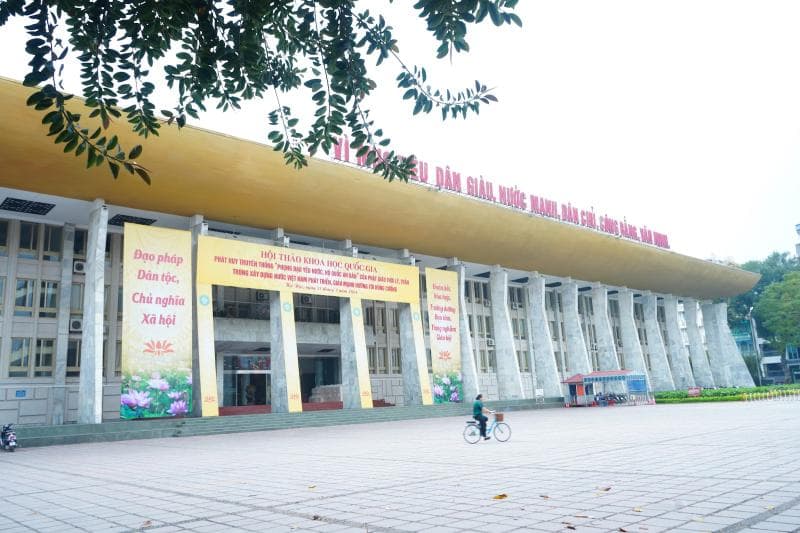
Explore the Hanoi Opera House's Exhibition Hall in Hanoi, Vietnam, a cultural gem showcasing French colonial architecture and Vietnamese history.
Overview
The Hanoi Opera House, known locally as Nhà hát Lớn Hà Nội, stands as a majestic and enduring symbol of French colonial architecture and Vietnamese cultural resilience in the heart of Hanoi, Vietnam. Completed in 1911, this opulent structure is a miniature replica of the Palais Garnier in Paris, serving historically as a grand venue for European performing arts and evolving into a pivotal site for Vietnamese national events. Today, it remains a distinguished landmark, drawing visitors with its rich history and architectural splendor, even as it undergoes significant restoration.
While not possessing a formally named 'Exhibition Hall' in the traditional sense, the public areas of the Opera House, particularly its grand foyer and other elegant spaces, effectively function as a continuous exhibition of its storied past and intricate design during guided tours. These tours offer a unique opportunity to immerse oneself in the building's historical and cultural narrative.
History & Cultural Background
The story of the Hanoi Opera House began in 1901 when the French colonial administration commenced its construction, driven by a desire to establish a cultural hub reflecting French prestige in Indochina. Designed by architects Broyer and V. Harley, with later refinements by Francois Lagisquet, the building took a decade to complete.
Initially, it catered almost exclusively to the European elite and upper-class Vietnamese, hosting opera, ballet, and classical concerts. However, its role dramatically shifted following Vietnam's independence. It transformed from a symbol of colonial power to a powerful emblem of national pride and self-determination. The Opera House became the stage for momentous political gatherings, notably hosting a mass meeting during the August Revolution in 1945 and the first session of the National Assembly of the Democratic Republic of Vietnam in 1946. This evolution underscores its deep historical significance, woven into the fabric of Vietnam's modern history.
What Makes It Special
What truly sets the Hanoi Opera House apart is its breathtaking architectural design, a harmonious blend of French Neoclassical and Beaux-Arts styles with subtle Gothic elements. The facade, characterized by grand Ionic columns, ornate balconies, and decorative friezes, is instantly recognizable.
Inside, visitors are greeted by lavish interiors that echo the grandeur of its Parisian inspiration. The grand foyer, with its sweeping T-shaped marble staircase and classical chandeliers, is a testament to meticulous craftsmanship. The Mirror Room (Salon de Miroirs) and the main auditorium, often adorned with red velvet, gold details, and ceiling murals, offer a glimpse into the opulent artistic preferences of the early 20th century. These spaces, rather than a dedicated 'Exhibition Hall,' serve as living exhibits of historical architecture and design, telling the story of an era through their very structure and decoration.
Stories, Fun Facts & Local Details
Beyond its grand appearance, the Hanoi Opera House holds many captivating stories. A lesser-known fact is that the entire structure was built on reclaimed marshland, necessitating the use of thousands of bamboo stakes for its foundation.
One of the most poignant stories dates back to the August Revolution in 1945, when the square in front of the Opera House was a pivotal gathering point for the Viet Minh, marking a crucial turning point in Vietnam's fight for independence. The red flag with a gold star was famously hoisted on its second-floor balcony.
The Opera House has undergone significant renovations, particularly in the mid-1990s, to preserve its architectural integrity and update its facilities. Today, it hosts a diverse array of performances, from traditional Vietnamese arts and Western classical concerts to contemporary dance and ballet, solidifying its role as a vibrant cultural center.
Visitor Perspective
As of January 2026, the Hanoi Opera House is temporarily closed for a comprehensive two-year restoration, with an anticipated reopening around 2028. This means that internal tours and access to its exhibition areas are currently suspended.
However, visitors can still admire the magnificent exterior and August Revolution Square, which remain freely accessible and provide excellent photographic opportunities at any hour. When the Opera House reopens, guided architectural tours typically include the grand foyer, Mirror Room, and auditorium, offering insights into its history and design. These tours often cost around 120,000 VND. Attending a performance, with tickets ranging from 300,000 VND to over 1,500,000 VND, is highly recommended for a full appreciation of this iconic landmark. It is advisable to check the official website for the latest updates on reopening schedules and tour availability.
Coordinates: 105.85783, 21.02419
View on Google Maps💬 How Travelers Describe This Place
Based on community votes
Beautiful
847Must See
685Unique
513Interesting
482Photogenic
62
Traveler Stories
Discover memorable experiences shared by travelers who have visited this place.
No traveler stories yet.
Be the first traveler to share what made this place memorable.

Tour
By
Spot
Discover amazing places around the world. Your journey starts here.
Explore
© 2026 TourBySpot. All rights reserved.