Historic Facade
Hanoi, Vietnam
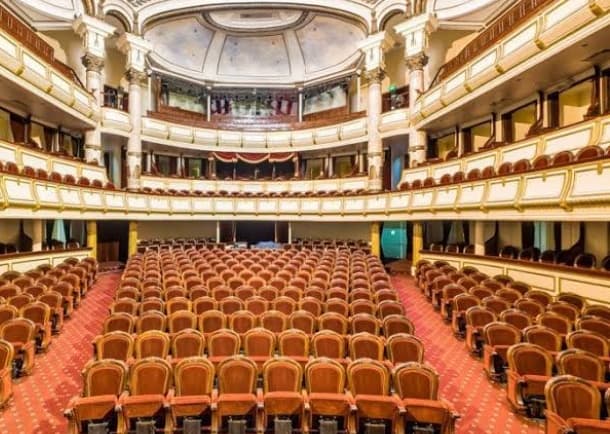
Explore the Historic Facade of Hanoi Opera House in Hanoi, Vietnam, an iconic French colonial masterpiece reflecting rich history and architectural grandeur.
Overview
The Historic Facade of the Hanoi Opera House, known locally as Nhà hát Lớn Hà Nội, stands as a magnificent testament to French colonial architecture nestled in the heart of Hanoi, Vietnam. This iconic landmark, inspired by the opulent Palais Garnier in Paris, presents a striking yellow-and-white exterior that immediately captures the eye. It is characterized by its grand scale, symmetrical design, and intricate details, making it one of the most photographed buildings in the city and a central symbol of Hanoi's rich cultural and architectural heritage. The facade offers a captivating first impression, hinting at the grandeur and history contained within its walls.
History & Cultural Background
The story of the Hanoi Opera House's facade begins with French colonial ambition at the turn of the 20th century. Construction commenced on June 7, 1901, and the building was officially completed in 1911, taking a decade to rise from what was once marshland. French architects Harlay and Broyer were the original designers, with later refinements by Francois Lagisquet, and the construction was overseen by Travary and Savelon. Initially, the opera house served as an exclusive cultural hub for European officials and the elite, a venue where Western arts like opera, ballet, and classical concerts were introduced to Vietnam, symbolizing French power and influence.
However, its significance dramatically transformed with Vietnam's journey to independence. After 1945, the Opera House became a pivotal stage for national events, hosting the first National Assembly session and major revolutionary meetings, thereby embodying Vietnam's new chapter of self-determination. It shifted from a colonial symbol to one of national pride. In the 1990s, recognizing its deteriorating condition after 80 years, the Vietnamese government undertook extensive restoration efforts, led by French-Vietnamese architect Ho Thieu Tri, to preserve its architectural beauty and upgrade its facilities, ensuring its legacy continues.
What Makes It Special
The Historic Facade of the Hanoi Opera House is a unique blend of architectural styles, primarily French neoclassical and Beaux-Arts, with discernible elements of Roman Ionic, Baroque, and even Gothic accents. Its imposing exterior features rows of Roman Ionic columns, which lend it a classical elegance. Visitors will notice the distinctive shuttered windows, characteristic of 19th-century French architecture, complemented by ornate balconies. Many of these balconies are made of wrought iron and exhibit graceful curved forms, showcasing Baroque influences. Tiled friezes and intricate decorative details further enrich the facade, giving it a luxurious and sophisticated appearance.
The building's signature yellow facade is a common color found in French colonial architecture in the region, making it instantly recognizable and a harmonious part of Hanoi's historic cityscape. The roof, covered with black stone tiles, is organized in a way that contributes to its French neoclassical spirit. While drawing inspiration from the Palais Garnier, the Hanoi Opera House was designed to adapt to Vietnam's climate and available materials, resulting in a structure that, according to some foreign architects, avoids superfluous details, making it even more magnificent and attractive in its own right.
Stories, Fun Facts & Local Details
Beyond its architectural splendor, the facade holds profound historical tales. A significant moment in Vietnam's history unfolded right before its grand entrance: during the August Revolution in 1945, a red flag with a gold star was dramatically installed on its second-floor balcony, marking a pivotal meeting for the establishment of the National Liberation Front (Viet Minh). This transformation from a colonial edifice to a stage for revolution adds a layer of emotional resonance to its stone and stucco.
The Opera House's strategic location at a busy downtown intersection, where five main roads converge, has made its facade a constant backdrop for daily Hanoian life. It has long been a favorite spot for locals and tourists alike to capture photographs, becoming an unwitting participant in countless personal histories. Its presence served as a cultural bridge, introducing Western artistic forms while later embracing and promoting Vietnamese performing arts, evolving into a venue that reflects the country's vibrant artistic present.
Visitor Perspective
For any traveler exploring Hanoi, approaching the Historic Facade of the Hanoi Opera House is an immersive experience. The sheer scale and intricate details of its exterior immediately transport one to another era. It stands proudly, almost like a living monument, at the end of Trang Tien Street, beckoning visitors to explore the surrounding French Quarter. Simply walking around the building, observing its Roman Ionic columns, ornate balconies, and the distinctive yellow hue, provides a deep appreciation for its architectural artistry.
Even when the interior might not be accessible for tours or performances, the facade itself offers an enriching journey into Hanoi's history and architectural legacy. It's a place where history whispers through its ornate carvings and where the echoes of past events can almost be felt. The exterior is consistently accessible and highly photogenic, making it a must-see landmark for anyone keen to connect with the grandeur of Hanoi's past and present, offering an unforgettable visual spectacle day or night.
Coordinates: 105.8547, 21.0212
View on Google Maps💬 How Travelers Describe This Place
Based on community votes
Unique
980Must See
712Beautiful
288Photogenic
247Interesting
130
Traveler Stories
Discover memorable experiences shared by travelers who have visited this place.
No traveler stories yet.
Be the first traveler to share what made this place memorable.

Tour
By
Spot
Discover amazing places around the world. Your journey starts here.
Explore
© 2026 TourBySpot. All rights reserved.