Church Of Saints Simon And Helena
Minsk, Belarus
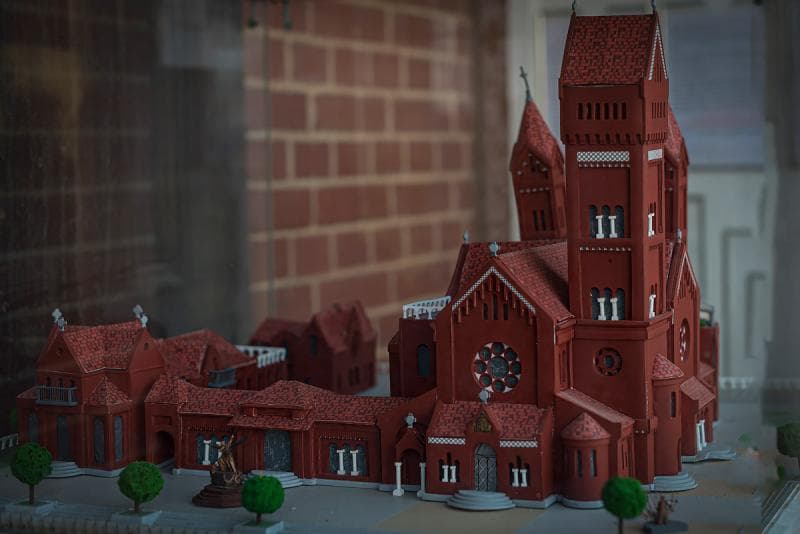
Discover the iconic Red Church (Church of Saints Simon and Helena) in Minsk, Belarus. Explore its unique red brick architecture, poignant history, and cultural significance.
Overview
Dominating Independence Square in Minsk, Belarus, stands the striking Church of Saints Simon and Helena, affectionately known to locals and visitors alike as the 'Red Church'. This Roman Catholic edifice, with its distinctive red brick and prominent towers, is more than just a place of worship; it is a profound architectural and historical landmark, a testament to enduring faith and personal tragedy. Its unique appearance, blending elements of Neo-Romanesque and Neo-Gothic styles, creates a stark yet beautiful contrast with the surrounding urban landscape of the Belarusian capital.
Completed in the early 20th century, the church has witnessed over a century of significant historical upheaval, from its inception as a private memorial to its transformation into a secular establishment during the Soviet era, and its eventual return to the Catholic community. Today, it remains a focal point in Minsk, drawing attention not only for its architectural grandeur but also for the poignant story embedded within its very foundations.
History & Cultural Background
The story of the Church of Saints Simon and Helena is deeply intertwined with the personal sorrow and philanthropic spirit of Edward Woyniłłowicz, a prominent Belarusian-Polish landowner and civic activist. He financed the church's construction between 1905 and 1910, dedicating it to the memory of his two young children, Szymon (Simon) and Helena, who passed away prematurely. Szymon died at the age of 12, and Helena at 19, leaving Woyniłłowicz grief-stricken and determined to perpetuate their memory.
Designed by Polish architects Tomasz Pajzderski and Władysław Marconi, the church was consecrated on September 20, 1910, and officially opened in December of the same year. The distinctive red bricks used in its construction were sourced from Częstochowa, while the roof tiles came from Włocławek, both in Poland.
Throughout the 20th century, the church endured tumultuous periods. Following the Bolshevik Revolution, it was sacked by the Red Army in 1921. In 1932, Soviet authorities closed it down, secularizing the building and converting it first into a Polish theater, and later a cinema known as 'Soviet Belarus'. During the German occupation in 1941, it briefly returned to its original religious function but was again used as a cinema after World War II. It was only in 1990, after persistent efforts and hunger strikes by Catholic activists, that the building was finally returned to the Roman Catholic Church. In 2006, the remains of Edward Woyniłłowicz and his wife were reburied within the church, bringing their story full circle.
What Makes It Special
The Church of Saints Simon and Helena stands out as an architectural marvel in Minsk, primarily due to its striking red brick facade, which earned it the enduring nickname 'Red Church'. Its Neo-Romanesque and Neo-Gothic design, with hints of Art Nouveau, creates a powerful visual presence on Independence Square, contrasting with the often more utilitarian Soviet-era architecture surrounding it.
Architecturally, the church features an asymmetrical composition with three towers. A towering 50-meter rectangular bell tower dominates one side, while two smaller, hipped towers flank the main facade. These two smaller towers are said to symbolize the children Simon and Helena, with the taller, central tower representing the parents' sorrow, a poignant detail that adds to the building's emotional resonance. The church is recognized as an architectural monument and is included in the State List of Historical and Cultural Values of Belarus.
Inside, visitors can appreciate its meticulously restored interior, characterized by impressive stained-glass windows, symbolic murals, and ornate altars that create a serene and inspiring atmosphere.
Stories, Fun Facts & Local Details
The most compelling story connected to the Red Church is its origin as a deeply personal memorial. The legend suggests that Helena, while gravely ill, had a dream in which an angel showed her a magnificent temple, prompting her to ask her parents to build a similar church after her death. This tale underscores the profound love and grief that led to the church's creation, making it a unique example of monumental commemoration born from personal loss.
Beyond its dedication, the church features several notable elements. In 1996, a bronze sculpture of Archangel Michael, measuring 4.5 meters in height, was erected in front of the church. This sculpture, depicting Michael slaying a serpent, symbolically represents the victory of celestial power over darkness and is often considered a patron symbol for Belarus.
Another significant installation is the 'Bell of Nagasaki', a memorial composition placed near the church in 2000. This replica of a bell that miraculously survived the atomic bombing of Nagasaki serves as a powerful reminder of the victims of nuclear disasters in Hiroshima, Nagasaki, and Chernobyl. Since its dedication, the bell rings every Sunday at 12 o'clock, a solemn tribute for peace. The church also houses a copy of the Turin Shroud, a gift received in the year 2000 from the Turin Cathedral, adding to its spiritual treasures.
Visitor Perspective
The Church of Saints Simon and Helena, or the Red Church, stands as a visually stunning landmark and a rich cultural site in Minsk, highly recommended for any curious traveler. Its prominent location on Independence Square makes it an unmissable part of exploring the city center. While historically a vibrant center of religious, cultural, and social life for the Roman Catholic community, including the Belarusian Greek Catholic Church, its accessibility for religious services has seen recent challenges.
Following a fire in September 2022, Belarusian authorities prohibited the parish from continuing to use the church for worship, and attempts to reopen it for religious services have been rejected by officials. Despite these restrictions on worship, the church remains an architectural and historical treasure, offering visitors a profound glimpse into Minsk's past and the resilience of its cultural heritage. Its unique narrative, from its deeply personal origins to its turbulent history of secularization and return, provides a compelling experience. Visitors can still appreciate the exterior's grandeur, the historical markers on its grounds, and the significant monuments like the Archangel Michael sculpture and the 'Bell of Nagasaki', making it an essential stop for anyone interested in history, architecture, and the cultural fabric of Belarus.
Coordinates: 27.5474778, 53.8965194
View on Google Maps💬 How Travelers Describe This Place
Based on community votes
Beautiful
804Unique
733Must See
563Interesting
404Photogenic
336
Traveler Stories
Discover memorable experiences shared by travelers who have visited this place.
No traveler stories yet.
Be the first traveler to share what made this place memorable.
Things to see at Church Of Saints Simon And Helena



Tour
By
Spot
Discover amazing places around the world. Your journey starts here.
Explore
© 2026 TourBySpot. All rights reserved.