Red Brick Facade
Minsk, Belarus
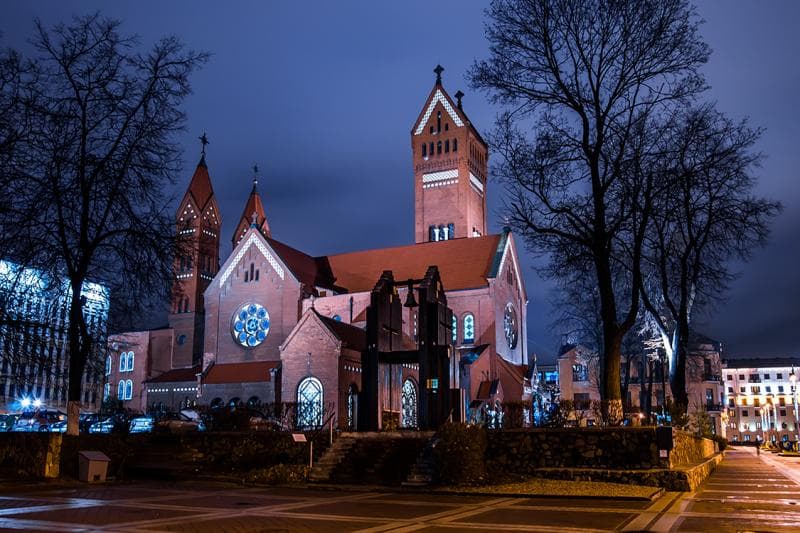
Explore the Red Brick Facade of the Church of Saints Simon and Helena in Minsk, Belarus. Discover its unique architecture and poignant history.
Overview
Standing proudly on Independence Square in Minsk, Belarus, the Church of Saints Simon and Helena is an undeniable architectural marvel, affectionately known by locals and travelers alike as the 'Red Church'. Its distinctive crimson facade, crafted entirely from red bricks, makes it an immediate focal point in the cityscape. This Roman Catholic church is not merely a place of worship; it is a profound symbol of endurance, a testament to personal sorrow transformed into enduring beauty, and a witness to over a century of Belarusian history. Its striking neo-Romanesque design, imbued with elements of Neo-Gothic and Art Nouveau, draws the eye, inviting closer inspection of its intricate brickwork and soaring towers.
The 'Red Brick Facade' is more than just an exterior; it is the very identity of this iconic structure, giving the church its popular name and making it one of Minsk's most recognizable landmarks. Built between 1905 and 1910, the church’s warm, reddish hue stands out against the surrounding urban environment, especially captivating under varying light conditions. Beyond its visual appeal, the facade whispers stories of a family's grief, a nation's trials, and a community's unwavering faith.
History & Cultural Background
The genesis of the Red Church is rooted in a deeply personal tragedy. The construction was generously financed by Edward Woyniłłowicz, a prominent Belarusian-Polish landowner, businessman, and civic activist. He initiated the building of this magnificent temple in memory of his two young children, Simon and Helena, who both passed away prematurely. The church was named and consecrated in their honor, eternally preserving their memory within its hallowed walls.
Designed by renowned Polish architects Tomasz Pajzderski and Władysław Marconi, the cornerstone was laid in 1905, with the church officially opening its doors in 1910. The choice of red brick as the primary building material was deliberate and aesthetically impactful. These bricks were notably sourced from Częstochowa, Poland, adding a layer of material significance to its Polish architectural roots. This architectural style, combining neo-Romanesque grandeur with Gothic flourishes and Art Nouveau details, was a bold statement at the turn of the 20th century.
Throughout its history, the Red Church has mirrored the tumultuous events of Belarus. Following the Bolshevik Revolution, the church was tragically plundered and, in 1932, closed by Soviet authorities. It was subsequently repurposed, serving as a Polish theater, then a Belarusian film studio, and later the House of Cinema. Its sacred purpose was suppressed for decades, with religious services only briefly resuming during the German occupation in World War II. It was not until 1990, after persistent efforts and hunger strikes by Minsk Catholic activists, that the building was finally returned to the Roman Catholic Church, symbolizing a national and spiritual resurgence.
What Makes It Special
The Red Brick Facade of the Church of Saints Simon and Helena is its most distinctive and special characteristic. The choice of rich red brick not only lends the church its popular 'Red Church' moniker but also creates a warm, inviting, yet imposing presence. This striking color and material stand in stark contrast to much of Minsk's more subdued architecture, making it visually unforgettable.
Architecturally, its asymmetrical composition sets it apart. A towering, four-tiered main spire, reaching 50 meters, dominates the southeastern part of the structure. Flanking the altar, rather than the main facade, are two smaller hipped towers, each 36 meters high, dedicated to the memory of Simon and Helena. This unique placement is a subtle yet powerful tribute to the children who inspired its creation. The main facade is further adorned with a large rose window under a triangular pediment, characteristic of Neo-Gothic design, and intricate decorative brickwork that adds texture and depth to its grand exterior.
Stories, Fun Facts & Local Details
The story of Edward Woyniłłowicz and his children is deeply embedded in the church's identity. His profound grief over the loss of his son Simon (who died at 12) and daughter Helena (who died at 18) drove his philanthropic endeavor. He and his wife insisted on choosing the project themselves and naming the church after their children's patron saints, intertwining personal sorrow with public sacred space.
A poignant detail is the reburial of Edward Woyniłłowicz and his wife's remains within the church in 2006, finally bringing the founder back to the edifice born of his love and sorrow.
Outside the church, visitors will find two significant monuments. One is a 4.5-meter sculpture of Archangel Michael, erected in 1996, depicting him slaying a serpent—a powerful symbol of good triumphing over evil and a protector of Belarus. The other is the 'Bell of Nagasaki', installed in 2000. This peace memorial, a replica of a bell that survived the atomic bombing of Nagasaki, serves as a solemn reminder of the victims of nuclear disasters and a call for global peace, ringing out every Sunday.
Today, the church is a vibrant cultural hub, hosting not only religious services in multiple languages (Belarusian, Polish, Lithuanian, and Latin) but also a gallery, a theater, and a public library on its ground floor.
Visitor Perspective
For any curious traveler, the Red Church offers an experience that blends historical depth with architectural splendor. Approaching Independence Square, the vivid red brick facade immediately captures attention, standing as a beacon of Minsk's rich past. Its distinctive appearance makes it an exceptional subject for photography, especially when the light emphasizes the texture and color of the bricks.
Inside, the atmosphere is one of serene contemplation, enhanced by beautiful stained-glass windows and symbolic murals created by Belarusian artist Franciszek Bruzdowicz. The sense of history is palpable, from the crypt holding the founder's remains to the knowledge of its transformation from sacred space to secular venue and back again. Walking around the church, one can reflect on the stories of resilience and faith that have shaped this building and the city around it. The exterior monuments—Archangel Michael and the Bell of Nagasaki—add further layers of meaning, providing moments for reflection on both spiritual protection and global peace. This is a place where history, architecture, and personal narrative converge, offering a truly enriching visit.
Coordinates: 27.5475588, 53.8965271
View on Google Maps💬 How Travelers Describe This Place
Based on community votes
Beautiful
897Photogenic
657Must See
605Unique
498Interesting
481
Traveler Stories
Discover memorable experiences shared by travelers who have visited this place.
No traveler stories yet.
Be the first traveler to share what made this place memorable.

Tour
By
Spot
Discover amazing places around the world. Your journey starts here.
Explore
© 2026 TourBySpot. All rights reserved.