Historic Interiors
Minsk, Belarus
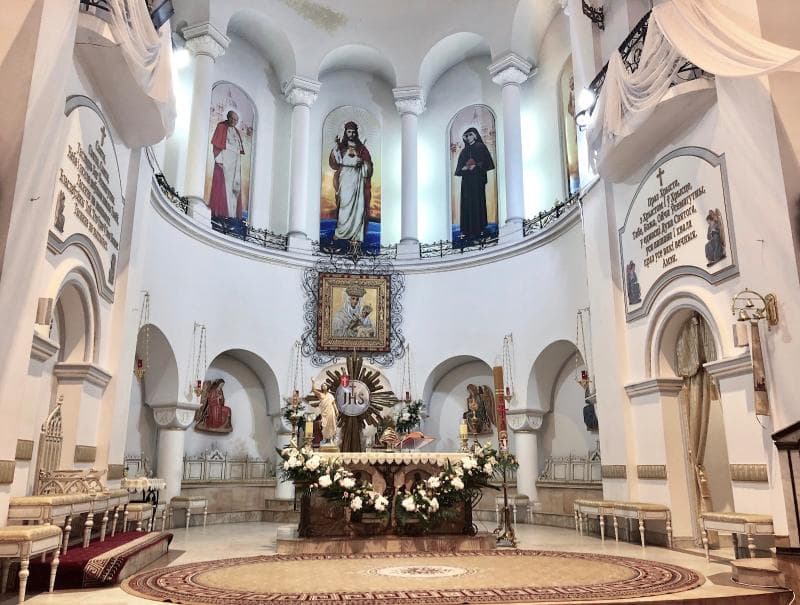
Explore the historic interiors of the Church of Saints Simon and Helena (Red Church) in Minsk, Belarus. Discover its stunning altars, stained glass, and poignant history.
Overview
Stepping inside the Church of Saints Simon and Helena, affectionately known as the 'Red Church,' in Minsk, Belarus, offers a profound journey through history, faith, and architectural artistry. The historic interiors of this neo-Romanesque and neo-Gothic masterpiece are a testament to enduring devotion and resilience, revealing layers of intricate design and spiritual significance. Visitors are greeted by a serene atmosphere, where richly adorned altars, symbolic stained-glass windows, and evocative murals narrate centuries of Belarusian history and Catholic tradition. Beyond its striking red brick exterior, the church's interior provides a tranquil sanctuary, inviting contemplation and admiration for its meticulously restored beauty.
History & Cultural Background
The genesis of the Church of Saints Simon and Helena's interiors is rooted in a deeply personal tragedy and a collective yearning for spiritual solace. Construction began in 1905 and was completed in 1910, largely financed by Edward Voynilovich, a prominent Minsk nobleman. He dedicated the church to the memory of his two prematurely deceased children, Simon and Helena, a poignant act of remembrance that imbues the entire structure, including its inner spaces, with profound emotional weight.
The architectural style of the interior, much like the exterior, is a harmonious blend of Neo-Romanesque, Neo-Gothic, and Art Nouveau elements, designed by Polish architects Tomasz Pajzderski and Władysław Marconi. This fusion created a unique aesthetic, distinct from many contemporary European churches. However, the church's history took a tumultuous turn during the Soviet era. In 1932, it was closed to worship, its sacred spaces repurposed as a Polish State Theatre, then a film studio, and later the House of Cinema. These periods of secular use led to significant alterations, including extensions, merged apses, and the covering of original interior paintings, obscuring much of its initial splendor.
It was not until 1990, amidst Belarus's national awakening, that the church was returned to the Roman Catholic Church. A meticulous restoration process began, aiming to reinstate the original grandeur of its historic interiors. This restoration brought back to light original frescoes on the vaults and presbytery, and revitalized the intricate details that had been hidden or damaged.
What Makes It Special
The historic interiors of the Church of Saints Simon and Helena are distinguished by several remarkable features. The main altar, a focal point of devotion, is notably carved from pure white Italian marble, a luxurious and somewhat unexpected detail for a church in this region. Throughout the church, visitors will discover statues of saints and detailed wall paintings, including a notable depiction of the 'Last Supper' positioned above the main entrance.
Perhaps one of the most captivating elements is the array of stained-glass windows. While some depict allegories of five types of art, adding a unique cultural layer, others beautifully illustrate scenes from the lives of Saints Simon and Helena, casting vibrant hues across the interior when sunlight filters through. The elaborate woodwork, particularly visible around the entrance, and the copper lamps and chandeliers further contribute to the rich, historical ambiance. The sculptor Zygmunt Otto was responsible for many of the interior decorations and bronze details, including the ambo and fences, adding another layer of artistic excellence.
A deeply revered relic within the church is a copy of the Shroud of Turin, presented as a gift to the Belarusian people in 2000, underscoring the church's significant spiritual role. In 2006, the remains of Edward Voynilovich and his wife were reburied within the church, fulfilling his will and solidifying the personal legacy intertwined with this architectural marvel.
Stories, Fun Facts & Local Details
The story of the 'Red Church' is intimately tied to a father's enduring love, a tale that resonates deeply within its walls. Edward Voynilovich's decision to build this magnificent edifice as a memorial to his lost children, Simon and Helena, speaks volumes about the enduring human spirit and the power of remembrance. The two smaller towers on either side of the altar are said to symbolize his children, a subtle yet powerful architectural nod to their memory.
During its Soviet-era transformation into a cinema and theatre, the very elements that temporarily damaged its religious character also inadvertently preserved its structure. While many other sacred buildings were demolished, the practical utility of the 'Red Church' for secular culture meant its walls remained standing. This resilience against adverse historical tides makes its fully restored interior even more remarkable.
Today, the church is not only a place of worship but also a cultural hub. It sometimes hosts classical music concerts, utilizing its acoustics to offer unique cultural experiences to the public. This blend of sacred and cultural activities reflects its importance to the Minsk community beyond purely religious functions.
Visitor Perspective
For a curious traveler, a visit to the historic interiors of the Church of Saints Simon and Helena offers a deeply immersive experience. The tranquil and reflective atmosphere provides a welcome respite from the bustling city outside. Upon entering, one immediately senses the layers of history and spiritual devotion embedded in every detail. The interplay of light through the stained-glass windows, particularly around midday, creates a mesmerizing dance of colors across the marble floors, a truly captivating sight.
Exploring the various altars, admiring the detailed paintings, and appreciating the craftsmanship of the woodwork gives insight into the rich artistic heritage of Belarus. While photography is generally permitted, visitors are kindly reminded to do so without flash, especially during services, to maintain the sanctity and peace of this active place of worship. Taking a moment to observe the smaller artworks in the side chapels can reveal hidden gems. The church is open to visitors throughout the year, and entrance is free, though donations are appreciated to support its upkeep and ongoing spiritual mission.
Coordinates: 27.5476, 53.8964
View on Google Maps💬 How Travelers Describe This Place
Based on community votes
Interesting
799Must See
639Beautiful
526Unique
181Photogenic
30
Traveler Stories
Discover memorable experiences shared by travelers who have visited this place.
No traveler stories yet.
Be the first traveler to share what made this place memorable.

Tour
By
Spot
Discover amazing places around the world. Your journey starts here.
Explore
© 2026 TourBySpot. All rights reserved.