Memorial Areas
Minsk, Belarus
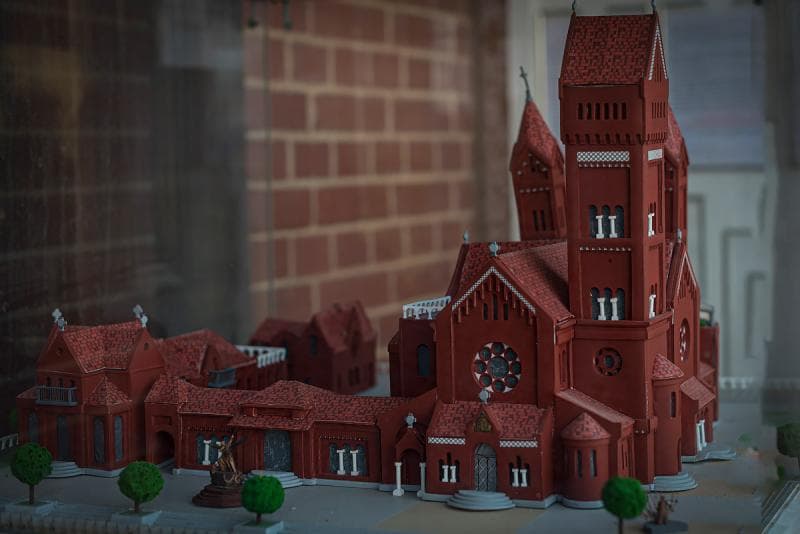
Explore the Memorial Areas at the Church of Saints Simon and Helena in Minsk, Belarus, dedicated to its founders and victims of global tragedies.
Overview
The Church of Saints Simon and Helena, affectionately known as the Red Church due to its distinctive brick facade, stands as a prominent and deeply meaningful landmark in the heart of Minsk, Belarus. More than just an architectural marvel, this Roman Catholic church holds profound memorial significance, built in remembrance and dedicated to enduring legacies. Located on Independence Square, its striking Neo-Romanesque and Neo-Gothic elements draw the eye, but it is the stories of remembrance woven into its very foundation that truly capture the spirit of this sacred space.
While the entire church serves as a grand memorial, specific areas within and around it are dedicated to preserving the memory of individuals and significant historical events. These 'Memorial Areas' invite visitors to pause, reflect, and connect with the poignant history of the Voynilovich family, whose personal tragedy led to the church's creation, and with broader themes of peace and remembrance.
History & Cultural Background
The genesis of the Church of Saints Simon and Helena is rooted in a deeply personal tragedy. Its construction was initiated and financed by Edward Woyniłłowicz, a prominent Belarusian-Polish landowner and civic activist, in memory of his two young, deceased children, Simon and Helena. Their early deaths profoundly impacted Woyniłłowicz and his wife, leading them to commission a grand church to honor their children and their patron saints.
Construction began in 1905, and the church was consecrated and opened in 1910. Designed by Polish architects Tomasz Pajzderski and Władysław Marconi, the church's vibrant red brick exterior, sourced from Częstochowa, earned it the popular moniker 'Red Church'. Beyond its initial purpose, the church has endured a tumultuous history. During the Soviet era, it was closed to worship, robbed, and repurposed, serving as a Polish theater, a film studio, and later the House of Cinema. It was only in 1990, after a period of fervent activism, that the building was returned to the Roman Catholic Church, undergoing extensive restoration to reclaim its original sacred purpose.
What Makes It Special
The memorial aspects of the Church of Saints Simon and Helena are central to its unique character. The very architecture reflects its commemorative origin; the two smaller towers of the church are specifically designed to symbolize the memory of Simon and Helena Woyniłłowicz. This architectural tribute ensures that the children's legacy is physically embedded in the structure of the church itself.
Within the church grounds, visitors can find the reburial site of Edward Woyniłłowicz and his wife. Their remains were brought back to the church in 2006, fulfilling Woyniłłowicz's will. A sculpture of Jesus marks his grave, accompanied by a memorial plaque, providing a specific focal point for reflection on the church's founder and his family's enduring contribution to Minsk.
Outside the main edifice, a powerful outdoor memorial, 'The Bell of Nagasaki,' stands as a profound reminder of global tragedies. This composition includes a replica of the 'Angel' bell, which miraculously survived the atomic bombing of Nagasaki. It serves as a poignant war memorial, dedicated to the victims of Hiroshima, Nagasaki, and the Chernobyl disaster, ringing every Sunday as a call for peace.
Stories, Fun Facts & Local Details
The story of the Red Church is deeply intertwined with personal loss and profound faith. Edward Woyniłłowicz's dedication to building such a magnificent structure in honor of his children, Simon and Helena, speaks volumes about the human spirit's capacity to transform grief into a lasting legacy. Simon died at the age of 12, and Helena at 18, both from illnesses. Their father's desire was to create a place of solace and prayer, not just for his family, but for the entire Catholic community in Minsk.
A fun fact related to its construction is that one of the three bells initially installed in the church was named 'Edward' in honor of its generous financier, while another was named 'Simon' after his son. The church's resilience is another noteworthy detail; it was one of the few significant buildings in Minsk to survive World War II largely intact, a conflict that devastated much of the city's historical architecture. This survival makes its current status even more remarkable, a testament to its enduring significance.
Beyond the architectural and historical facts, the church also houses a copy of the Shroud of Turin, a revered relic presented as a gift to the Belarusian people in 2002, further adding to its spiritual importance. Additionally, a sculpture of Saint Michael, considered the patron saint of Belarus, stands proudly before the church, symbolizing the victory of celestial power over darkness.
Visitor Perspective
Visiting the Memorial Areas within and around the Church of Saints Simon and Helena offers a deeply moving experience. As you approach the striking red brick facade on Independence Square, the sheer architectural beauty is undeniable, but knowing the personal story behind its creation adds layers of emotional resonance. Stepping inside, one can appreciate the tranquility and spiritual atmosphere that has been painstakingly restored after decades of secular use. The quiet reverence near the reburial site of Edward Woyniłłowicz provides a direct link to the church's founding narrative, inviting personal reflection on family, loss, and legacy. The presence of the Shroud of Turin replica offers a powerful spiritual focal point.
Outside, 'The Bell of Nagasaki' serves as a stark and moving reminder of global human suffering and the ongoing call for peace, transcending local history to address universal themes. This memorial provides a space for contemplation on the devastating impact of war and nuclear tragedy, and the importance of remembrance. The sculpture of Saint Michael, poised dynamically, reinforces themes of protection and hope. Together, these elements offer a comprehensive and thought-provoking journey, blending architectural grandeur with profound historical and emotional depth. The Memorial Areas are not merely points of interest; they are invitations to connect with a powerful human story and reflect on broader societal values.
Coordinates: 27.5475, 53.8965
View on Google Maps💬 How Travelers Describe This Place
Based on community votes
Photogenic
971Interesting
594Must See
516Unique
301Beautiful
82
Traveler Stories
Discover memorable experiences shared by travelers who have visited this place.
No traveler stories yet.
Be the first traveler to share what made this place memorable.

Tour
By
Spot
Discover amazing places around the world. Your journey starts here.
Explore
© 2026 TourBySpot. All rights reserved.