Main Sanctuary
Minsk, Belarus
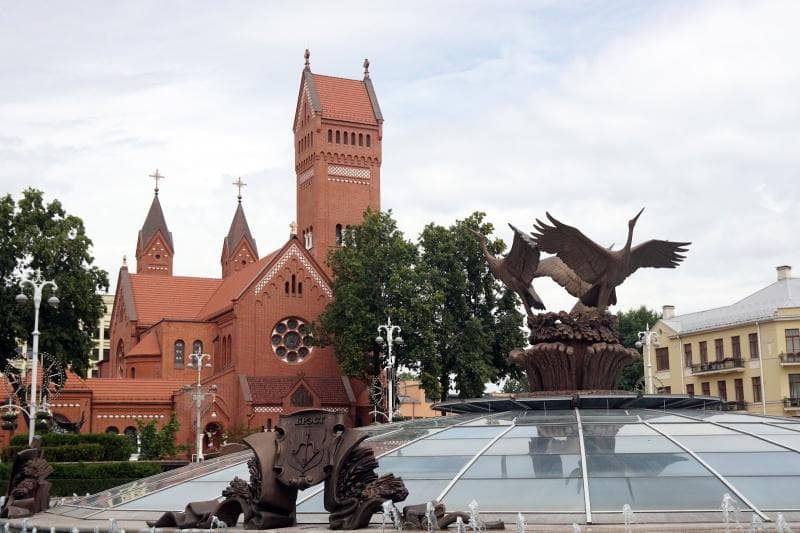
Explore the Main Sanctuary of the Church of Saints Simon and Helena in Minsk, Belarus. Discover its rich history, unique architecture, and cultural significance.
Overview
The Church of Saints Simon and Helena, affectionately known as the ‘Red Church’, stands as a majestic Roman Catholic beacon in the heart of Minsk, Belarus. Its distinctive red brick facade, which gives it its popular moniker, dominates Independence Square, making it an unmissable landmark for any visitor. The church is a stunning example of Neo-Romanesque architecture, gracefully intertwined with elements of Neo-Gothic and Art Nouveau styles, creating a visual symphony of historical design. Inside, the main sanctuary unfolds as a serene and spiritually rich environment, a testament to enduring faith and architectural artistry. It serves as a living place of worship and a profound cultural monument, reflecting both resilience and beauty in its every detail. The sanctuary, with its five naves and grand transept, invites contemplation and offers a deep sense of peace away from the bustling city life.
History & Cultural Background
The history of the Church of Saints Simon and Helena is deeply personal and culturally significant. Its construction, initiated in 1906 and completed by 1910, was a poignant act of remembrance by Edward Woynillowicz, a respected Belarusian-Polish landowner and activist. Woynillowicz financed the entire project in memory of his two young, deceased children, Simon and Helena, hence the church's sacred dedication. This origin story imbues the church with a profound emotional depth, making it more than just a structure but a monument to parental love and loss.
However, the church's journey has been far from tranquil. During the turbulent Soviet era, its religious purpose was suppressed. In 1932, it was closed and repurposed, first serving as a Polish theatre, then a film studio, and eventually the 'House of Cinema'. This period saw its sacred spaces transformed for secular use, yet its spirit endured. A turning point arrived in 1990 when, following fervent efforts by Catholic activists, the building was triumphantly returned to the Roman Catholic Church. Its interior underwent extensive restoration, reinstating its original splendor and spiritual function. In a touching ceremony in 2006, Edward Woynillowicz and his wife were reburied within the church's hallowed grounds, further cementing their legacy within this magnificent edifice.
What Makes It Special
Stepping into the main sanctuary, visitors are immediately struck by its impressive scale and intricate details. The church hall reaches a height of nearly 15 meters, creating an expansive and uplifting atmosphere. The architects, Tomasz Pajzderski and Władysław Marconi, designed a space that is both grand and intimate. A standout feature is the main altar, crafted from pure white Italian marble, which provides a striking focal point against the rich interior. The sanctuary is also adorned with stunning stained-glass windows, created by artist Francisk Bruzdovich, that depict scenes from the lives of Saints Simon and Helena, casting vibrant hues across the floor, particularly at midday.
Artistic contributions extend beyond the windows; sculptures, the ambo, and various bronze details within the main worship area were fashioned by Zigmund Otto. Among the church's most revered treasures is a precious copy of the Shroud of Turin, received as a gift in 2000, adding another layer of spiritual significance to the sanctuary. The architectural ingenuity is further highlighted by the evolution of its apses; originally three, they were combined into a single, central semi-cylindrical apse during a Soviet-era reconstruction, a subtle yet profound alteration in its design.
Stories, Fun Facts & Local Details
The very towers of the Red Church tell a story. While the main bell tower soars to 50 meters, two smaller, 36-meter hipped towers hold special meaning. These smaller towers are said to commemorate Edward Woynillowicz's children, Simon and Helena, while the taller central tower symbolizes the parents' enduring sorrow. Early in its history, three bells were installed: one named 'Edward' in honor of the benefactor, another 'Simon' after his son, and a third named 'Michael' for the Archbishop of Minsk.
Beyond the architectural marvels, the church grounds host a bronze sculpture of Archangel Michael, installed in 1996, depicting him slaying a snake—a powerful symbol of good triumphing over evil, and a long-standing patron saint for Belarus. Another poignant memorial outside is 'The Bell of Nagasaki,' a replica of a bell that miraculously survived the atomic bombing. This composition serves as a solemn reminder of the victims of nuclear tragedies and, since 2000, its bell tolls every Sunday at noon, a powerful message of peace. Within the sanctuary, services are conducted in multiple languages, including Belarusian, Polish, Lithuanian, and Latin, reflecting the diverse community it serves.
Visitor Perspective
For the curious traveler, the main sanctuary of the Church of Saints Simon and Helena offers a deeply moving and educational experience. It remains an active and welcoming place of worship, where one can observe or participate in services. Visitors are encouraged to explore the interior respectfully; photography is permitted, though flash is to be avoided, especially during religious rites. To fully appreciate the tranquil atmosphere and the intricate stained-glass windows, a weekday morning visit is often recommended, or precisely at noon to witness the sunlight's magical dance through the glass. Entry to the church is free, though donations are gratefully accepted to support its upkeep. Beyond the central worship area, discreet side chapels often house smaller, easily overlooked artworks that offer quiet moments of discovery. Checking the notice board near the entrance might even reveal information about occasional free classical music concerts, adding another layer to the visitor's cultural immersion. Dressing modestly and removing headphones before entering are customary gestures of respect in this sacred space.
Coordinates: 27.5474778, 53.8965194
View on Google Maps💬 How Travelers Describe This Place
Based on community votes
Unique
961Interesting
695Photogenic
605Must See
404Beautiful
336
Traveler Stories
Discover memorable experiences shared by travelers who have visited this place.
No traveler stories yet.
Be the first traveler to share what made this place memorable.

Tour
By
Spot
Discover amazing places around the world. Your journey starts here.
Explore
© 2026 TourBySpot. All rights reserved.