Religious Artworks
Minsk, Belarus
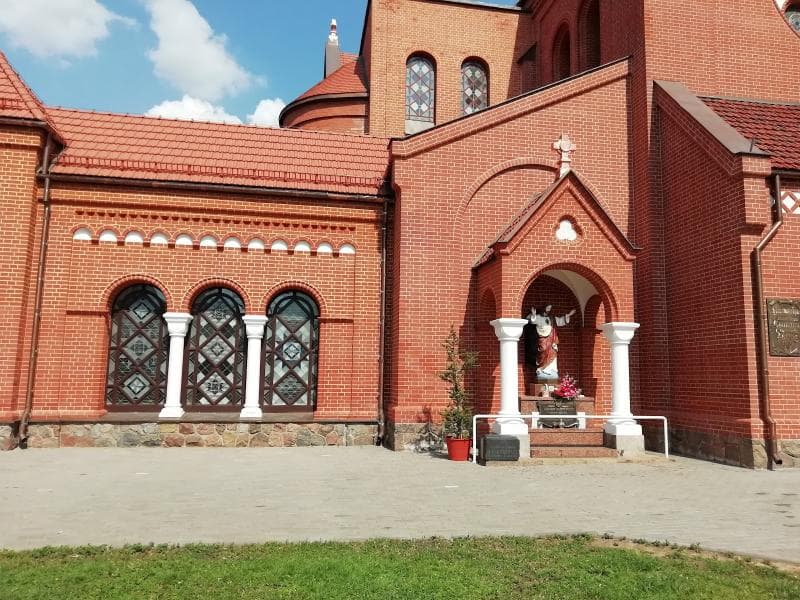
Explore the religious artworks and poignant history of the Church of Saints Simon and Helena, also known as the Red Church, in Minsk, Belarus.
Overview
Nestled within the bustling Independence Square of Minsk, Belarus, the Church of Saints Simon and Helena, affectionately known as the Red Church, stands as a striking testament to both faith and resilience. Its vibrant red brick facade and distinctive Neo-Romanesque architecture immediately capture the eye amidst the city's modern landscape. More than just an architectural marvel, this Roman Catholic church houses a collection of religious artworks that weave together centuries of belief, personal devotion, and national history, offering a profound glimpse into Belarus's spiritual heritage.
As you approach, the church reveals an interior rich with symbolic artistry. Visitors are invited to explore a space where sacred sculptures, delicate stained-glass windows, and meaningful paintings contribute to a deeply reverent atmosphere. Beyond its walls, significant monuments further extend the church's narrative, inviting contemplation on themes of remembrance and peace.
History & Cultural Background
The story of the Church of Saints Simon and Helena is one born from profound personal loss and unwavering faith. Its construction, initiated between 1905 and 1910, was generously financed by Edward Woyniłłowicz, a prominent Belarusian-Polish landowner, in memory of his two young, deceased children, Simon and Helena. This deeply personal dedication imbues the church with an emotional resonance that sets it apart.
Designed by Polish architects Tomasz Pajzderski and Władysław Marconi, the church's Neo-Romanesque style, incorporating elements of Gothic and Art Nouveau, was chosen as a conscious nod to a time before the schism between Eastern and Western Christianity. Its striking red brick was sourced from Częstochowa, Poland, further connecting it to a broader Catholic heritage. Over the decades, the church endured immense hardship during the Soviet era. From 1932, it was closed for worship and repurposed first as a Polish theater, then a film studio, and later the House of Cinema, its sacred function suppressed. It was only after two hunger strikes by Minsk Catholic activists that the building was finally returned to the Roman Catholic Church in 1990, symbolizing a powerful return to its spiritual roots and becoming a vital center of religious, cultural, and social life.
What Makes It Special
The religious artworks within the Church of Saints Simon and Helena are not merely decorative; they are integral to its identity and narrative. The interior is adorned with beautiful stained-glass windows and wall paintings, which, along with copper chandeliers, create an ethereal glow and contribute to the solemnity of the space. Notably, many of the interior sculptures, including the ambo, fences, and various bronze details, were crafted by the talented Zigmund Otto.
Among the most revered treasures inside is a copy of the Turin Shroud, a significant relic gifted to the church in the year 2000. Outside, the church's artistic and spiritual significance continues with powerful sculptures. The bronze sculpture of Archangel Michael, installed in 1996 and created by sculptor I. Golubev, stands at 4.5 meters tall. It depicts the archangel slaying a serpent, a symbolic representation of divine power triumphing over darkness, and Archangel Michael has long been regarded as the patron saint of Belarus.
Another deeply moving artwork is 'The Bell of Nagasaki,' a memorial composition that includes a replica of the 'Angel' bell, which miraculously survived the atomic bombing of Nagasaki. This monument, a gift from the Japanese people to Belarus, serves as a poignant reminder of the victims of nuclear disasters in Hiroshima, Nagasaki, and Chernobyl. Every Sunday at noon, the bell rings, its sound echoing across three cities as a powerful plea for peace and a reminder of life's preciousness.
Stories, Fun Facts & Local Details
The church's distinctive silhouette, featuring three towers of varying heights, holds a poignant story. The two smaller towers are said to commemorate Edward Woyniłłowicz's children, Simon and Helena, while the taller central tower symbolizes the enduring sorrow of the grieving parents. This deeply personal architectural detail turns the entire edifice into a heartfelt memorial.
A popular local legend, though its factual basis is less certain, suggests that Helena herself envisioned the future church in a dream and left a drawing before her passing. While perhaps apocryphal, this story has resonated with locals because it beautifully encapsulates the emotional foundation of the Red Church, making it feel less like an anonymous public project and more like grief transformed into a tangible, sacred space.
During the Soviet era, when the church was used as a film studio, it is said that people would still gather to pray, despite the ban on religious services. A portrait of Lenin even appeared in its window during this time, creating a stark juxtaposition of ideologies. The miraculous survival of the church through World War II, when much of Minsk's historical legacy was destroyed, further cemented its status as a symbol of endurance for the city. Edward Woyniłłowicz and his wife are honorably reburied within the church's territory, ensuring their legacy is forever intertwined with the spiritual heart of Minsk.
Visitor Perspective
Visiting the Church of Saints Simon and Helena offers more than just a historical tour; it is an experience that connects one to the enduring spirit of Minsk. The exterior, with its warm red bricks, provides a striking contrast to the surrounding urban landscape, making it an ideal spot for reflection and photography.
Inside, the tranquil atmosphere, illuminated by the soft light filtering through stained-glass, encourages quiet contemplation. While specific access to all areas may vary, the profound beauty of its interior artworks and the weight of its history are palpable. The sculptures of Archangel Michael and 'The Bell of Nagasaki' outside provide a compelling prelude to the interior, inviting visitors to ponder themes of faith, loss, and the pursuit of peace. The Red Church stands as a powerful reminder of Minsk's past and its vibrant present, offering a deeply meaningful cultural experience for any curious traveler.
Coordinates: 27.5474778, 53.8965194
View on Google Maps💬 How Travelers Describe This Place
Based on community votes
Unique
771Interesting
767Photogenic
516Must See
479Beautiful
181
Traveler Stories
Discover memorable experiences shared by travelers who have visited this place.
No traveler stories yet.
Be the first traveler to share what made this place memorable.

Tour
By
Spot
Discover amazing places around the world. Your journey starts here.
Explore
© 2026 TourBySpot. All rights reserved.