Bell Tower
Minsk, Belarus
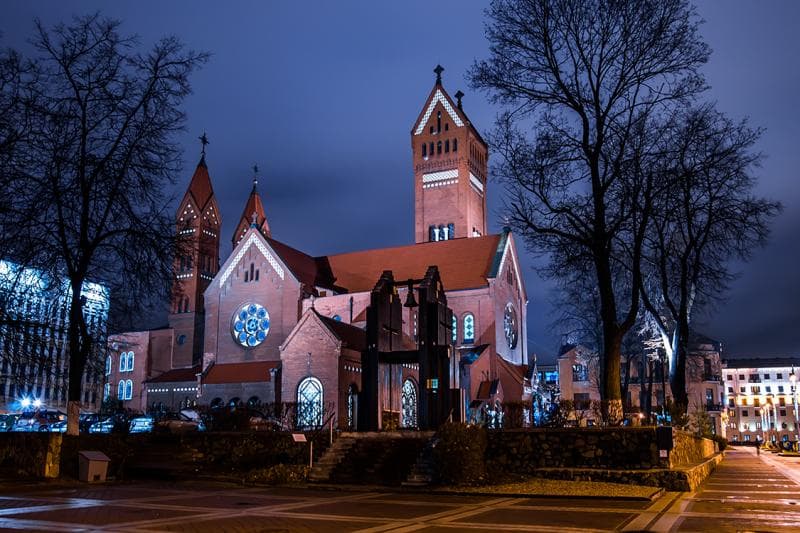
Explore the historic Bell Tower of the Church of Saints Simon and Helena in Minsk, Belarus. Discover its unique architecture and poignant history.
Overview
Standing proudly amidst the bustling Independence Square in Minsk, Belarus, the Bell Tower of the Church of Saints Simon and Helena, more commonly known as the Red Church, is an unmissable landmark. This Roman Catholic church, instantly recognizable by its striking red brick facade, presents a dramatic silhouette against the city skyline. While the entire edifice is a testament to resilience and faith, its commanding main tower, reaching an impressive 50 meters, serves as a visual anchor and a symbolic heart for the structure. It is not merely an architectural feature but a profound part of Minsk's cultural and historical identity, beckoning curious travelers to delve into its rich past and significant symbolism.
History & Cultural Background
The genesis of the Church of Saints Simon and Helena, and by extension its prominent Bell Tower, is rooted in a deeply personal and poignant family tragedy. Its construction, initiated in 1905 and completed in 1910, was generously financed by Edward Woyniłłowicz, a respected Belarusian-Polish landowner and civic activist. Woyniłłowicz sought to commemorate his two young children, Simon and Helena, who had passed away prematurely. The church was consecrated in their memory, a lasting tribute to a father's enduring grief and faith. Designed by Polish architects Tomasz Pajzderski and Władysław Marconi, the church was built in a distinctive Neo-Romanesque style, incorporating elements of Neo-Gothic and Art Nouveau. The vibrant red bricks, sourced from Częstochowa, gave the church its popular 'Red Church' moniker. Throughout the 20th century, the church endured immense hardship under Soviet rule, being closed, secularized, and repurposed as a Polish theater, film studio, and cinema. However, in 1990, it was finally returned to the Roman Catholic Church, symbolizing a triumphant return to its original spiritual purpose.
What Makes It Special
The Bell Tower of the Church of Saints Simon and Helena is a central and defining feature of its unique architectural composition. The main tower, a four-tiered rectangular structure, stands at a remarkable height of 50 meters in the southeastern part of the church. This towering presence was, at the time of its construction, reportedly the highest in the city, making it a prominent beacon. Complementing this grand tower are two smaller, 36-meter high hipped towers. What makes these particularly distinctive is their unusual placement not on the main facade, but on the altar sides, thoughtfully symbolizing the memory of Woyniłłowicz's children, Simon and Helena. The very bricks of the church, with their deep red hue, contribute significantly to its character, ensuring its visibility and endearment to locals and visitors alike. Inside, the historical significance extends to the original bells, which were famously named 'Edward' after the church's benefactor, 'Simon' after his son, and 'Michael' in honor of the Archbishop of Minsk.
Stories, Fun Facts & Local Details
Beyond its architectural grandeur, the Bell Tower and the church itself are steeped in local lore and poignant narratives. One widely shared story tells of Helena, Edward Woyniłłowicz's daughter, who reportedly dreamt of a beautiful church shortly before her untimely death and left a sketch of her vision. This dream is said to have profoundly influenced her father's decision and the design of the church, adding an ethereal layer to its origins. Furthermore, the commanding 50-meter main tower is often seen as symbolizing the deep sorrow of the parents, while the two smaller towers specifically honor the children they lost. These elements transform the architecture into a silent narrative of love, loss, and remembrance. In the church's forecourt, visitors will encounter another significant, albeit external, 'bell'—the Bell of Nagasaki. Erected in 2000, this memorial is a replica of the 'Angel' bell from Nagasaki, Japan. It serves as a powerful symbol of peace and a poignant remembrance of the victims of the atomic bombings of Hiroshima and Nagasaki, as well as the Chernobyl nuclear disaster. Intriguingly, every Sunday at noon, this bell resonates, sounding simultaneously in Minsk, Nagasaki, and Hiroshima, creating a shared moment of reflection and unity across continents.
Visitor Perspective
Approaching the Church of Saints Simon and Helena, the Bell Tower immediately draws the eye, its red brick structure a striking contrast to the surrounding urban landscape of Independence Square. It's a place that invites contemplation, offering a respite from the city's dynamism. Visitors can walk around the church, appreciating the architectural details of the main tower and its smaller counterparts, each telling a part of its compelling story. The presence of the Bell of Nagasaki monument nearby adds another layer of profound reflection, connecting the church to global events and universal themes of peace and remembrance. While the church has faced periods of closure and renovation, its exterior remains a powerful visual narrative of history and faith. Even if interior access varies, the sheer presence of the Bell Tower and the Red Church on Independence Square provides a rich experience, allowing one to connect with Minsk's past, its enduring spirit, and the deeply human stories etched into its very fabric. It stands not just as a building, but as a living monument, reflecting the triumphs and tragedies of a nation and its people.
Coordinates: 27.5474778, 53.8965194
View on Google Maps💬 How Travelers Describe This Place
Based on community votes
Interesting
817Photogenic
711Must See
657Beautiful
299Unique
19
Traveler Stories
Discover memorable experiences shared by travelers who have visited this place.
No traveler stories yet.
Be the first traveler to share what made this place memorable.

Tour
By
Spot
Discover amazing places around the world. Your journey starts here.
Explore
© 2026 TourBySpot. All rights reserved.