Bogd Khan Palace Museum
Ulaanbaatar, Mongolia
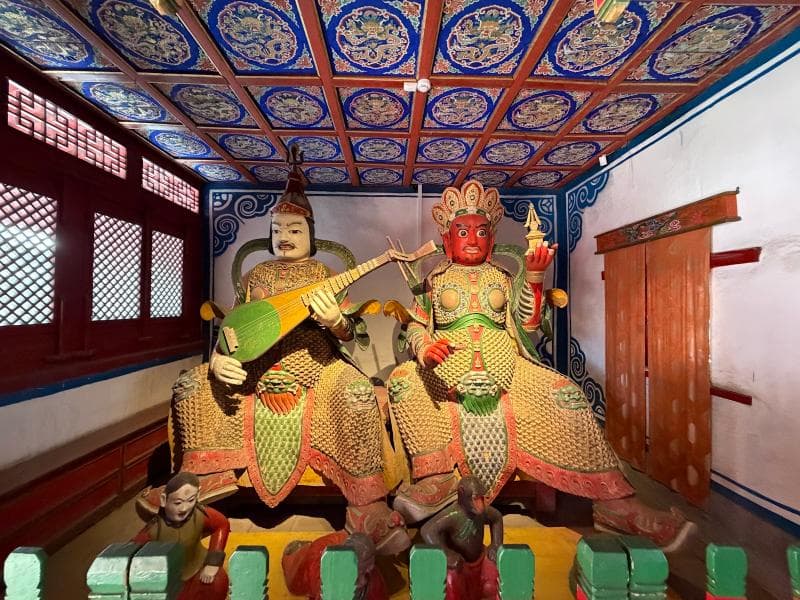
Explore the Bogd Khan Palace Museum in Ulaanbaatar, Mongolia, the preserved residence of the last Bogd Khan. Discover rich history, unique art, and cultural artifacts.
Overview
Nestled in Ulaanbaatar, Mongolia, the Bogd Khan Palace Museum stands as a captivating testament to the nation's rich history and cultural heritage. It is one of Mongolia's oldest and most significant museums, uniquely preserving the legacy of the last theocratic ruler, Bogd Khan (Javzandamba). Unlike many historical sites in Mongolia that succumbed to political upheaval, this palace complex is one of the few Ulaanbaatar attractions to have survived the communist era, offering a rare glimpse into a bygone era.
The museum complex is often referred to as the 'Green Palace' and comprises two main sections: the Winter Palace, a distinctive two-story European-style building, and a collection of traditional Mongolian temples and pagodas, sometimes cited as seven 'Wisdom Glorifying Temples'. These structures are symmetrically arranged around two courtyards, showcasing a unique blend of architectural influences. With over 8,000 exhibits, including 72 items officially designated as unique by the State, the museum draws between 19,000 and 40,000 visitors annually, many of whom are international travelers.
History & Cultural Background
The Bogd Khan Palace Museum was once the imperial residence of the eighth Jebtsundamba Khutughtu, known as Bogd Khan, who served as Mongolia's spiritual leader and later as its last monarch. The core of the complex, the Winter Palace, was constructed between 1893 and 1903. Its design reflects a fascinating blend of European and traditional architectural styles, with its main building specifically crafted by Tsarist Russian architects. The Bogd Khan and his queen, Dondogdulam Khatan, resided in the Winter Palace for two decades, using it as their primary residence during the colder months.
A pivotal moment in Mongolian history is intrinsically linked to this site. In 1911, following the collapse of China's Qing Dynasty, Outer Mongolia declared its independence, and the eighth Jebtsundamba Khutughtu was proclaimed Bogd Khan, the absolute monarch of the newly independent Mongolian state. After his passing in 1924, the Winter Palace was transformed into a museum in 1926, effectively preserving his legacy and the rich cultural artifacts within its walls. Its survival is particularly noteworthy given the widespread destruction of religious and cultural sites during the late 1930s under the Mongolian People's Revolutionary Party.
What Makes It Special
The Bogd Khan Palace Museum stands out as the only one of the Bogd Khan's four imperial residences that remains intact today, making it an invaluable historical asset. Its ability to withstand the tumultuous communist era is a significant part of its unique narrative. The architectural fusion, combining the European elegance of the Winter Palace with the vibrant, traditional Buddhist temples, provides a visual representation of Mongolia's historical connections and spiritual depth.
Within its halls, visitors can explore a vast collection of personal effects belonging to the Bogd Khan and Queen Dondogdulam, offering an intimate look into their lives. These include state ceremonial robes, elaborate crowns, and a variety of gifts received from domestic and foreign dignitaries. The museum is also a treasure trove of Buddhist art, featuring priceless sculptures, thangkas, and religious iconography, notably including 21 invaluable sculptures of Taras by the revered First Bogd Zanabazar.
Among the complex's architectural marvels is the 'Andi Men' or Gate of Peace, an impressive structure built between 1912 and 1919. This gate is renowned for its construction without a single nail, instead utilizing 108 different forms of interlocking joints, a testament to traditional Mongolian craftsmanship. Another unique feature is the 'Yampai,' a protective gate symbolically shielding the temple from unseen evils, adorned with dragons and a representation of Mount Sumber.
Stories, Fun Facts & Local Details
Beyond its historical significance, the Bogd Khan Palace Museum offers a wealth of intriguing stories and fascinating details. The Bogd Khan himself was known for his eclectic tastes, particularly his fondness for exotic animals. This passion is vividly displayed through his personal collection of taxidermied animals, some of which were part of his private zoo. A notable story recounts his pet elephant, imported from Russia at a cost of 22,000 rubles, whose jeweled regalia is now on display.
His extravagant lifestyle is further highlighted by items such as a ceremonial ger (yurt) lined with the skins of 150 snow leopards and a pair of golden ceremonial boots, a gift from Russian Tsar Nicholas II. The complex includes the 'Temple of Developing Wisdom,' built in 1893, featuring inscriptions in Sanskrit, Tibetan, Mongolian, Manchu, and Chinese scripts. Inside the Winter Palace, a captivating 1912 portrait by artist Jugder depicts Ulaanbaatar as if viewed from the sky, offering a historical aerial perspective of the capital. Visitors can also admire the humorous and insightful drawings by Marzan Sharav, which depict daily life in Mongolia at the turn of the 20th century. The 'Three Open Gates' of the palace grounds symbolize an invitation for good deeds, fortune, and happiness to enter, always remaining unobstructed. The palace grounds were also historically used for two significant annual religious ceremonies dedicated to worshipping sky and water spirits.
Visitor Perspective
Located in the southern part of Ulaanbaatar, specifically in the Khan Uul District on the road to Zaisan, the Bogd Khan Palace Museum is easily accessible and often combined with a visit to the nearby Zaisan Memorial. A typical visit is recommended to last between one to two hours, allowing ample time to explore the various temples and the Winter Palace. While the grounds are open for photography, taking pictures inside the museum's structures often requires a separate pass or is prohibited, so it's wise to inquire upon arrival. Visitors are advised to wear sturdy shoes, as exploring the extensive complex involves a fair amount of walking.
The museum generally operates with opening hours between 9:00 AM and 6:00 PM or 10:00 AM and 5:00 PM, though it is typically closed on Mondays. Exploring this well-preserved site offers a profound sense of Mongolia's monarchical past and its deeply ingrained religious traditions, providing a rich cultural experience that resonates with both historical and spiritual significance.
Coordinates: 106.90667, 47.8975
View on Google Maps💬 How Travelers Describe This Place
Based on community votes
Interesting
982Must See
903Beautiful
458Photogenic
235Unique
197
Traveler Stories
Discover memorable experiences shared by travelers who have visited this place.
No traveler stories yet.
Be the first traveler to share what made this place memorable.
Things to see at Bogd Khan Palace Museum



Tour
By
Spot
Discover amazing places around the world. Your journey starts here.
Explore
© 2026 TourBySpot. All rights reserved.