Besakih Temple
Bali, Indonesia
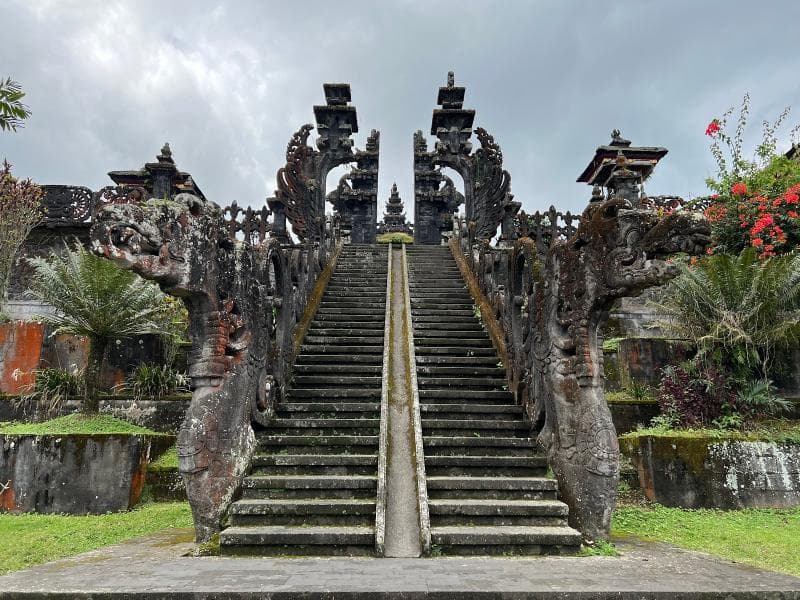
Explore Besakih Temple, Bali's revered Mother Temple in Indonesia. Discover its ancient history, spiritual significance, and stunning architecture on Mount Agung.
Overview
Perched majestically on the southwestern slopes of Mount Agung, Bali's highest volcano, Besakih Temple in Indonesia stands as the island's most significant and sacred Hindu temple complex. Often referred to as the 'Mother Temple of Bali', this sprawling spiritual center offers visitors a profound glimpse into Balinese Hinduism and culture. Situated at an elevation of approximately 1,000 meters above sea level, the temple complex provides breathtaking panoramic views of lush landscapes, rice terraces, and the imposing volcano itself.
Besakih Temple is not merely a single structure but an extensive collection of dozens of individual temples, with sources noting totals from 23 to over 80 or 86 separate sanctuaries. At its heart lies Pura Penataran Agung, the grandest and most important of these, serving as the primary site for major ceremonies and worship. Its tiered layout, ascending the mountainside, creates a powerful sense of spiritual ascent, inviting both devotees and curious travelers to embark on a contemplative journey.
History & Cultural Background
The origins of Besakih Temple are deeply rooted in ancient Balinese history, with its establishment believed to date back over a thousand years, potentially as early as the 8th century AD. Balinese legend attributes its founding to the revered Hindu sage Rsi Markandeya, who, guided by divine forces, established a sacred site on the slopes of Mount Agung. Evidence suggests the site was a holy place even in prehistoric times, with the stone bases of some temples, including Pura Penataran Agung, resembling ancient megalithic stepped pyramids.
Culturally, Besakih Temple is dedicated to the Hindu trinity, known as the Trimurti: Brahma the creator, Vishnu the preserver, and Shiva the destroyer. Each of the main temples within the complex is symbolically aligned with these deities. Pura Penataran Agung, for instance, is dedicated to Shiva and is adorned with white banners. To its right, Pura Kiduling Kreteg honors Brahma with red banners, while Pura Batu Madeg is dedicated to Vishnu, marked by black banners. The entire complex is meticulously designed according to the Balinese Hindu philosophical concept of Tri Hita Karana, which emphasizes harmonious balance between humanity, nature, and the divine. This philosophy is not just an abstract idea but a living principle that breathes through every spiritual activity conducted at Besakih.
What Makes It Special
What truly sets Besakih Temple apart is its remarkable fusion of spiritual profundity, historical depth, and natural grandeur. Its strategic location on the sacred Mount Agung imbues it with an unparalleled mystique; for Balinese Hindus, the mountain itself is believed to be the dwelling place of gods and a source of spiritual energy. This connection to the mountain is physically manifested in the temple's architecture, with buildings intentionally pointing upwards towards Mount Agung, symbolizing a closer communion with the divine.
The complex is an architectural marvel, characterized by its distinctive multi-tiered meru towers, which resemble pagodas. These towers, with their thatched roofs stacked in odd numbers (from three to eleven), are not just aesthetic features but symbolic representations of Mount Meru, the cosmic mountain at the center of the universe in Hindu cosmology. The number of tiers reflects the spiritual importance of the deity to whom each meru is dedicated. Intricate stone carvings adorn the walls and gateways, telling stories from Hindu epics and offering profound insights into Balinese mythology and values. The iconic candi bentar (split gates) serve as majestic transitions between the mundane and the sacred, creating a powerful sense of entering a truly hallowed space. This combination of stunning views, rich symbolism, and active spiritual life makes Besakih an extraordinary destination.
Stories, Fun Facts & Local Details
The name 'Besakih' itself carries interesting historical and mythological weight. It is thought to be derived from the Sanskrit word 'Wasuki', meaning 'safe', or linked to the legend of Naga Basuki, a mythical dragon figure believed to maintain the balance of the universe. Perhaps the most astonishing story associated with Besakih is its miraculous survival of the catastrophic 1963 eruption of Mount Agung. Despite the immense destruction caused by the lava flows, which narrowly missed the temple complex by mere meters, Besakih emerged virtually unscathed, a phenomenon widely regarded by locals as a divine miracle.
Besakih remains a vibrant center for numerous ceremonies and rituals. Among the most significant are the Panca Wali Krama, a grand purification ceremony held every ten years, and the exceedingly rare Eka Dasa Rudra, the holiest ritual in Balinese Hindu tradition, which occurs only once every century. The last Eka Dasa Rudra took place in 1979. Interestingly, the black-colored walls of many temples within the complex are constructed from volcanic stone, naturally integrating the mountain's essence into the sacred architecture. With over 80 individual temples, the complex also includes numerous smaller sanctuaries belonging to specific clan groups and regencies across Bali, highlighting its role as a spiritual nexus for the entire island.
Visitor Perspective
Visiting Besakih Temple is an immersive experience that requires respect for its sacred nature. All visitors are required to wear a sarong and sash, which are typically provided as part of the entrance fee, to cover legs and shoulders as a sign of reverence. Comfortable shoes are highly recommended, as exploring the vast complex involves considerable uphill walking and numerous stairs. It's also important to be mindful of ongoing ceremonies; certain areas might be temporarily inaccessible to visitors out of respect for worshippers. Traditionally, women during menstruation are asked to refrain from entering the temple grounds.
For the best experience, aim to visit early in the morning, ideally between 7:00 AM and 10:00 AM. This timing not only helps avoid larger crowds but also offers the clearest views of Mount Agung before the clouds typically gather. While the temple is open for tourists from around 7 AM to 6 PM, it remains open 24 hours for local practitioners. The entrance fee for international visitors is generally around IDR 150,000, which often includes a local guide, sarong, and a shuttle service to the main entrance. Transportation to Besakih is best arranged via private car or driver, as public transport options are limited, with the journey typically taking about two hours from popular areas like Ubud or Kuta.
Coordinates: 115.517, -8.3764
View on Google Maps💬 How Travelers Describe This Place
Based on community votes
Unique
836Interesting
797Photogenic
286Beautiful
255Must See
86
Traveler Stories
Discover memorable experiences shared by travelers who have visited this place.
No traveler stories yet.
Be the first traveler to share what made this place memorable.
Things to see at Besakih Temple


Tour
By
Spot
Discover amazing places around the world. Your journey starts here.
Explore
© 2026 TourBySpot. All rights reserved.