Meru Towers
Bali, Indonesia
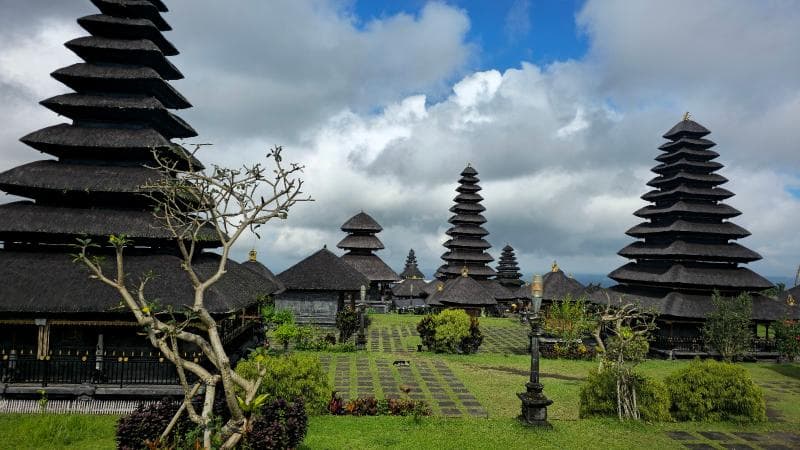
Explore the sacred Meru Towers at Besakih Temple, Bali, Indonesia's holiest site. Discover their history, spiritual meaning, and unique architecture.
Overview
Nestled high on the sacred slopes of Mount Agung, Bali's revered volcano, lies the magnificent Besakih Temple complex, often hailed as the 'Mother Temple' of Bali. Within this sprawling spiritual heartland, the Meru Towers stand as iconic and deeply symbolic architectural features, immediately capturing the eye with their distinctive multi-tiered, pagoda-like roofs. These impressive structures are far more than mere buildings; they are central to Balinese Hindu cosmology and practice, serving as sacred shrines that represent the cosmic mountain, Mount Meru. Their presence underscores Besakih's profound significance as the largest and holiest temple complex on the island, a vibrant testament to centuries of unwavering spiritual devotion.
Comprising 23 separate temples arranged across six terraced levels, Pura Besakih offers a journey through the spiritual landscape of Balinese Hinduism. The Meru Towers, with their ascending tiers of black palm fiber thatch, guide the eye and spirit upwards, reflecting the Balinese understanding of the universe and the path to the divine.
History & Cultural Background
The origins of Besakih Temple are ancient, with historical records suggesting its establishment around the 8th century AD, though some stone bases resemble megalithic stepped pyramids dating back over 2,000 years, indicating prehistoric use of this sacred volcanic slope. The concept of the multi-tiered Meru roof itself is believed to have been introduced to Bali by Mpu Kuturan, a revered priest from Java, in the 11th century, significantly influencing the island's temple architecture. By the 15th century, Besakih had risen to prominence as the state temple of the powerful Gelgel dynasty, whose patronage led to the construction of numerous shrines and solidified its supreme status among Bali's directional temples.
Culturally, the Meru Towers embody Mount Mahameru, the sacred mountain at the center of the Hindu cosmos, fabled to be the abode of the gods. They function as 'pelinggih', or shrines, acting as temporary 'seats' for gods and ancestral spirits who descend from the heavens during elaborate ceremonies. The meticulous construction of these towers adheres to traditional Balinese architectural philosophies, such as Asta Kosala Kosali, which imbues them with deep symbolic meaning and religious power.
What Makes It Special
The Meru Towers are distinguished by their unique architectural design: multi-tiered, pagoda-style roofs that are always oddly-numbered—ranging from three to an impressive eleven tiers. Each tier, known as 'tumpang', diminishes in size as it ascends, symbolizing different levels of the cosmos and reflecting the spiritual importance and rank of the deity to whom the Meru is dedicated. The roofs are traditionally crafted from the durable black fibers of the sugar palm tree, called 'ijuk'.
The tallest eleven-tiered Meru Towers are reserved for the most revered Hindu gods, including the Trimurti—Brahma, Vishnu, and Shiva—underscoring the temple's role as a cosmic axis connecting heaven and earth. Five-tiered Merus are dedicated to deities such as Bhatara Mahajaya, the god of Mount Agung, while three-tiered Merus often honor legendary priests or local gods. This hierarchical representation within the Meru Towers, set against the backdrop of the sacred Mount Agung, makes Besakih a powerful spiritual focal point, where the natural environment, spiritual beliefs, and intricate craftsmanship converge.
Stories, Fun Facts & Local Details
A remarkable story associated with Besakih Temple and its Meru Towers is their miraculous preservation during the catastrophic 1963 eruption of Mount Agung. Despite the eruption claiming nearly 2,000 lives and devastating surrounding villages, the lava flows stopped just 15 meters from the outermost walls of Pura Penataran Agung, the complex's main temple. Balinese Hindus interpreted this near-miss as a divine signal, believing the gods demonstrated their power while protecting their earthly residence.
Beyond their cosmological symbolism, Meru Towers also carry the profound meaning of 'mother and father', referencing the elements of 'tattwa pradhana' (mother earth) and 'purusa tattwa' (father sky), which are seen as the great powers forming the source of everything on earth. This perspective reinforces their function as places for worshipping ancestral holy spirits. Pura Besakih is also unique as the only religious site in Bali where Hindus of all four castes are permitted to worship together in the same courtyard, symbolizing unity and equality within its sacred grounds.
Visitor Perspective
Visiting the Meru Towers within Besakih Temple offers a deeply immersive cultural and spiritual experience. Situated at an elevation of approximately 1,000 meters above sea level on Mount Agung's slopes, the air is refreshingly cool, providing a serene atmosphere for exploration. The temple complex's layout, with its stepped terraces and continuous ascent, symbolizes a physical and spiritual journey towards the divine.
Visitors are encouraged to dress modestly, with a sarong and sash being mandatory for entry, which can typically be rented or purchased on site. To fully appreciate the grandeur of the Meru Towers and the entire complex, arriving early in the morning (around 7:00 – 8:00 AM) is recommended to avoid larger crowds and experience the tranquil ambiance. While tourists can explore many areas, certain inner courtyards and the most sacred sanctuaries housing the Meru Towers are reserved for worshippers, offering a glimpse into authentic Balinese Hindu practices.
Coordinates: 115.4628, -8.3633
View on Google Maps💬 How Travelers Describe This Place
Based on community votes
Unique
995Photogenic
839Beautiful
603Must See
581Interesting
388
Traveler Stories
Discover memorable experiences shared by travelers who have visited this place.
No traveler stories yet.
Be the first traveler to share what made this place memorable.

Tour
By
Spot
Discover amazing places around the world. Your journey starts here.
Explore
© 2026 TourBySpot. All rights reserved.