Penataran Agung Temple
Bali, Indonesia
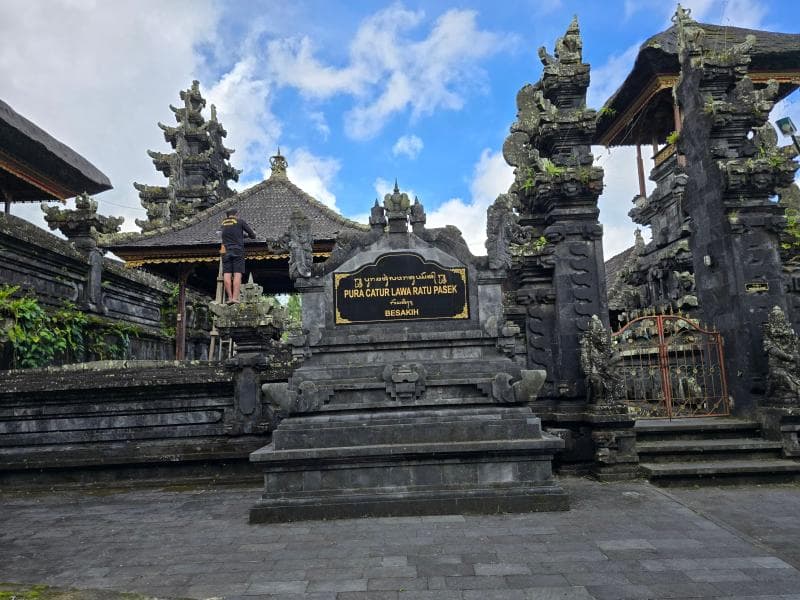
Explore Pura Penataran Agung, the central and most sacred temple within the sprawling Besakih Temple complex in Bali, Indonesia. Discover its rich history and cultural significance.
Overview
Deep within the spiritual heart of Bali, Indonesia, lies the revered Besakih Temple complex, often called the 'Mother Temple'. At its core, presiding with unmatched significance, is Pura Penataran Agung. This majestic sanctuary is the largest and most central temple within the sprawling Besakih site, nestled gracefully on the southwestern slopes of Mount Agung, Bali's highest and most sacred volcano. It serves as the principal hub for Balinese Hindu religious activities, drawing devotees from across the entire island. With its terraced courtyards and soaring shrines, Pura Penataran Agung embodies the profound spiritual connection between the Balinese people, nature, and the divine.
History & Cultural Background
The origins of Pura Penataran Agung, and indeed the wider Besakih complex, are steeped in ancient lore, dating back to at least the 8th century AD. Balinese tradition credits the Hindu sage Rsi Markandeya with its foundation. Legend says Rsi Markandeya, after a spiritual journey from Java, was guided by divine visions to establish a sacred site on Mount Agung. His ritual of planting five precious metals, known as Panca Datu, laid the spiritual groundwork for what would become the Besakih Temple. Over centuries, under the patronage of powerful dynasties like the Gelgel in the 15th century, the complex underwent significant expansion and development, solidifying its status as the state temple and paramount religious center of Bali.
A poignant chapter in its history occurred during the devastating 1963 eruption of Mount Agung. While the eruption caused widespread destruction, the lava flows miraculously bypassed Pura Penataran Agung by mere meters. This event was widely interpreted by the Balinese as a divine sign, a powerful demonstration of the gods' will to protect their sacred earthly abode, further cementing the temple's spiritual importance and resilience.
What Makes It Special
Pura Penataran Agung is unique in its architectural grandeur and its spiritual role. It is designed with a series of ascending terraced courtyards and flights of stairs, all aligned along a single axis leading spiritually upward towards the sacred mountain. This layout symbolizes the journey of the soul towards the divine. The temple's striking 'candi bentar' (split gateway) marks the entrance, leading to an inner sanctuary adorned with intricate carvings and multi-tiered 'meru' towers. These meru, reminiscent of the cosmic Mount Meru, can reach up to eleven tiers, signifying the highest levels of divinity.
Spiritually, Pura Penataran Agung is dedicated to Sang Hyang Widhi Wasa, the Supreme God in Balinese Hinduism, often manifested as the Hindu trinity: Brahma (the Creator), Vishnu (the Preserver), and Shiva (the Destroyer). The central Padmasana (lotus throne) within the temple is the focal point of worship, dedicated to these manifestations. Crucially, Besakih Temple, including Pura Penataran Agung, is the only sanctuary in Bali where people of all castes worship together, embodying a rare sense of unity and spiritual egalitarianism.
Stories, Fun Facts & Local Details
The name 'Besakih' itself is believed to derive from the Sanskrit word 'Wasuki,' meaning 'safe,' or from 'Basuki,' referring to the mythical dragon 'Naga Basuki' said to inhabit Mount Agung. This ties into the ancient belief that the temple protects the island. The miracle of the 1963 volcanic eruption, where lava flows stopped just short of the temple, is a deeply ingrained local story that reinforces the temple's sacred protection and the power of the gods.
The entire Besakih complex, with Pura Penataran Agung at its core, beautifully reflects the Balinese philosophy of 'Tri Hita Karana' – the harmonious relationship between humans, nature, and the divine. The use of local volcanic rock (paras) in its construction further emphasizes this connection to the natural landscape. Pura Penataran Agung is the central venue for significant ceremonies such as 'Bhatara Turun Kabeh,' a grand annual event where all the gods are believed to descend to earth, drawing thousands of devotees for continuous prayers.
Visitor Perspective
Visiting Pura Penataran Agung offers a profound glimpse into Balinese spirituality. The experience begins with ascending its impressive stone staircases, a symbolic journey towards spiritual elevation. While tourists are typically restricted to the outer courtyards to respect ongoing ceremonies, the views of the intricate architecture and the sacred Mount Agung in the background are breathtaking. Many visitors find the early morning hours ideal, offering clearer views of the volcano before clouds gather and fewer crowds.
Respectful attire is mandatory: all visitors must wear a sarong and sash, and shoulders must be covered. These are often available for rent or included in the entrance fee. It's crucial to observe ongoing rituals quietly, avoid walking in front of worshippers, and refrain from climbing on sacred structures. Engaging a local guide can significantly enrich the visit, providing invaluable insights into the temple's history, symbolism, and cultural practices, helping to bridge the gap between curious traveler and sacred tradition.
Coordinates: 115.4628, -8.3633
View on Google Maps💬 How Travelers Describe This Place
Based on community votes
Photogenic
953Unique
695Beautiful
396Must See
286Interesting
22
Traveler Stories
Discover memorable experiences shared by travelers who have visited this place.
No traveler stories yet.
Be the first traveler to share what made this place memorable.

Tour
By
Spot
Discover amazing places around the world. Your journey starts here.
Explore
© 2026 TourBySpot. All rights reserved.