Ceremonial Areas
Bali, Indonesia
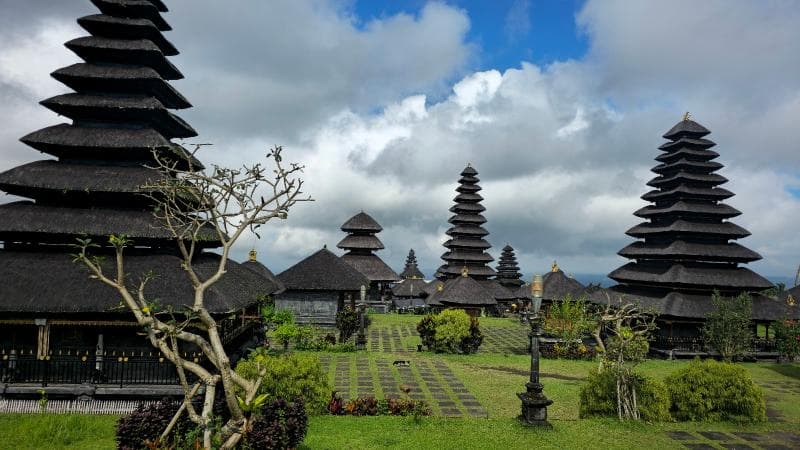
Explore the sacred Ceremonial Areas of Besakih Temple, Bali, Indonesia's holiest Hindu complex. Discover its rich history, cultural significance, and spiritual practices.
Overview
Nestled high on the southwestern slopes of Mount Agung, Bali's sacred volcano, the Ceremonial Areas of Besakih Temple form the largest and holiest Hindu temple complex on the island of Bali, Indonesia. Often revered as the 'Mother Temple' (Pura Besakih), this vast spiritual center is not a single structure, but an intricate network of over 80 individual temples and numerous shrines, spread across terraced hillsides. These consecrated spaces collectively serve as the heart of Balinese Hinduism, where devotees from across the island gather to perform rituals, offer prayers, and celebrate important festivals. It is a living, breathing testament to centuries of spiritual devotion, offering a profound glimpse into the cultural and religious tapestry of Bali.
History & Cultural Background
The origins of Besakih Temple's Ceremonial Areas are deeply rooted in Bali's ancient past, with evidence suggesting its significance as a holy site dates back to prehistoric times. Archaeological findings, such as stone bases resembling megalithic stepped pyramids, indicate human activity and spiritual practices here as far back as 2,000 years ago, predating the arrival of Hinduism on the island. Hindu worship at the site is definitively recorded from 1284 AD, following the settlement of Javanese conquerors in Bali.
Legend attributes the temple's founding to the revered Javanese priest Mpu Kuturan in the 11th century, or to the sage Rsi Markandeya around the 8th century, who was guided by divine forces to build a temple on Mount Agung's sacred slopes. By the 15th century, Besakih had become the state temple of the powerful Gelgel dynasty, solidifying its pivotal role in Balinese spiritual and political life. The Ceremonial Areas are fundamentally dedicated to the Hindu trinity—Brahma, the creator; Vishnu, the preserver; and Shiva, the destroyer—and embody the Balinese philosophy of 'Tri Hita Karana,' emphasizing harmony among God, humans, and nature.
What Makes It Special
The distinctive layout of Besakih's Ceremonial Areas is a masterpiece of Balinese architecture and spiritual design. The complex is structured on parallel ridges, with stepped terraces and ascending flights of stairs, intentionally guiding the spiritual person upward towards the sacred mountain. At its heart lies Pura Penataran Agung, the largest and most significant temple within the complex, dedicated primarily to Shiva and the god of Mount Agung.
Alongside it, Pura Kiduling Kreteg is dedicated to Brahma, while Pura Batu Madeg honors Vishnu, forming a sacred triad. Other individual temples, like Pura Pedharman, are designated for specific family or ancestral ceremonies. The architecture features iconic tiered meru roofs, symbolizing the cosmic Mount Meru and linking the earthly and divine realms, along with intricately carved candi bentar (split gateways) and kori agung. Uniquely, Besakih stands as the only temple in Bali where devotees from all four Hindu castes are permitted to worship together, highlighting its inclusive spiritual embrace.
Stories, Fun Facts & Local Details
One of the most compelling stories associated with Besakih's Ceremonial Areas is its miraculous survival during the catastrophic 1963 eruption of Mount Agung. Lava flows, which claimed over a thousand lives, stopped mere meters from the main temple complex, a phenomenon widely regarded by the Balinese as a powerful sign of divine protection and a testament to the temple's profound sanctity. The name 'Besakih' itself is believed to derive from the Sanskrit word 'Basuki,' meaning 'congratulations,' or from 'Naga Besukian,' a mythical dragon believed to inhabit Mount Agung.
Adding to its vibrant spiritual life, the Ceremonial Areas host over 70 festivals annually, each commemorating the anniversary of a particular shrine. During these events, the temple transforms into a kaleidoscope of color, sound, and devotion, with thousands of Balinese clad in traditional attire, presenting elaborate offerings and participating in ancient rituals. Mount Agung is revered as the dwelling place of the gods and a bridge between the divine and earthly realms, further amplifying the spiritual aura of the entire complex.
Visitor Perspective
Exploring the Ceremonial Areas of Besakih Temple offers a deeply enriching cultural experience, though it requires respect for its active religious functions. Visitors are required to wear a sarong and sash, which cover the legs and waist, and ensure shoulders are covered. These items are typically available for rent at the entrance if you do not bring your own. It is essential to be mindful of ongoing ceremonies; maintain a respectful distance, avoid interrupting worshippers, and refrain from walking directly in front of those performing prayers. Traditionally, women during menstruation are asked to refrain from entering the temple grounds due to beliefs about spiritual purity.
For a comprehensive understanding of the temple's history, symbolism, and rituals, hiring a registered local guide is highly recommended. These guides offer invaluable insights that might otherwise be missed during a self-guided tour. Some inner courtyards are exclusively reserved for Balinese Hindus performing rituals, but visitors are welcome to observe from designated areas. The best time to visit is often early in the morning to avoid crowds and to catch clearer views of Mount Agung, which can become shrouded in clouds later in the day. Be prepared for steep steps as you navigate the terraced levels, as the complex is not wheelchair accessible.
Coordinates: 115.450833, -8.374444
View on Google Maps💬 How Travelers Describe This Place
Based on community votes
Beautiful
953Unique
658Photogenic
585Interesting
69Must See
22
Traveler Stories
Discover memorable experiences shared by travelers who have visited this place.
No traveler stories yet.
Be the first traveler to share what made this place memorable.

Tour
By
Spot
Discover amazing places around the world. Your journey starts here.
Explore
© 2026 TourBySpot. All rights reserved.