Topkapi Palace
Istanbul, Turkey
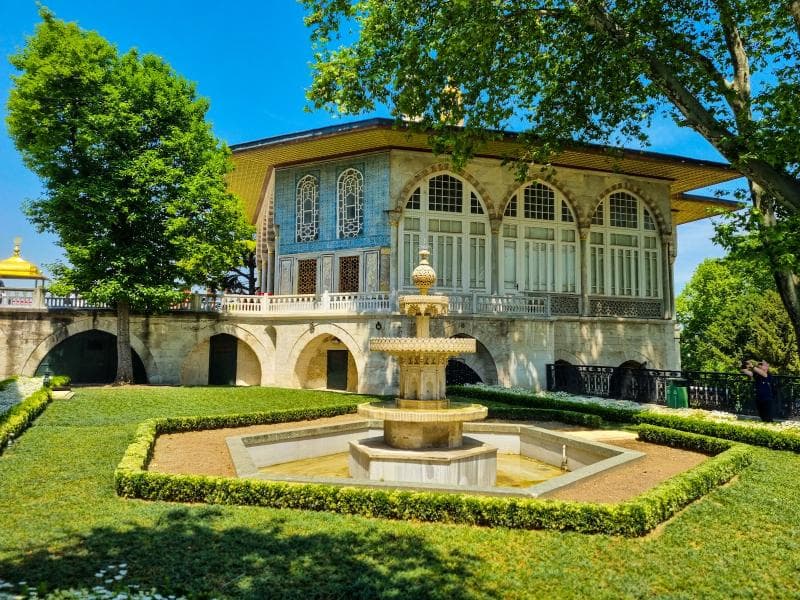
Explore Topkapi Palace in Istanbul, Turkey. Discover the rich history, stunning Ottoman architecture, and captivating stories of this former imperial residence and museum.
Overview
Perched majestically on Seraglio Point in Istanbul, Turkey, Topkapi Palace is a sprawling complex that once formed the heart of the Ottoman Empire. For nearly four centuries, from the 1460s to the mid-19th century, it served as the principal residence and administrative headquarters for Ottoman sultans and their court. More than just a palace, it was a city within a city, a self-contained entity where decisions shaping a vast empire were made. Today, this magnificent site is a UNESCO World Heritage property and one of Istanbul's most visited museums, offering an unparalleled glimpse into the grandeur and complexities of Ottoman life.
The palace is not a single monumental building but rather an extensive collection of low buildings, pavilions, and courtyards, interconnected by gardens and passages, sprawled across an impressive area. Its strategic location offers breathtaking panoramic views of the Golden Horn, the Bosphorus, and the Sea of Marmara, underscoring its historical importance and aesthetic appeal.
History & Cultural Background
The construction of Topkapi Palace began in 1459, just six years after Sultan Mehmed II's conquest of Constantinople. Originally known as the 'New Palace' (Saray-ı Cedîd-i Âmire) to distinguish it from an earlier one, it was designed to reflect the burgeoning power and prestige of the Ottoman Empire. Over the centuries, successive sultans expanded and renovated the complex, integrating a diverse array of architectural styles, including Ottoman, Byzantine, Islamic, and even Baroque influences, showcasing the empire's wide cultural reach.
For hundreds of years, the palace was not only the sultan's home but also the nerve center for governing a vast empire spanning three continents. It housed the imperial treasury, libraries, mint, and served as an educational institution, fostering artistic production and preserving valuable manuscripts. After the sultans moved to the more European-style Dolmabahçe Palace in the mid-19th century, Topkapi gradually transitioned away from being a primary residence. Following the abolishment of the Ottoman monarchy in 1923, a government decree transformed Topkapi into a museum in 1924, opening its doors to the public and preserving its rich heritage for future generations.
What Makes It Special
Topkapi Palace's allure lies in its unique blend of history, architecture, and priceless collections. It is distinguished by its layout, which comprises four main courtyards, each with its own distinct function and level of accessibility, reflecting the strict hierarchy of the Ottoman court. These courtyards seamlessly transition from public administrative spaces to the sultan's most private quarters.
Among its most celebrated features are the Imperial Treasury, which houses dazzling artifacts like the 86-carat Spoonmaker's Diamond, surrounded by 49 smaller diamonds, and the famed Topkapi Dagger, adorned with emeralds. The palace is also a significant spiritual site, as it safeguards the Holy Relics, including the cloak and sword of Prophet Muhammad, brought from Medina in the 16th century, making it a sacred place for Muslim visitors.
The Harem, a world shrouded in mystery and often misunderstood, is another special aspect. It was not merely a 'pleasure quarter' but the private residential complex for the sultan, his mother, wives, concubines, and children, functioning as a strictly disciplined institution and a hub of political power.
Stories, Fun Facts & Local Details
The walls of Topkapi Palace hold countless stories of power, intrigue, and daily life. The Harem, for instance, housed up to 300 women and their children, overseen by the powerful Valide Sultan (Queen Mother) and Chief Black Eunuch. Women like Hürrem Sultan, known in the West as Roxelana, a former slave from present-day Ukraine, rose through the ranks to become the legal wife of Sultan Suleiman the Magnificent, wielding immense political influence and transforming the Harem into a significant political powerhouse. Her story is a testament to the fact that power was not solely a male prerogative within the palace.
A less glamorous, but equally crucial, detail is the palace's enormous kitchen. It was one of the largest in the Ottoman Empire, capable of preparing meals for thousands of residents daily. The complex also featured the 'Cage' (Kafes) within the Harem, where imperial princes were confined to prevent succession wars. While intended to maintain stability, this isolation sometimes led to mental instability among the princes.
Visitor Perspective
Exploring Topkapi Palace is an immersive journey into Ottoman history. A typical visit can take anywhere from 3 to 4 hours, though a full day could easily be spent appreciating its many sections. The palace is open from Wednesdays to Mondays, usually from 9:00 AM to 5:00 PM or 6:00 PM depending on the season, and is notably closed on Tuesdays for cleaning and maintenance. It's advisable to visit early in the morning right after opening or in the late afternoon to avoid the largest crowds, particularly on weekdays, as weekends tend to be busier.
Visitors can wander through the lush gardens, marvel at the intricate tilework and calligraphy, explore the opulent chambers of the Harem, and witness the stunning collections of imperial treasures and sacred relics. Appropriate clothing is required when visiting the Holy Relics section, respecting the sacred nature of the artifacts. Topkapi Palace offers a profound connection to a bygone era, allowing curious travelers to walk the same grounds where sultans ruled and history unfolded.
Coordinates: 28.984, 41.013
View on Google Maps💬 How Travelers Describe This Place
Based on community votes
Photogenic
836Interesting
620Beautiful
594Must See
166Unique
83
Traveler Stories
Discover memorable experiences shared by travelers who have visited this place.
No traveler stories yet.
Be the first traveler to share what made this place memorable.
Things to see at Topkapi Palace



Tour
By
Spot
Discover amazing places around the world. Your journey starts here.
Explore
© 2026 TourBySpot. All rights reserved.