The Audience Chamber
Istanbul, Turkey
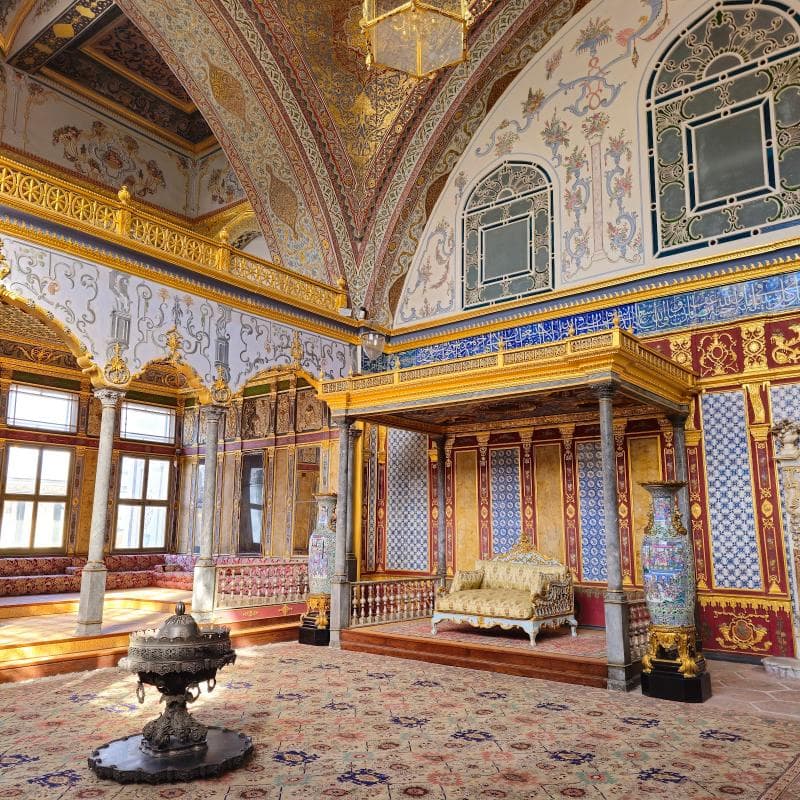

Explore The Audience Chamber (Arz Odası) in Topkapi Palace, Istanbul, Turkey. Discover its imperial history, unique architecture, and fascinating stories.
Overview
Stepping into the Audience Chamber, or Arz Odası, within Istanbul's magnificent Topkapi Palace, is to enter the very heart of the Ottoman Empire's power. Nestled behind the ceremonial Gate of Felicity, this historically significant building served as the primary setting where the Sultan directly engaged with state affairs and received dignitaries. It was a space designed not just for meetings, but to profoundly impress and convey the absolute authority of the Ottoman ruler. The Audience Chamber was a critical junction between the outer administrative world of the palace and the Sultan's private domain, emphasizing its central role in governance and diplomacy for centuries.
History & Cultural Background
The Audience Chamber's origins trace back to the 15th century, commissioned by Sultan Mehmed the Conqueror, who established Topkapi Palace after the conquest of Constantinople. Over time, this pivotal structure underwent several transformations. Sultan Ahmed III initiated a renovation in 1723. However, a devastating fire in 1856 led to its reconstruction during the reign of Sultan Abdülmecid I, resulting in its present-day appearance that incorporates Empire and Neoclassical styles. Architecturally, it exemplifies a blend of Ottoman, Seljuk, and Persian influences. Its strategic location directly behind the Gate of Felicity was symbolic, acting as a threshold between public and private, and ensuring the Sultan's inner sanctum remained largely unseen.
What Makes It Special
What truly sets the Audience Chamber apart is its unparalleled historical significance as the stage for Ottoman statecraft and diplomacy. This square-shaped Ottoman kiosk, characterized by a colonnade of 22 columns supporting a grand roof, was where the Sultan, often referred to as 'the Shadow of God on Earth', held court. It was in this chamber that Grand Viziers reported to the Sultan after Imperial Council meetings, and foreign ambassadors presented their credentials. The interior design further amplified its grandeur and symbolic power. The ceiling was once adorned with ultramarine blue paint and golden stars, while the walls were lined with striking blue, white, and turquoise tiles. The chamber's very existence reinforced the carefully controlled rituals of the Ottoman court, where every detail was orchestrated to project immense power and authority.
Stories, Fun Facts & Local Details
- The Silent Fountain: Just inside the entrance, a small marble fountain was strategically placed. Its bubbling water served a practical, yet fascinating, purpose: to muffle sensitive conversations, ensuring privacy during crucial diplomatic or administrative exchanges.
- Ambassadorial Protocols: Foreign ambassadors faced a strict protocol upon entering the Audience Chamber. After being dressed in Ottoman robes, they were often escorted by two deaf-mute eunuchs who would hold their arms. Ambassadors were not permitted to make eye contact with or speak directly to the Sultan; all communication was conveyed through an interpreter, a clear demonstration of the Sultan's elevated status and the formidable power of the empire.
- The Throne's Dragon and Simurg: The richly decorated throne, in the form of a baldachin, dates back to the reign of Sultan Mehmed III. Its lacquered ceiling features intricate foliage patterns, alongside a captivating depiction of a dragon fighting a simurg, a mythical bird. This imagery powerfully symbolizes the Sultan's absolute authority and power.
- Vizier's Fate: For viziers and high-ranking officials, reports to the Sultan in the Audience Chamber could be life-altering. Depending on their performance, they might be showered with gifts and promotions, or in more dire cases, face severe consequences, including strangulation by deaf-mute executioners.
- 'High Office' Designation: In official decrees, the Audience Chamber was frequently referred to as the 'makam-ı muallâ' or 'High Office', underscoring its supreme administrative and political importance within the Ottoman state.
Visitor Perspective
Today, as a visitor to Topkapi Palace, observing the Audience Chamber offers a profound glimpse into a bygone era of imperial grandeur and rigid protocol. Standing in this room, one can almost sense the palpable tension of diplomats and officials awaiting the Sultan's presence. While the current interior may reflect later restorations, the essence of its original purpose remains. It is a powerful reminder of how governance and diplomacy were conducted in one of the world's most enduring empires. Located within the Third Courtyard, access to this area immerses you deeper into the palace's inner sanctums, inviting contemplation of the lives and decisions that shaped history here. It's an experience that offers historical context, connecting you directly to the narrative of the Ottoman sultans who once commanded from this very spot.
Coordinates: 28.984, 41.013
View on Google Maps💬 How Travelers Describe This Place
Based on community votes
Interesting
838Unique
685Beautiful
539Photogenic
421Must See
369
Traveler Stories
Discover memorable experiences shared by travelers who have visited this place.
No traveler stories yet.
Be the first traveler to share what made this place memorable.

Tour
By
Spot
Discover amazing places around the world. Your journey starts here.
Explore
© 2026 TourBySpot. All rights reserved.